
10WZC
“An engine for community prosperity”
By expanding its network and connectivity the World Zarathushti Chamber of Commerce hopes members will draw inspiration from each other’s success
"At the end of the day we need to ask ourselves two things: How many have we helped enter business? How many businesses have we helped grow? This is our only barometer and yardstick. If we have done this, we can pat our back; if not, we need to look where we have gone wrong,” noted Kersi Limathwalla, president of the World Zarathushti Chamber of Commerce (WZCC) in the year ending report as he lay down his office "with a sense of great satisfaction, not so much for what has been achieved — because this is an ongoing exercise – but for being part of an initiative that contributes to community well-being and prosperity in an environment of congeniality and camaraderie.”
With the inclusion of the newest entrant, the Vancouver chapter, WZCC now has a network of 21 functional chapters in six regions with a global membership exceeding 1,000. As acknowledged Limathwalla, "It is the commitment, volunteering efforts and inspiring leadership of the regional directors and chapter chairs that has created the image of the Chamber as an engine for community prosperity reminiscent of an era when we were recognized as a leading business community with impeccable integrity.”
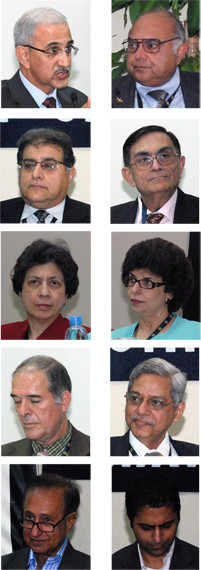
Present at the WZCC session in Dubai (clockwise from top left): Kersi Limathwalla, Firdosh Mehta, Rusi Gandhi, Zarine Commissariat, Yazdi Tantra, Eric Engineer, Phil Madon, Khodayar Attaie, Dr Zareen Karani Araoz and Rustom Engineer
The difficulty in establishing the Vancouver chapter has been explained in detail by Fariborz Rahnamoon whose report was incorporated in the WZCC 2009 annual report prepared by the international directors, chapter chairs and special activity directors, and presented at the annual general meeting held at the Crowne Plaza hotel in Dubai on December 29, 2009. Rahnamoon refers to the directors of the British Columbia Chamber of Commerce who did not know who a Zarathushti is and could not understand the need for another chamber of commerce considering that chapters already existed in every municipality. They were given a quick lesson in Zoroastrianism, referred to the website www. ancientiran.com and cited the example of industrialist Ratan Tata and his Nano. "All that put together helped in establishing our credentials,” with the letter of consent arriving a fortnight later. Within a short time span the new chapter set up its own website www. wzccbc.com Negotiations are in progress for making available $ 20,000 to finance Zarathushti business in Tajikistan and Uzbekistan under the aegis of a Zarathushti Enterprise Fund.
Since many in the US are facing economic, job and professional challenges, chapters like Boston and Houston decided to waive the membership fees for 2009 and subsidize certain events. There are chapters like Atlanta that are inactive and others like North Texas that meet periodically despite their membership being restricted to 10 individuals. The 17-member Seattle chapter gives credit to "esteemed member Alayar Dabestani (for) many young Irani Zarathushtis …making Seattle a gateway city for immigrating to the USA.” On his recommendation the chapter even introduced a special post of director of orientation and integration to assist the newly arrived Zarathushtis from Iran to assimilate into the new culture. Whilst inviting eminent speakers from different commercial sectors Houston remains "dedicated and proactive in our mission to be visible amongst other chambers of commerce like the Indo American Chamber of Commerce and South Asian Chamber of Commerce.” The New York chapter sought to establish ties with other like-minded organizations such as The Indus Entrepreneur (TiE). The pilot project of Zoroastrian Yellow Pages has been completed and included in the ZAGNY (Zoroastrian Association of Greater New York) directory. Youth involvement was the focus of the Chicago chapter that had meetings and presentations organized throughout the year. The Southern California chapter reported an increase in membership from 12 to 22 over an 18-month period and the less than two-year-old Central Florida chapter has 25 members including youth.
Factory visits, financial talks, felicitation, fraternization marked the activities of the Mumbai chapter that had certain programs conjointly with the Pune chapter. Talks and seminars too on subjects connected with commerce and computers sought to educate the members. The Business Plan Contest proved to be an eye-opener for the organizers as also the competitors. The formation of the youth chapter is in keeping with the decision of the international board to encourage youth participation in the management of the WZCC. The Delhi chapter proposes to bring out a directory listing the business activities of entrepreneurs in the northern region. They have decided to invite non members as guests so that the entrepreneurial spark is ignited.
The chapter in Iran is known as the Moasseseh Jahani Pishevaran Zartosht with a membership count of 151. They too are working on the creation of a data bank of Zoroastrian businesses and industries in Iran.
Australia will endeavor to share collective knowledge to build on individual strengths, admitting candidly that their Youth Enhancement Plan failed to appeal to the youngsters.
"If one can brand soap, one can brand a community. We have strong brand values and brand equity: trust, honesty, integrity and principles,” reminded Sam Balsara, managing director of Madison India, in his address to the members of the Middle East region. He further warned, "Luck can run out. Future generations should benefit from the brand equity of Parsis. The que sera sera (whatever will be, will be) attitude must go.” The most extensive report included in the annual report of the WZCC was from the Middle East chapter that gave a detailed account of the two meetings held during the year. Five-year-old SynergyZ, the international journal of WZCC, published by the editorial board in Dubai sustains itself through revenue from advertisements and donations and seeks promotion as "an established, reliable and effective media of publication.”
"As a chronicler of events” the website http://wzcc.net provides a single source of information for the activities of WZCC worldwide. "This year we have added videos of many of the events that have taken place which are a live showcase of the vibrancy of WZCC,” wrote technical director Yazdi Tantra. He also referred to the two new initiatives of 2009: a special group for WZCC on LinkedIn (courtesy Eric Engineer, youth representative on the international board) where members can post discussions and information of common interest; and a special group for WZCC on Facebook where more than 350 Zarathushtis have registered online and are establishing contacts. Yet another effort by Engineer is the Zoroastrian Stimulus Plan in collaboration with the Federation of Zoroastrian Associations of North America (FEZANA) to register Zoroastrians who are un/underemployed and seeking a job.
Further connectivity has increased with Kersi Commissariat’s e-newsletter and Dr Zareen Karani Araoz’s Zchamber Yahoo Group. "Our lifeline to disseminate information globally, ask for input, post jobs, ask for professional help, publicize events,” the role of Zchamber Network was summarized by Karani Araoz who believed it needs "to be closely monitored if all members do not work within the guidelines of the Zchamber objectives and parameters. We had some challenges with that this year, so I have started the laborious task of reviewing all postings before they are posted so nothing offensive or irrelevant to our WZCC mission is sent out.”
"While the WZCC does have a member database on its website, LinkedIn offers greater depth/freshness of information and functionality,” observed Engineer explaining, "By embracing LinkedIn, WZCC’s membership will have greater visibility into each other’s experiences, skill-sets and networks…”
"For an organization like ours, member administration is a paramount function,” stressed Tantra, "The more the number of members and the more accurate the information, the greater the confidence of the users to use the data to their benefit.”
◆ ◆ ◆
From the archive