
Cover Story
Mesdames mobedyars
Eight Iranian ladies who passed the tests in the recitation and understanding of the scriptures and performance of rituals were initiated as mobedyars
Eight out of 15 lady candidates who had undergone stringent and extensive religious training in the Avesta and had passed the tests set by the council of priests, Tehran Anjoman-e-Mobedan (AM), were recently conferred the title of mobedyar. The felicitation in their honor was organized at the Khosravi Community Hall on March 25, 2011 to coincide with Jashn-e-Esfandgan (Fasli roz Spandarmad, mah Spandarmad, the day traditionally glorifying the position of women by associating it with the spiritual aspects of Spenta Armaity), the details of the event were posted on the AM website.
The eight mobedyars who received their certificates were Mitra Mazdapour, Rashin Jahangiri, Sarvar Tarapourvala, Parva Namiranian, Fariba Mali, Behnaz Naeemabadi, Mehrzad Kaviani and Paria Mavandi. Four of them are from Tehran, two from Yazd, one from Kerman and one will practice in Karaj. Each of them expressed their thanks for being selected for this "holy post and (pledged) their commitment to serve the community.” Parsiana was able to establish e-mail contact with Jahangiri and Namiranian, two of the eight mobedyars conversant in English.
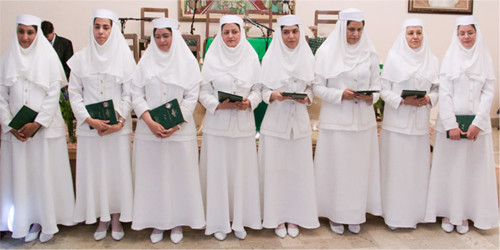
Women mobedyars trained to carry forward the religious torch
"The main aim of the whole process was to put into practice Zarathushtra’s teachings and our cultural belief about the equality of men and women and freedom of choice,” stated Namiranian, the youngest woman mobedyar whose husband Ramin Shahzadi is the youngest male mobed of Iran. Her husband was ordained a mobed soon after their marriage and she writes, "My zeal for doing all that I could for our religion multiplied since then and in the days when female priests could not be thought of, I was dreaming of such an opportunity.”
Although Jahangiri does not come from a mobed family nor is she married into one, her husband Rostam Mazdeyasni being a civil engineer, she states that her "interest in the Zoroastrian religion and culture, especially Gathas and Avestan scripture” was thanks to the encouragement of her family, particularly her mother Shirin Khoubchehr, a sports administrator and manager of Adorian, a Zoroastrian religio-cultural-sports organization. She further attributed her involvement in religious issues to the regular conferences and religious and cultural programs within the community.
Both the ladies come from a medical background. Jahangiri who studied at the Shahid Beheshti University worked as a doctor in a tuberculosis center and at Zafar Thalassemia Clinic is now preparing for a medical assistant examination. Namiranian is a seventh year medical student in the Tehran University of Medical Sciences and is simultaneously studying homeopathy at the Iran branch of Berkeley International University. She additionally teaches research methodology at the Research Committee of Tehran University of Medical Sciences and is a member of its Gifted and Talented Students Center. She also enjoys the honor of being the first and only Zarathushti medical student in Iran chosen by the International Federation of Medical Students Association to participate in the Student Exchange Program in 2010.
Despite their professional preoccupations, the mobedyars are proficient in the Avestan language and Din Dabire alphabet, the Pahlavi script, Avestan grammar and other religious literature. Their official curriculum as prescribed by AM required fluency in the recitation of the entire Khordeh Avesta and portions of the Yasna including the Gathas, etc as required for performing the outer rituals; learning the translations, interpretations and philosophy of the scriptures as well as the religion; and learning the performance of the outer rituals. Individual tests had to be passed in all these three areas. Their mentors were Mobed Mehraban Firouzgary, Mobed Ardeshir Khorshidan, Mobed Pedram Soroushpour and Dr Farzaneh Goshtasb.
Besides study, the mobedyars also make time to share their religious knowledge and participate in other community events. Thus both of them have written articles and news items for several Zoroastrian websites and publications, and presented papers at religious meets. They also help in organizing different sports events like Jam-e-Janbakhtegan, the biannual exhibition of Zartoshti culture and Manthra.
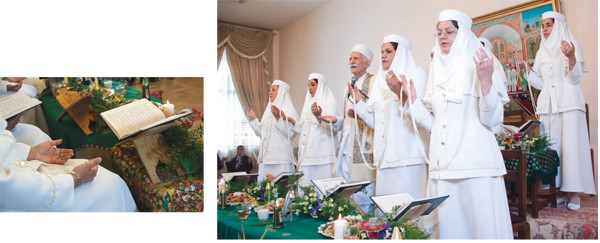
At the function to felicitate the newly ordained mobedyars
Photos: Maziar Nikbakhsh, www.amordad.com
Soroushpour who had played an active role in conducting the training sessions announced AM’s plans to extend training to other ladies interested in religious training. He reminded that Zarathushtra had named his daughter Paoroochista (meaning equipped with much knowledge) to signify his belief and desire that women ought to seek knowledge, especially religious perception.
Mobedyars are authorized to perform sudreh pooshi (navjote), jashan and other ceremonies like their male counterparts. However, this is only in case of emergencies or when the occasion demands. To begin with and until formally announced the ladies would not enter any atash behram or adarians to tend a holy fire, nor would they pray at the burial ceremony in any aramgah, declared AM president Dr Ardeshir Khorshidian. He believed that the basic principles of the Zoroastrian religion preached equality of rights for both men and women as also the duty of human beings to make the world progressive.
Dr Esfandiar Ekhtiyari, the Zoroastrian representative in the Iranian Parliament presented a token gift to each of the mobedyars commending their religious fervor. He viewed this development as a demonstration of the advanced thinking of the Zoroastrian community and its Prophet Zarathushtra who advocated that more important than gender, race or material power is the humanitarian approach.
Appreciating the efforts of AM "for all the hard work and determination that they have put in to achieve such a goal in spite of fierce opposition from different quarters” the Tehran Zartoshti Anjoman president Dr Rostam Khosraviani lauded the role that women have played in the fields of education and social work and considered this occasion "a solid proof that our community is progressive.”
Zarathushti researcher Prof Katayoun Mazdapour reiterated Zarathushtra’s message of equality that respected human rights, justice and peace. She then delineated extracts from Hirbadestan (Aerepatestan) dating back to the Achemenian dynasty which referred to men and women acquiring and imparting religious knowledge and performing rituals in equal measure. "In spite of all the above, however, outside influences and the victory of force over reason left the females subdued by the males,” she mentioned.
A director of the Zartoshti Women’s Organization Mehrangiz Shahzadi referred to earlier restrictions on women holding public posts a few decades earlier which after a community referendum was modified such that two ladies could be elected to the Tehran Zartoshti Anjoman. This led to Farangis Shahrokh founding the Iranian Association of Zartoshti Women in Tehran 60 years ago.
Soon after this felicitation Mobedyar Fariba Mali participated in a gahanbar ceremony in Nosratabad in Yazd when she and Mobedyar Mehrban Afarin recited passages from the Avesta, it was reported on berasad website. Congratulating the Nosratabadi Zoroastrians for organizing this ceremony Afarin urged the attendees to freely invite both male and female mobedyars for future ceremonies. Mali stated that she looked forward to serving the community in her holy white costume.
The woman mobedyar’s attire comprises a full length skirt and a long coat to facilitate the tying and untying of kusti in public. The headgear consists of a cap with a scarf sewn to it to ensure that even long hair is fully covered, explain Namiranian and Jahangiri.
Looking forward to carrying the torch of the religion, Namiranian is "optimistic” about the future of Zoroastrianism stating, "After all we have survived four millennia.” Declares Jahangiri, if Zoroastrians were to be united, "I am sure we (would) be one of the most successful and best religious communities in the world.” But she specifies that this would only be possible if there were strong religious and cultural ties between Zoroastrians of different countries with exchange of religious information and cultural education among the youth.
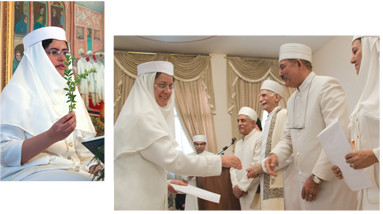
Mobedyars Parva Namiranian (left) and Rashin Jahangiri (center) with their mentors
Laurels for the ladies
Buoyed by the news of the eight lady mobedyars, liberals from different corners of the world sent e-mail messages. Wrote Adi Gandhi of Los Angeles, "While we are crying about shortage of mobeds in India, Iran has set the tradition and solved the problem. Why not we follow the same?” Another e-mail circulated by Shiraz Malegam stated, "While it is heartening to note that the Zoroastrian community and their community leaders in Iran are progressive and actually following the principles of Asho Zarathushtra of gender equality, here in India the so-called orthodox in our community are busy trying to implement their version of Talibanization on the community by issuing senseless fatwas, banning priests, tearing Russian sudrehs and subjecting the females of our community to all sorts of religious discrimination. The Bombay Parsi Punchayet (BPP), World Alliance of Parsi Irani Zartoshtis and the other so-called orthodox in our community need to learn from our Zoroastrian brethren in Iran.”
Further Internet correspondence was exchanged following a news report in DNA which quoted Vispy Wadia, founder of the Association of Revival of Zoroastrianism, as stating, "What they (Iranian Zoroastrians) have done adheres to the basic principles of gender equality in the religion. They are being progressive and not talibanizing the religion.” The same report quoted two other community members: erstwhile BPP trustee Noshir Dadrawala, "Nowhere is it mentioned that women cannot become priests but it is also true that traditionally there were no women priests amongst the Parsis;” and principal of the Dadar Athornan Institute Ervad (Dr) Ramiyar Karanjia, "India and Iran are two different places. They are confusing the issue. In India, only the ones from a (priestly) family line can become priests.”
A lively yet entertaining online discussion ensued: Pointed out Homi Dalal, "Yes in India only the ones from a family line can become priests. But from where and when did this practice come? When in Iran… no such monopoly practice is being followed then how is that followed in India?” Countered Rustom "The present community is only following what the saviors of Zoroastrianism passed on through sacrifice, sweat and holocausts… Zoroastrianism survives only due to the efforts and policy of those… ‘gender biased.”’ Supported Phiroze, "Why should the Parsis follow what happens in Iran? It should be the other way around. After all what we Parsis practice here is much more than what the Iranians even know about Zoroastrianism. All they have is the translations of some European scholars that they wave above their heads. They have turned their temples into tourist spots.”
Mentioned Ratan Unwalla, "Just compare the lady mobedyars’ dress code with the semi nude Parsi girls in the ZYNG (Zoroastrian Youth for the Next Generation) calendar…Aren’t they looking well dignified, totally covered and respectful (maan malajo saathé)?”
Insisted Siloo Kapadia, "There is no reason that women cannot become Parsi priests. None. All these restrictions on women… (are) taken from Hinduism. So the question is do we want to be Parsi Zoroastrians or do we want to be quasi Hindus? The so-called ‘orthodox’ Parsis want no changes to anything. In that sense they have already abandoned the religion to superstition and to Hindu influences. Toba (God forbid)! …In the end common sense will prevail. For those that want no changes, they will die out. Their demise is beyond recall.”
Priests in perspective
Once the public sentiments had abated, Parsiana sought to obtain a historical and religious perspective. We attempted to glean the reactions of three High Priests in India but Dastur (Dr) Kaikhusroo JamaspAsa was the only one who responded declaring, "It is not correct for ladies to become mobedyars.” According to him the Zoroastrian religion did not permit it.
However scholars like Farrokh Vajifdar and Ali Jafarey had a different view. "What has occurred in Iran with the ordination of women priests is both religiously and legally sanctioned,” asserted Vajifdar though he is neither in agreement with the terms mobedyar nor paramobed. He believes, "One either is a priest or not one. Anyone, man or woman, can and should perform all religious ceremonies. There is no bar whatever. I can understand certain sentiments expressed against a woman priest who is in her menses — that is all!”
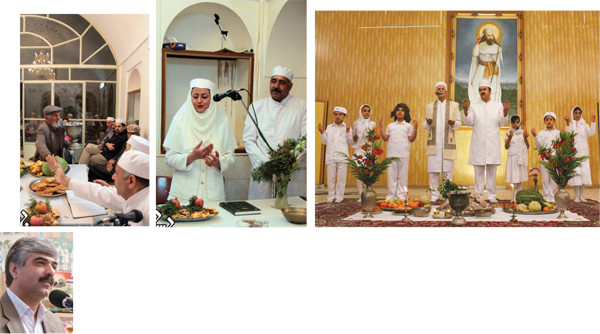
(Above): At the gahanbar in Nosratabad in Yazd; (center) Mobedyars Fariba Mali and Mehrban Afarin Photos:www.berasad.com (right) young initiates in Iran; (alongside) Dr Esfandiar Ekhtiyari
He justified his statement by adding, "Zarathushtra’s teachings on the eligibility and qualifications for the priesthood were very straightforward. Men and women were treated on an equal basis — no ifs, no buts. The founder clearly states that the one who teaches the union of mind and body (‘both existences’) along the straight paths of truth (to where Ahura Mazda dwells) is a savior of mankind. He urges that righteous men and women rule over us through right-mindedness. Elsewhere it is said, ‘We revere the souls of truthful men and women, wherever born, whose better spiritual values prevail.’ In around the sixth century CE, the late priestly composition Nirangistan licences women priests to accompany male priests in their ministering travels.
"One simply cannot argue with these texts since the Gathic Avestan and Avestan texts are actually prayed by ordained male priests before the sacred flame (in temples during the yasna ceremony, and at thanksgiving and commemorative jashans)! Herbads/ervads are teaching priests — they should teach our pure religion in truth with good mind.”
Jafarey cited Erpatistan, "a book for the priestly class that has not reached us in full but fortunately has the part dealing with women officiants at rituals.” According to his findings men and women both officiated, whenever invited as priests. Priority was given to one’s agricultural profession, and whichever partner was dispensable proceeded to the ritual scene on the understanding that he/she would not be absent for a total of six nights from his/her daily profession.
Jafarey further mentions that "those willing to become priests had to undergo a three-year rigorous course of learning, memorizing, comprehending and expounding the Gathas and the Haptanghaiti, till then the only ‘guiding principles of life’ and the only prayers used in rituals.” The Vispered is a booklet devoted to the seasonal festivals of gahanbars. It shows that eight officials, each responsible for a specific function took part in the ritual when the zaotar (literally invoker) or the chief officiant, summoned representatives of different professions, including a house mistress. A woman is variously referred to as hush-ham-sasta (literally well instructed in religious lore) or ratu-khshathra (rite-authority). "The Gathic texts go a little further to mention that both the sexes enjoy equal rights in every spiritual (Gathic mental) and physical phase of human life. The two are free to emulate each other in matrimonial union in order to win each other in righteous service,” writes Jafarey.
Not only were the women invited to officiate at rituals, there was veneration of feminine yazatas like Daena, conscience or religion, Chista, perception, Ashi Vanguhi, good reward. Further, yashts were dedicated to pre-Zarathushtrian deities Ardevi Sura Anahita, Tishtrya, Mithra, Varethraghna and Drvaspa. Jafarey cites the "Farvardin Yasht, a post-Gathic Avesta text, that venerates the names of 261 persons, 16 of whom are married women and 11 are maidens.” The Yasht states in separate paragraphs: "We venerate the righteous men… we venerate the righteous women…who (were) foremost in accepting the divine doctrine… who have been successful in learning the thought-provoking message, who have been successful in improving their souls, and who have been successful in obtaining all that is good.”
In summing up a woman’s position, Jafarey states, "Time has come to turn to the divine doctrine in order to comprehend her true and rightful status.”
◆ ◆ ◆
From the archive