
History
Women in the Gathas and the later Avesta – I Menstrual taboos
Though taboos were often used by men to dominate women, the Gathas gave equal rights to both sexes
This series deals with the role of women in the region of the Iranian Plateau where the Zarathushtrian religion originated. The Gathas accord man and woman total parity, even more than is evident in modern "advanced” societies. The position was altered in the post-Gathic period in favor of male authority, though there is not a single sentence in the Avesta that belittles women.
The first part covers the period from pre Zarathushtrian times up to the end of the Prophet’s successful mission and shows how women held their own despite social and religious taboos.
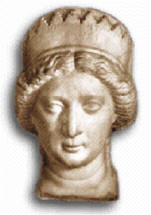
Parthian Queen (Tehran Museum)
A founder director of the Zarathushtrian Assembly and a founder trustee of the Cyrus Society, Dr Ali Jafarey’s fields of specialization include Indo-Iranian history, geography, culture, religion, linguistics and literature. Author of 16 books in Persian and English on the Zarathushtrian religion and Iranian culture, Jafarey has taught at various universities and institutions in Iran and Pakistan.
"We venerate the righteous woman who is good in thoughts, words and deeds, who is well-educated, is an authority on religious affairs, is progressively serene, and is like the women who belong to the Wise God.
"We venerate the righteous man who is good in thoughts, words and deeds, who knows well the religion he has chosen, and who does not know blind following.
"It is these people who, with their actions, promote the world though righteousness (Aiwisruthrem Gah 9 and Vispered 3.4).”
Much has been said and written about man and woman. Some tell the truth. Others are empty claims. While enough has been written about the ascendancy of man, much more through might than right, to his present position in human society, the role of woman has not been depicted the way it should be. The reason is obvious: man is the author of most of the statements! These statements show that woman has been downgraded from the lady paramount of society to a mere chattel at home. While "mother” has been acclaimed by some as the highest source of love and the best training for progress, "woman” has been accused by others of being the cause of the downfall of mankind and the origin of pollution. Even in the 21st century when women are said to have won complete equality with men in advanced countries, comparative statistics of women holding high positions in administrative and other key posts is sadly very low. On the other hand, publicity stunts still show her no more than a cheap, showy object exploited for commercial profit.
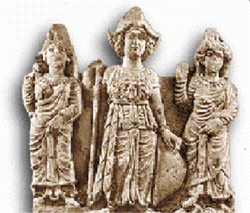
Parthian ladies, Hatra Temple (Marble, Berlin Museum)
To fully comprehend the position of woman in the Avesta, we should first have a look at the topographical position of the land where the Zarathushtrian religion rose, spread, met other religions and had its worst setbacks — the Iranian Plateau. It is a vast highland with an average height of 1,220 meters (4,000 feet) above sea level. It has rings of mountains, green valleys and bleak deserts. It lies between the Caspian Sea, the Aral Sea, and the plains in the north, the Persian Gulf and the Indian Ocean in the south, the Indus Valley and the Pamirs in the east, and the Mesopotamian Valley in the west. It has had three major religious changes: pre-Zarathushtrian, Zarathushtrian and Islamic. Our subject covers the first two. The pre-Zarathush-trian period has two phases: pre-Aryan beliefs and the Aryan cult.
Pre-Aryan beliefs
Archeological evidence shows that the pre-Aryan or indigenous civilization was mostly confined to proto-town settlements located at distances all over the Plateau. The people of these settlements were generally self-sufficient, yet they maintained trade links with each other. The trade network between Mesopo-tamia and the Indus interlaced them all together in cult and culture so much so that the only Dravidian language of the ancient Indus civilization is Brahui, the others being Tamil, Telugu, and Kannada in southern India. This language is now languishing in eastern Iran and western Pakistan, proof that once upon a time natives of at least the eastern part of the Plateau shared a common language with the inhabitants of the Indus Valley civilization.
Women dominated religion and society in central and eastern parts of the Plateau, but were themselves dominated by the patriarchal cult of male priests in the western parts. Some were reduced to serving the dominating male priests and pilgrims as temple prostitutes, remnants of which practice one finds in the so-called "Devadasis” of southern India. Cult prostitution has its own story in the ancient Mediterranean region. However, temple prostitution meant going to temples only during the period they could sexually serve men. Menstruation kept them away from going to temples and participating in the "holy rite,” an act which is the main source of the menstrual taboos still observed by many tradition-bound religions and communities. The passage of time has exaggerated the once natural absence from attending their temple "duty” of sensually entertaining priests and pilgrims to the much abhorred "uncleanliness” of the menstrual period and segregation of the later days when the real reason for not attending temple services were forgotten, and fables were woven to justify the segregation. Modern research shows that the taboos, menstruation and others, were imposed by men in order to dominate women, who were/are ahead in many characteristics, except in sheer physical power.
Aryan Cult
The mass migration of Aryans changed the entire Plateau. Pastoral and agricultural in profession and superior in number, strength and speed, but not in settled civilization, these people soon spread over all the available virgin lands. They seem to have bypassed and generally circumvented old settlements because we have no stories preserved by the Aryans of their conquest, occupation and subjugation of non-Aryans. The change brought in a gradual Aryanization of the entire population through assimilation. It is obvious that they were influenced by the natives too, particularly in the field of town settlement and civilization in which the latter were far more advanced than the pastoral Aryans. Many customs, especially those brought in by women married to newcomers, were adopted without any evident opposition. Some of these customs are reflected in their paraphrased version in Avesta in the Vendidad.
The Avesta has no creation myth to say how the first man and woman were created. It simply says that Ahura Mazda created, among other things, the living world of mankind and other animals. Therefore, the earliest mention of woman is made when Yima Khshaeta (King Jamshed/Jamshid of the Persian epics) was divinely warned of the coming ice age spell and was directed to lead a group of 1900 "men and women” of the greatest, best and finest species along with cattle, sheep, dogs, birds and blazing fires inside a spacious cave complex to save themselves (Vendidad 2.1-43). Archeology has shown that human beings survived the cold spell, which covered parts of Eurasia between 8,000 to 12,000 years ago, by taking shelter in caves and that fire kept them warm.
But a casual mention cannot give us a true picture of women in the ancient Indo-Iranian society. However, the high regard in which female deities were held, and other Avestan and Vedic evidence shows women enjoyed a fairly high position in the moderately patriarchal Aryan society.
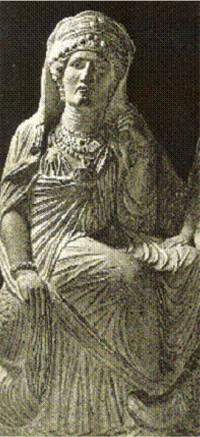
Parthian lady, Palmyra (silver, bowl, Damascus Museum)
Zarathushtrian
It is with the advent of Asho Zarathushtra that the position of women in society clearly emerged. The Gathas and supplementary texts in the Gathic dialect are explicit on the subject. The famous stanza on the "choice of religion” gives equal rights to both: "Hear the best with your ears and ponder with a bright mind. Then each man and woman, for his or her self, select either of the two (the better and bad mentalities). Awaken to this Doctrine of ours before the Great Event (of Choice) ushers in (Gathas Song 3 = Yasna 30, stanza 2). To those who make the right choice and join the Good Religion, he says: "Wise God, whoever, man or woman, shall give me what You know to be best in life — rewards for righteousness, power through good mind — I shall accompany him and her in glorifying such as You are, and shall, with them all, cross over the sorting bridge.” (Gathas S 11 = Y 46, st 10). In yet another stanza he lauds: "The Wise God knows best any person of mine for his or her veneration done in according with righteousness. I shall, on my part, venerate such persons, passed away or living, by their names, and shall lovingly encircle them.” (S 16, st 22). It is this stanza which is later paraphrased in the famous Yenghe Hâtâm formula, also in a late Gathic dialect: "The Wise God knows better every man and woman among the living for his or her veneration done in accordance with righteousness. We, on our part, venerate such men and women.”
Furthermore, the Gathas present an inspiring message for the wedding couple. Of his three sons and three daughters, Zarathushtra selected his youngest daughter Pouruchista to give his advice and blessing. He wanted her to have a person "who is steadfast in good mind, united with righteousness and with the Wise One” and advised her to "consult him with your wisdom,” and be progressively serene and munificent. She assured her father that she would "emulate and choose” him in such a way that her act would be an honor for the father, the husband, the settlers and the family. "As a righteous woman among the righteous people,” she committed herself to wisely serve the Good Religion more than ever. Pouruchista moved her father to leave an ever-fresh word for all the wedding couples. "These words I speak to the charming brides and to you, bridegrooms. Do bear them in mind. Comprehend them with your conscience. Master the life which belongs to the good mind. May you each win the other through righteousness.” Zarathushtra tells them to remain united and to strengthen and promote the universal fellowship of the Good Religion (S 17 = Y 53, sts 3-7).
The last blessing given by Zara-thushtra near the end of his successful mission of 47 years put the finishing touches to his divine task: "May the desired fellowship come for the support of the men and women of Zarathushtra, for the support of good mind, so that the conscience of every person earns the choice reward — the reward of righteousness — a wish regarded by the Wise God” (Y 54.1).”
To be continued
◆ ◆ ◆
From the archive