
Education
“The power of the mind” - IV
Corporate philanthropy epitomized by the House of Tata and the House of Godrej has worked from both ends of national development: `postgraduate research institutions and uplifting labor
The first installment of the Parsiana report on the K. R. Cama Oriental Institute’s two day seminar on the Parsi contribtion to national education dealt with the establishment of schools for girls, both Parsi and cosmopolitan, in the teeth of orthodox opposition. The second part featured the formation of the University of Bombay and the establishment of medical, technical and art education in the city. The third part referred to the madressa, the library and new initiatives to educate children hitherto considered outside the pale.
The final session dealt with specialized institutions. Of the five presentations four dealt with nation building institutions founded by the House of Tata. Dr Ketayun Dinshaw, speaking about the Tata Memorial Hospital (TMH) in her valedictory address brought the score to five. The sixth dealt with the way the House of Godrej looked after its employees in its Pirojshanagar township in Vikhroli, a remote suburb when the enterprise first shifted there in the early 1950s.
As the first school of social work in Asia, the Tata Institute of Social Sciences (TISS) played a pivotal role in the establishment of other schools of social work in India and elsewhere, noted its director Dr S. Parasuraman. Its alumni have filled leadership positions in many of these academic institutions. Established in 1936 as the Sir Dorabji Tata Graduate School of Social Work, the postgraduate institution had a national stature in the training of service professionals. It had a key role to play in the evolution of social policies in education, health care and social welfare sectors and in policies related to women, children and the family, the aged, the disabled and other areas. Accorded the status of a deemed university in 1964 and funded by the University Grants Commission since then, TISS continually responds to social realities through research and the development and application of knowledge towards creating an ecologically sustainable and just society that promotes and protects human dignity, equality, social justice and human rights for all.
The Tata Institute of Fundamental Research (TIFR), the other path-breaking institution promoted by the Tatas, was conceived by Dr Homi Bhabha who also created the Atomic Energy Establishment which was later renamed the Bhabha Atomic Research Centre after his tragic death.
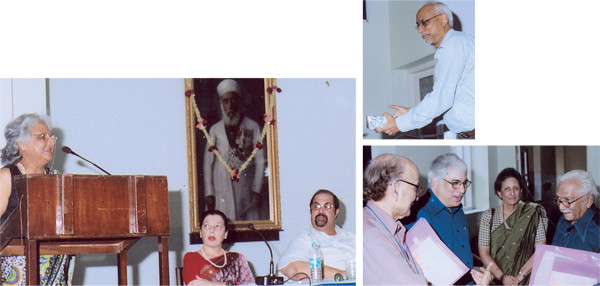
Far left (L to R): Dr Ketayun Dinshaw, Homai Modi and Muncherji Cama; (alongside) Dr S. Parasuram; (below) Prof S. M. Chitre, Dr Spenta Wadia, Dr Nawaz Mody and Prof Vishwas Yande
Having trained in Cambridge where he worked with some of the greatest physicists of the times, Bhabha returned to India and in his position as Reader at the Indian Institute of Science was placed in charge of the Cosmic Ray Research Unit. While working there he realized that there was no scientific institution in India devoted to fundamental research in the new branches of physics like nuclear physics, cosmic rays and high energy physics, noted Prof Dr Spenta Wadia, director of the International Centre for Theoretical Sciences at the TIFR. Bhabha is said to have convinced J. R. D. Tata of "the electrifying effect” such an institution would have on the development of science in India and with support from the Sir Dorab Tata Trust the TIFR initially started functioning from Bangalore in 1945. By 1962 the Institute was fully functional in its new campus in Bombay which was inaugurated by Prime Minister Jawaharlal Nehru.
The TIFR has been conducting research in theoretical physics, mathematics and experimental work in cosmic rays and high energy physics. Bhabha invited many eminent scientists like M. G. K. Menon, Bernard Peters, Govind Swarup, Obaid Siddique among them, to take charge of the fledgling units. In 1962 Bhabha reiterated the idea of a symbiotic relationship between the TIFR and the Government of India’s Atomic Energy Programme, noted Wadia.
Coordinator in the Archives and Publications Cell of the Indian Institute of Science, Sharath Ahuja delved into the long correspondence between the visionary Jamsetjee Tata and the British Government that checkered the path to his goal of establishing an institution of higher learning.
The university Tata foresaw had been inspired by a convocation address by Lord Reay, governor of Bombay and chancellor of Bombay University, in 1889. In 1898 Jamsetjee offered to donate landed property worth Rs 30 lakhs which would yield an annual income of Rs 1.25 lakhs for the university. The gift was conditional on the Government of India agreeing to hold more property in perpetuity which would generate 2.5 lakh rupees annually. The administration of the properties was to be vested in five trustees — three nominated by the university and two by the Tata family.
Tata appointed Burjorji Padshah to plan the new university. Padshah toured scientific and medical institutions, universities and industries throughout the world for 18 months to get the requisite information on which to base his plan. The remarkable Padshah worked unceasingly to bring Tata’s vision of the steel plant, the hydroelectric company and the research institution to fruition, stated Ahuja. Padshah chose the Johns Hopkins University in Baltimore — the first university to be established as a postgraduate institution — as his model and prepared a tentative scheme for the proposed ‘Teaching University of India.’ Tata and Padshah had to tread a long and thorny road to convince the new viceroy Lord Curzon of India’s need and ability to create such an institution.
The offer of 371 acres of land and five lakh rupees towards the construction of the buildings plus a promised annual subsidy of Rs 50,000 from the Mysore royal family secured Bangalore as the location.
Jamsetjee died in 1904 but the scheme was pursued by his sons Dorab and Ratan aided by Padshah. The vesting order of the establishment of the Institute was issued on May 27, 1909, noted Ahuja.
"What advances a nation or community is not so much to prop up its weakest and most helpless members as to lift up the best and most gifted so as to make them of the greatest service to the country.” It was this philosophy of Jamsetjee Tata that led him to create his Endowment for the Higher Education of Indians in 1892. And the first J. N. Tata scholar he selected was Dr Freany K. R. Cama to study midwifery and the diseases of women and children for two years at the London and Rotunda Hospitals in England and Ireland, noted Dr Nawaz Mody, the current director of the Endowment. Cama returned to establish Bombay’s Cama and Allbless Hospital. "Jamsetjee gave Cama Rs 10,000. Today we (J. N. Tata Endowment) give about four lakh rupees,” mentioned Mody who as joint secretary of the K. R. Cama Oriental Institute was the conceiver and organizer of this seminar on education.
The Endowment provides loans at very low interest. "For the first 30 years almost all the Tata scholars returned to India. Most went on to become ICS (Indian Civil Service) officers, teachers, researchers, engineers,” noted Mody. Open to all without distinction, with merit as the sole criterion, the roll of Tata scholars includes such stalwarts as Sir Ardeshir Dalal ICS, Sir Nowrosji Wadia, judge of the Bombay High Court, Dr Jivraj Mehta, later chief minister of Gujarat, Dr V. K. R. V. Rao, Union Minister of education and K. R. Narayanan, President of India.
In the later years "the trustees tried hard to get Tata scholars to return to India. JRD urged Tata companies to create openings for them,” stated Mody. She also referred to Ms Vesugar, "the formidable but kind lady” director of the Endowment, whose interest in helping the young students extended to teaching them to dress, acquire table manners and social niceties, and the fine art of tipping…She saw to it that the innocents going abroad were properly equipped, said Mody.
The scholars were placed in some of the world’s best teaching institutions. "The Endowment has made a unique contribution to facilitating the acquisition of high quality education and played a unique role in developing skilled manpower of the highest quality to serve the country and the international community,” wrote Mody.
Vrunda Pathare, archivist and head of the Godrej Archives, focused on the Godrej contribution to the field of education. The post Independence era was one of monumental transformation and growth for the House of Godrej. The period witnessed the transfer of their workshop from Lalbaug to the newly created industrial township in Vikhroli. Swadeshi was the creed that had driven the foundation of the company. Now the introduction of new products like the typewriter and the refrigerator made Godrej a household name. When the Vikhroli township was planned it was necessary that the workers were provided with basic facilities. A survey was undertaken to understand the needs of workers and eventually the Pragati Kendra (welfare center) was inaugurated in 1955 with three objectives: to provide all round development of the employees and their family members; to raise the standard of living; and to provide counseling and casework services.
Aloo Mowdawalla, a TISS graduate, was appointed as the welfare officer. She conducted a survey among the workers to ascertain their requirements. The workers asked for a dispensary, a flour mill and a consumer store — and a school, as none of these existed in Vikhroli. Hence an educational program was planned encompassing both, a school for children as well as adult education.
Priority was given to adult education as the literacy level was low. Literacy classes were conducted in Marathi, Gujarati and Hindi at the Pragati Kendra for women in the afternoon and for men at night. A survey conducted by the Council for Social Development in 1972 found that 92 percent of the men and 60 percent of the women who responded were literate, noted Pathare. Increased literacy among workers resulted in the successful implementation of the family planning program, proving that family planning is a function of literacy.
"Pirojshah Godrej envisioned education as a process of socialization that prepares a child/human being for collective life. He carefully shaped the character of the school based on the holistic concept of education which seeks the overall development of a person. It teaches students not only to learn about various concepts but to study them in relation to the society they live in. Thus by the holistic concept of education he meant the progress of the whole community of workers and all those who were part of the industrial township,” wrote Pathare.
Taking the guidance of Cooverbai Vakil, a product of Shantiniketan, he nurtured the love of nature and the arts in the Udayachal schools. The vernacular medium of the primary schools was intended to be continued in the high school until the management realized that the workers started sending their children to the Ghatkopar English medium school. Realizing this, English medium was also started from the first standard onward and even introduced in the pre-primary level. In 1967 the first batch of students appeared for the SSC examination.
At the behest of the workers technical subjects were introduced in the curriculum of the secondary school, with a fully equipped technical section for practical training. Then commerce subjects were added to the curriculum and a typing room with Godrej typewriters created for the commerce section. Later the typewriters gave way to computer education. The emphasis on education has led the children of the workers to go on to higher levels of productivity, becoming plant managers and directors, said Pathare.
Presiding over the valedictory function KRCOI president Muncherji Cama noted that much had been presented over the two days to document the Parsi involvement in education. But there were still many endeavors and individuals whose contributions had not been accounted for. The Petit family’s funding of the Navsari madressa, the contribution of Bachoobai Moos who founded the Girton School, the outstanding alumni produced by the Bharda New High School were examples he offered.
"The presenters have done justice to their subjects; they have given us a spectrum of information on the history (of Parsi commitment to education). It would be amiss if we left out the Tata Memorial Hospital,” Dr Ketayun Dinshaw, former director of the TMH who had planned and inaugurated its new campus for research in New Bombay began her valedictory address. Dinshaw is the current president of the International Society of Radiation Oncology.
When Sir Dorab Tata’s wife Meherbai was diagnosed with leukemia she was treated in the US. In her memory Tata established the then 80-bed TMH. "Its ethos of service was laid out by Sir Dorab. Everything had to be under one roof, from diagnosis to treatment, to palliative care. Also education and research,” noted Dinshaw.
When the institution was handed over to the Ministry of Health in 1957, "cancer was not on their screen.” Very little attention and a paltry budget led to rapid deterioration, she noted. Dr Paymaster who was then the director of the TMH brought the sad tale to J. R. D. Tata who discussed it with Dr Homi Bhabha. "Within a few months the reins of the Hospital were transferred to the Atomic Energy Department with the mandate to develop radiation medicine without changing the name of the Hospital.” The managerial board comprises four members of the Atomic Energy Department and three members from the Tatas. The chairman is the chairman of the Atomic Energy Department.
"The last two days brought out certain names — the Camas, Sir Dinshaw Petit, the Readymoneys, the Billimoria family, the Tatas, the Godrejs: the benevolence and vision of individuals and families for the benefit of society. Parsis and other communities have taken so much for granted without thinking how it all started,” noted Dinshaw adding, "Schools, hospitals, institutes of technology, madressas, libraries, special education initiatives… The demand for them is much more, the need is tremendous, but they are islands of excellence. It was important for independent India to be ready with higher educational institutions. There is romance in the little tidbits we heard today…
"Where are we today? How do we go forward?” asked Dinshaw and urged the gathering, "We need to support, upgrade these institutions to put them on par with similar institutions in other parts of the world. Social justice demands the injection of a little extra commitment. The country needs many more centers of excellence…” Concluded
◆ ◆ ◆
From the archive