
The Padshah of Tatas
Burjorji Padshah helped Jamsetji Tata shepherd the business house through its formative years and beyond
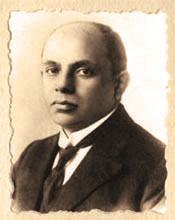 finally persuaded to join the founder of the Tata empire in his business ventures. According to a note on the Tata Central Archives (TCA) website, Padshah, "whose vision was wide and comprehensive, was specially qualified for the gigantic schemes which Jamsetji had in mind, and readily accepted the offer.” The able aide to the industrialist was intimately involved in the execution of Tata’s three major dreams — a scientific research institute [Indian Institute of Science (IISc)], iron and steel works (now Tata Steel) and the hydro electric projects (Tata Power and associated companies), besides several others.
 Padshah, who passed away 75 years ago, is referred to the website of IISc in these words: "The plan (of the setting up of the institute) was shepherded through many difficult years by Burjorji Padshah, a close associate of (Jamsetji) Tata.” A postage stamp issued by the government in December 2001 to commemorate the centenary of the founding of the IISc shows Padshah along with eight other stalwarts involved in the setting up and strengthening of this institution. An editorial in the January 2008 issue of Current Science by a former director of IISc, Prof P. Balaram, Padma Shri awardee and biochemist states "Padshah, who enjoyed the confidence of Tata can be described as his alter ego.” (www.iiscalumni.com)
In the editorial the professor writes: "I have realized that the story of the early history of IISc really centers around one man, Burjorji Padshah (1864-1941) … Even a cursory glance at available archival material between 1898 and 1910, establishes Padshah as the central figure in realizing Tata’s vision (of setting up the institution), notes Balaram. Commending his skills at negotiations, prodigious intellectual capabilities and his complete detachment from material pleasures, Balaram calls these qualities "key elements in his successful pursuit of the goals set by Tata.”
In an article to commemorate the centenary of the establishment of the IISc, Outlook magazine of October 13, 2008 reports that Padshah had then written to Nobel laureate Sir William Ramsay about the difficulties faced in the setting up of the Institute: "If we are beaten for the present we are not dismayed. We cannot give up the idea. We still hold that no sum can be more advantageously expended for the benefit of India than in attempting to bring into existence a scientific milieu in the country.” Padshah was also uncompromising about the quality of teachers he wanted to attract to the place. He wrote: "A research institute staffed by men whose research is of the bottle-washer order is an absurdity.”
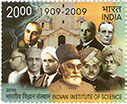
Commemorative postage stamp on the centenary of IISc
"Few men were more valuable to Jamsetji for his projects than Padshah. And few he felt closer to,” wrote the late Rusi Lala in his biography For the Love of India: The Life and Times of Jamsetji Tata. The note on the website of TCA indicates that from the very inception of the idea of manu- facturing steel in India, Padshah had collaborated first with Jamsetji and then with his sons (Dorabji and Ratan) and that "it is largely to his vision and foresight that the Tata Iron and Steel Company owes its foundation and growth.”
Padshah’s association with the third dream of Tata (after the Institute and the iron and steel works) was reflected in his involvement with the hydro electricity projects of the founder. The TCA website comments that "Burjorji followed every inch of the investigations not merely on paper but …walked over many miles of the (Western) Ghats before the final reports were made and the spots selected for the lakes.” That Padshah was in sync with the Tata philosophy of giving is reflected in the following statement: "When it was thought that there would be difficulty for all the power to be consumed, Burjorji, with that broad view of sharing profits with others, induced the directors … to enter into an underwriting agreement with others who guaranteed the consumption of all the power generated by the Tata Hydro-Electric Company.”
When the plague struck Bombay, Jamsetji instructed Padshah to offer all possible help to Dr Waldemar Haffkine, the European medical man who was researching vaccines and who Jamsetji greatly admired. The aide "recruited all the young Parsi students studying at St Xavier’s College to help the Jewish - Ukranian professor specially in gathering and maintaining of statistical records of his work, and subsequently of the inoculation program,” notes the TCA newsletter Sands of Time dated April 2005 in a feature on Padshah.
The prolific Padshah was involved in other projects of the visionary Tata. Lala notes in Jamsetji’s biography that two decades prior to the start of Tata Oil Mills, the industrialist had asked Padshah to conduct the first investigations to set up an experimental plant to extract oil from seeds. As soon as Burjorji’s hands were a bit free, he turned to this industry and as a result the Tata Oil Mills were floated (in 1917), mentions the TCA website.
Shortly after the death of Jamsetji in 1904, Burjorji induced Dorabji and Ratan Tata and other financiers in Bombay to establish an Indian bank, as a result of which the Bank of India was started in 1906, states the website. In 1918, Padshah wrote a treatise on insurance and its benefits to the country which resulted in the establishment of the New India Assurance Company in 1919, continues the TCA website.
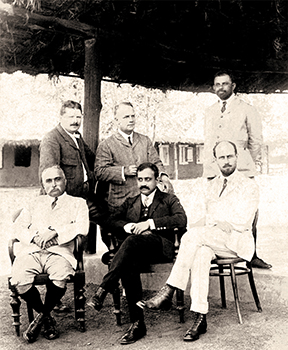
In For the Love of India, Lala noted that when Padshah’s father Jamaspji, a close friend of Tata’s died at an early age, the industrialist took over guardianship of the bereaved family. The young man was ready for matriculation at age 13 and covered himself with glory winning prizes and scholarships for history, English and physics at Elphinstone College; after that, he proceeded to Cambridge to study mathematics. So impressed was Tata when Padshah was invited to take a professorship at the Karachi college, that he sent his son Dorab to study at that institution. When Padshah was passed over for the principal’s post, Jamsetji dissuaded him from joining the Servants of India Society (the social service organization started by Gopal Krishna Gokhale) that the vice principal was inclined towards, and persuaded him to join him in his "investigations for a grand research institute.” Acceding to his guardian’s request, the protégé toured various universities and zeroed in on the Johns Hopkins University in Baltimore, USA as the role model for Tata’s dream which was to find fruition in the establishment of the IISc in 1909.
As an educationist, scholar and thinker, Padshah had few equals, notes the TCA website. A voracious reader, he was practically a living encyclopedia. His fine memory, his wonderful grasp of facts and figures, and his extraordinary mastery of the most complicated problems, were unique. "For all his projects, Jamsetji got the costing done thoroughly by Padshah,” states Lala in his biography of the visionary Jamsetji.
"All those who came in contact with him were impressed by the vastness of his information on almost every branch of learning and human understanding …whether it was general literature or poetry, science or philosophy, history or religion, sociology or politics, he was equally familiar with them all.” He had no use for mechanical aids like slide rules. When a young engineer is reported to have asked him: "Why tire the brain and not reserve its energy for higher things?” he is quoted as replying: "The more exercise the brain gets the more energy it generates.”
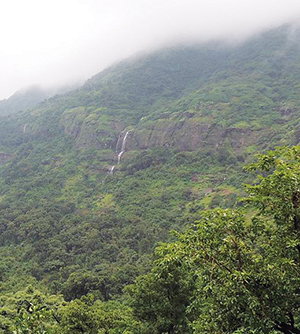
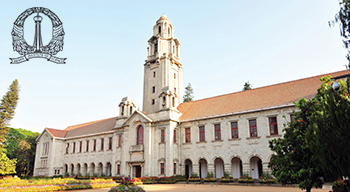
A view of the Indian Institute of Science in Bangalore
A disenchanted Theosophist, Padshah had once accompanied Madam Helena Blavatsky to the UK, but her beliefs soon lost their charm for him.
Padshah shared a close relationship with Mahatma Gandhi. Explaining his concept of non-violence, Gandhi wrote in a post card to Padshah from Sabarmati Jail that he always cooperated when he could, and "I non-cooperate when I must … you may depend on my withdrawing every demand that cannot stand the test of reason,” notes Sands of Time. The newsletter also quotes Gandhi as saying, "I knew Burjorji Padshah by his reputation... I had never met him, but friends said that he was eccentirc. Out of pity for the horses, he would ride in tram cars, he refused to take degrees in spite of a prodigious memory, he had developed an independent spirit, and he was a vegetarian, though a Parsi.” The vegetarianism was probably a manifestation of the love of animals developed in one of his earliest jobs as caretaker of his father’s stabling business in Byculla.
In yet another communication from Satyagrahashram in March 1922, Gandhi wrote to Padshah justifying his hard stance taken in a letter to the then viceroy. The preacher of non-violence had received a letter from the man of commerce that "it is certainly not divine to show the strength to intimidate an adversary into acquiescence in views of which he cannot be convinced without the intimidation.” In reply, stating that he wanted cooperation, Gandhi wrote: "it must be real cooperation …I assure you I will strain every nerve to prevent a bloody revolution.”
After he retired from the house of Tata in 1931, Padshah began touring round the globe. "People of all nationalities (were) attracted by the wide range of his knowledge and information collected,” notes the TCA write-up. He passed away in June 1941, at the age of 77 at the The B. D. Petit Parsee General Hospital in Bombay. The Parsee Prakash, Volume 8, 1941 to 1950 published by the trustees of the Parsi Panchayet Funds and Properties notes that as a mark of respect to the man, "the office of Tata Sons remained closed and the Bombay Municipal Corporation Assembly meeting was postponed.”
In a telegram of condolence on Padshah’s passing away sent to Sir Ardeshir Dalal, director in the Tata Group, available with TCA, Gandhi wrote: "Death (of) Barjorji (sic) is not only loss to Tatas but humanity.” The TCA website states: "The House of Tata had lost a man who, in their pioneering days, moulded and shaped their gigantic schemes.”
An obituary in The Indian Social Reformer of June 23, 1941 notes that "he disclaimed, and did so rather aggressively, any religious beliefs but few men with religious beliefs excelled him in behavior.” An extract from The Sind Observer of June 25 written by one Prof L. H. Ajwani available with the Tata archives notes Padshah’s efforts in setting up of the Parsi Gymkhana in Karachi. The article states that Padshah held at that date the record for the number of subjects taught by any professor — philosophy, history, mathematics and English.
The family chain
A descendant of Burjorji, 86-year-old Poona resident Pesi Padshah, was 11 when his ancestor passed away. A physical fitness professional, Pesi demurs at providing details about himself. He tells Parsiana on the phone on July 5, 2016 that his grandfather Pestonji was a brother of Burjorji. The latter married Pestonji’s widow Gulbai to be able to look after the family.
"I seem to have a lot in common with Burjorji,” states Pesi, revealing that he has been a vegetarian for the last 40 years and abhors the use of leather footwear, "just like Burjorji.” He has a very faint recollection of accompanying his grand-uncle/step grandfather on a cruise, while recuperating from a cricket injury. "I wish I could tell you more,” he continues, stating that he too has learnt much about Burjorji via the internet. "He was always spoken about with great reverence by my parents” (Jal, a dean of the King Edward Memorial Hospital, and Tehmina).