
Books
Legal role models
A brief autobiography of lawyer Mithan Lam has been published by the K. R. Cama Oriental Institute
The autobiography of Mithan J. Lam, the first woman barrister to practice law in any high court in India was released by former Supreme Court Justice Sujata Manohar on July 31, 2009 at the K. R. Cama Oriental Institute (KRCOI).
Lam was "a pioneer in the women’s movement,” said Manohar. "She had a brilliant and charming personality” and was a powerful orator. "My mother was a great admirer of hers. She was a role model for her daughters… when she was appointed (the first) sheriff of Bombay there was great elation in my family.” In 1947 Lam became the first woman to be appointed sheriff in India. A year later Mary Clubwalla was appointed sheriff of Madras.
Noting that Lam "lived in turbulent times,” Manohar regretted the autobiography was "so short and sketchy.” She hoped it would eventually "lead to a more full-bodied” biography.
The daughter of Hirabai and Ardeshir Tata, Lam attended the London School of Economics around 1919 and joined Lincoln’s Inn in 1920. In 1923 she was called to the bar. She joined the famed solicitor Bhulabhai Desai but found it "difficult to get work.” She received her first brief from a solicitor whose client was confident of winning his case but "wanted his opponent defeated at the hands of a woman,” related Manohar. (Cornelia Sorabji was the first Indian woman to qualify as a barrister but was not permitted to practice in the Calcutta High Court. Sorabji’s picture "in a lovely Parsi saree” is hung in Lincoln’s Inn, noted the jurist.)
Lam was for years the chairperson of the parliamentary committee of the Bombay (now called Maharashtra) State Women’s Council (MSWC), recalled Manohar who noted the government often referred bills relating to women to the Council. Lam was associated with the All India Women’s Council since 1937 and was elected the body’s president. She was appointed chairwoman of a committee to look to the welfare of women and children following Partition in 1947.
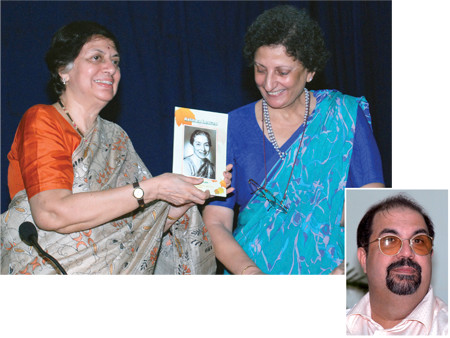
Justice Sujata Manohar (l) releasing the book as Dr Nawaz Mody looks on (Inset): Muncherji Cama
Unequal rights
Though women today are on "equal footing with men they still face hardship.” Manohar recalled when she joined the bar in 1958 there were only five to 10 women practicing law, among them being Mani Cooper and Freny Ponda. Dina Ahmedullah had qualified from Oxford but chose social work over the bar.
"Women’s quest for equal rights is still weak,” lamented Manohar though she noted things were improving. There were five women judges in the Bombay High Court and three in the Supreme Court. Manohar herself was the first woman to be appointed a judge of the Bombay High Court and the first woman to become chief justice of that court, noted KRCOI president Muncherji Cama while introducing the jurist.
She referred to the laws passed in the recent past that ensured more equal rights for women. Inheritance laws have been made more equitable for daughters as versus sons; in custodial matters the courts can decide which parent obtains custody of a child by looking to the best interests of the minor; the Roopkanwar Sati case "prohibited the glorification of sati in any manner;” the Mathura Rape case resulted in the law being amended to state that unless a woman consents to sexual intercourse the courts must presume she did not give her consent (in this case the High Court convicted two accused policemen of raping a 16-year-old girl in the police station but the Supreme Court set them free claiming she must have consented as she did not raise a hue and cry. Parliament then amended the law); in the Shah Banoo case the court granted certain monetary rights to divorced Muslim women. Unfortunately the Rajiv Gandhi government caved in to public pressure and amended the law in Parliament nullifying the effects of the judgment.
"Muslim law needs to be amended,” noted Manohar. But she cautioned that unless the laws had "social sanction” they would be "difficult to put into practice.” She cited the laws barring the giving and receiving of dowry but noted that "every day dowry is being asked for and given…Unless you have proper law and order there (is) no protection for the weaker sector. Where people are vulnerable, it is for the leaders of the community to come forward and fight for their well being.” The belief that women who were raped were of easy virtue or provocatively dressed was untrue, Manohar noted. Studies have shown "90 percent of them were wearing saris” when assaulted.
When a member of the audience inquired if a third party could take up the case of discrimination against Parsi women who marry non-Parsis as versus Parsi men marrying out, Manohar, a member of the National Human Rights Commission of India, said a precedent could be set if it were shown the case was in the larger public interest. But she counseled it would be better if the community as a whole moved the courts for change. When told this was not happening she replied, "it does not mean it cannot happen.”
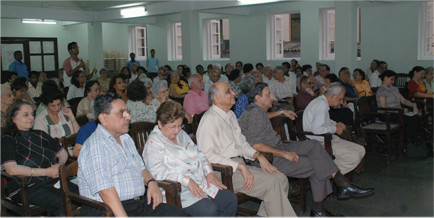
A section of the audience at the K. R. Cama Oriental Institute
Another member of the audience voiced his concern over section 498A being misused by women. He alleged the abuse was as high as "80 percent.” The section provides punishment to a husband or a relative of a husband who inflicts cruelty on the wife. Manohar said it is necessary "to train the police properly. The misuse has to be stopped. It does not mean the law has to be scrapped.”
Regarding the contentious bill reserving seats for women in the Indian Parliament, the former judge noted that reservations were given when a section of society faced "deep seated prejudice... are women in that position? It is a matter for the public to see. Politicians have so much prejudice.” She advocated "time bound reservation” which would "disappear” after some time and not continue "for decades on end…we require laws that do not discriminate.”
She bemoaned the small number of women in the top leadership positions "nationally and internationally…how many women vice chancellors do we have? We do not have a support system to back up women. In the US women were quitting jobs to look after their children. They cannot expect any help. We need many changes in the social structure.”
Giving the vote of thanks KRCOI joint honorary secretary Dr Nawaz Mody said Manohar is "an enduring role model for all those enrolling” in the legal profession. Mody noted the book "took quite some time” to materialize. A preface for the 76-page paperback priced at Rs 300 had been written in 1991 by Lam’s colleague, Lakshmi N. Menon. Mody thanked lawyer Keti Mehta, a member of the KRCOI’s managing committee, Lam’s nieces Soona and Aloo Surveyor and Meher Mirza for helping out with the book and said she had been in touch with Lam’s son, Soli. Lam’s husband Jamshed was a noted lawyer and active in community issues.
◆ ◆ ◆
From the archive