
Institutions
A ‘jewel’ at Kalina
Sir Pherozeshah Mehta Bhavan and Research Centre creates a new ambience on the University campus
"Pherozeshah Mehta’s association with the University of Mumbai started as a student and continued till the end of his life…If the universities in India enjoy a certain degree of autonomy in their functioning, the credit goes to Pherozeshah (who) throughout his career in public life… stood up to defend the rights and privileges of the University.”
Inaugurating the glittering new Pherozeshah Mehta Bhavan and Research Centre at the University of Mumbai’s Vidyanagari campus in suburban Bombay on December 27, 2006, governor of Maharashtra and chancellor of the University S. M. Krishna said he was paying his "pranams (obeisance) to one of the tallest nationalists in the pantheon of all time great leaders of India, (one who) was rightly called ‘Lion of Bombay’ and ‘Father of Municipal Governance’…Aside from being a prominent politician, he was a noted lawyer, educationist, fierce nationalist and a conscience-keeper of society… With the inauguration of the… Bhavan… the University of Mumbai has partially repaid the insurmountable debt it owes to Sir Pherozeshah Mehta, albeit after 91 years of his death.”
The fine one-storey structure comprising 40 rooms — the product of former sheriff of Bombay I. M. Kadri’s architectural prowess provided entirely free of charge —stands on a 1.9 acre plot allotted by the University and includes the state of the art Jamshed and Shirin Guzder Auditorium, the Zartoshty Brothers’ Library, seminar rooms, class rooms, faculty rooms, et al. An outer garden and an inner courtyard provide for landscaping and natural color. Commissioned by Sir Pherozeshah Mehta 150th Birth Anniversary Celebrations Committee (PMBACC) at a cost of six crore rupees, the commemorative edifice, the only one in the country dedicated to Pherozeshah, has been entirely financed by donations from the community and associated industries — the first time the University has permitted private construction — and pales the rest of the structures on the campus.
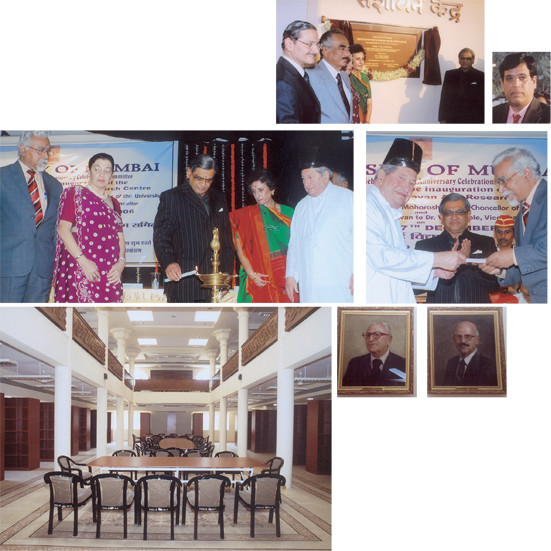
L to R (top left) Vijay Khole, Homai Modi, S. M. Krishna, Nawaz Mody and Jamshed Guzder; (above center) S. M. Krishna (center) watching Guzder bequeathing the Bhavan to Khole; (alongside) Cyrus Guzder, I. M. Kadri, Mody, Krishna and Arun Sawant; Bottom left: The Library at Sir P. Mehta Bhavan Alongside: Faridoon and Mehraban Zartoshty
The vice chancellor of the Univeristy — currently Dr Vijay Khole — is the ex-officio chairman of the PMBACC. Its vice chairman, Jamshed Guzder, emerged as the biggest donor to the project, having gifted Rs 1.25 crore, although it was the early contribution of Rs 90 lakh from Iranian Zoroastrian philanthropists Faridoon and Mehraban Zartoshty that provided the initial fillip for the construction. Other major donors gifting over five lakhs were corporates including ACC through the late Nani Palkhivala, six other Tata companies, Larsen and Toubro, the Bombay Community Public Trust, the Central and ICICI Banks and the Mahalakshmi Temple Charities. Other members of the Committee included noted lawyers Burjor Antia and Navroz Seervai, former governor’s nominee on the University Senate Homai Modi, solicitor Keti Mehta, academicians Dr Y. D. Phadke, Dr M. D. David, Dr L. H. Hiranandani, Suresh Vaidya and, ex-officio, Dr Arun Sawant, the University’s pro vice chancellor. Prof (Dr) Nawaz Mody, who held the Sir Pherozeshah Mehta Chair for Civics and Politics in the University since 1994, functioned as the member secretary since the Committee’s inception in 1995. Community stalwarts Homi Taleyarkhan, Palkhivala and former sheriff of Bombay Jehangir Nicholson, who had been a part of the Committee earlier had, sadly, not lived to see the fruition of the project, as Modi informed the gathering in her opening remarks.
Saluting the "close association of the Parsi community with this institution of learning,” Khole noted that the University in its 150 years had "seen outstanding contributions and inspiring moments” in its beautiful Fort campus which were now being reflected on its Kalina campus. "The Parsis have immensely contributed to the University’s growth, enabled us to compare with educational leaders anywhere in the world. The Bhavan forever will remind generations of students of the supreme contributions of Sir Pherozeshah Mehta,” said Khole, anticipating academic growth and achievement and the creation of men and women dedicated to nation building.
Ere he formally handed over the deed of trust and keys of the Bhavan to the University in the person of its vice chancellor, Guzder, himself a nonagenarian, recalled Mehta’s yeoman services to the city of Bombay and exclaimed with delight, "I never imagined the Bhavan would be so beautiful!” He also recorded his satisfaction that the inauguration was "taking place in this beautiful auditorium I’m honored to say is named after me.”
Along with the other items Guzder handed Khole a letter reiterating the terms and conditions (see box "Terms of bequest” pg 19) agreed to between the University and the PMBACC in November 2001. They were read out by Modi, who compered the evening’s program, to the invited audience thronging the auditorium.
In messages she read earlier, President of India Dr A. P. J. Abdul Kalam recalled how "Sir Pherozeshah Mehta’s life was a source of inspiration for the young generation in the pre-Independence period,” and added, "His thoughts were visionary and I am sure the University will continue his mission and provide education to its students that imbibes the ‘can do it’ spirit in them.”
In her message of congratulations All India Congress Committee president Sonia Gandhi acknowledged, "Sir Pherozeshah Mehta was not only one of the founders of the Indian National Congress and a builder of the city of Bombay, he was also a great educationist and humanist who served as vice chancellor of Bombay University and established its standards of enlightened thinking and academic excellence.
"It is heartening to learn that the funds for the new building have been raised entirely from donations. It is a tribute to the generous philanthropic spirit of the Parsi community, of which Sir Pherozeshah Mehta was such a luminous member. I hope the new generation of students at the University of Mumbai will continue to draw inspiration from his staunch patriotism and secularism, his far-sighted vision and his deep commitment to the nation and the community.”
"As someone who lived, studied and did business in Mumbai for 16 years, I am very proud of my Indian connection,” noted Mehraban Zartoshty’s message. Now resident in the US, Zartoshty expressed his satisfaction: "Today, India is at the center of the world. India is known here in the United States on account of its software industry and its brain power. I am delighted that the inauguration of this Bhavan is at the hands of S. M. Krishna who as chief minister of Karnataka did more than anyone else to put India and Bangalore on the world map,” he added, recording his and his family’s delight "when Homai Modi made a suggestion that we should fund the establishment of this magnificent Bhavan and in particular the Library. I am so glad that the project is now complete and the Library is named after our family. It will be a center of research and excellence.”
Krishna traced Mehta’s long association with the University in some detail. He was the first Parsi to get his master’s degree from the University, was appointed its Fellow at the age of 22, remained a member of the Senate for over 45 years and of the Syndicate (now called the Management Council) for 23 years, simultaneously served as dean of the faculty of Arts and of the faculty of Law, becoming the vice chancellor in 1915. The Senate moved a resolution awarding him and Dadabhai Naoroji the degree of Doctor of Laws in August 1915. However, Pherozeshah died before the honor could be conferred upon him. The governor noted that the inauguration of the Bhavan added "a special flavor to the University’s year-long sesquicentennial celebrations…
"Pherozeshah Mehta belonged to the moderate school of thought that sought self-government through constitutional methods like discussions, petitions and debate with the British authorities. Today, at a time when regional, religious and other parochial opinions increasingly dominate the political scene, we need people like Pherozeshah Mehta to restore sanity, ethics and probity to public life…
"The activities identified by the Bhavan such as a Centre for Good Governance, Centre for Human Rights and Citizenship and Centre for the Study of Mumbai which will together focus on emerging multi-disciplinary areas like political economy, human rights, urban history and problems of the city, new trends in governance and the emergent role of civil society are expected to produce men and women of sterling character and leadership qualities like Sir Pherozeshah Mehta.”
Appreciating the "untiring efforts made by distinguished members of the Parsi community,” Krishna noted, "Jamshed Guzder, the Zartoshty brothers of Iran, various Tata companies and other donors have kept alive the noble Parsi tradition of donating for a good cause…
"Two ladies stand out — Homai Modi and Dr Nawaz Mody. They deserve very special mention on this occasion. Were it not for their perseverance — despite several setbacks and disappointments, commitment to the cause, involvement in raising funds and planning the entire project so meticulously — the Bhavan would not have been completed even during this 161st (birth) anniversary of Sir Pherozeshah Mehta.” (Krishna’s compliments were echoed by Zartoshty in his message: "These two ladies have worked amazingly hard to raise funds and bring this project to fruition.”)
Complimenting and congratulating Kadri, "acknowledged as one of the brilliant architects of our times, he not only created this magnificent edifice but had pity on us and did not charge any fee,” Krishna added, "When I saw the Library I wished I had been born later so that I could study in this Library, get inspiration here!”
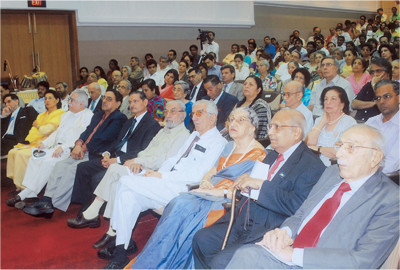
Distinguished invitees in the auditorium
Diverging from his published speech Krishna recalled a Mexican Nobel laureate who in the course of his lecture at the Indian Institute of Science in Bangalore in the early1990s had pointed out that the number of Indian papers at international seminars failed to reflect the large population of the country. Commenting on India’s impact on the international scene since then, Krishna noted, "Today we are justifiably recognized as leaders in technical development, particularly in information technology.” Adding an autobiographical aside, the normally reticent Krishna said, "As one who played a humble role (while chief minister of Karnataka), I know the tremendous odds I faced. I was dubbed an elitist, as playing to elitists…I wanted to take technology to rural areas. I know how precious is the record of land rights to farmers. To get a copy of land rights they go from one office to another, make one appeal after another to ensure their record of land rights is not tampered with. They are made to execute collaterals. I thought why should we not digitize it, provide kiosks where through his left thumb impression before the gadget the farmer can get his printout of land rights? We set up 224 kiosks in rural areas. Today (the scheme) is taken as a model for the entire country.”
"Our dream of establishing this beautiful Bhavan has finally come true,” exulted Mody. "We were inspired by the life and work of Pherozeshah Mehta who towered over Bombay like a colossus. It helped us persevere and complete this task.” Her vote of thanks recounted the many donors, co-members of the PMBACC present and past who had aided the project as well as former governor of Maharashtra Dr P. C. Alexander who had not only laid the foundation stone of the building but whose "crucial interventions at various stages” had helped to keep it going. Contractor and consultant Rustom Sethna (Sethna Constructions Pvt Ltd) had carried out the civil work, Cyrus Watchmaker, the electrical, while Sam Kerawala had been the theater consultant, said Mody. Voltas had provided the airconditioners and Ambuja Cement gave cement at a highly discounted price, she noted.
Thanking all concerned on behalf of the University for this "jewel among all the buildings…which has enriched the campus by its ambience and aesthetics,” Sawant noted that the project had seen three vice chancellors come and go. He explained, however, that the delays were "not because of lethargy. Administrative issues have to go through several authorities.” The kind of edifice, the painstaking effort to reflect the life of Pherozeshah Mehta, the concern for minute details befitting the memorial, were all time consuming, he averred, comparing the new building to the splendid Sir Cowasji Jehangir Convocation Hall on the University’s Fort campus as "another landmark.” Complimenting the "two strong ladies at each end of the dais, how much work they have done!” Sawant added, "Dr Nawaz Mody has left an indelible mark on this department and on the functioning of the University. We are sad to see you go (Mody retires this year). Wherever you will be, this University will always remember your contribution.”
In Pherozeshah's footsteps
It was on Sir Pherozeshah Mehta’s birth centenary in 1945 that the citizens of Bombay collected four lakh rupees to endow the Pherozeshah Mehta Chair of Civics and Politics in the University of Bombay. "When the Municipal Corporation also contributed one lakh rupees, the University created the Department of Civics and Politics – the only one in India – because of Mehta’s involvement with civic and political issues,” says Dr Nawaz Mody, adding that other universities have departments of political science or of history and politics.
When she assumed the chair and became head of the department in 1994 Mody set the wheels in motion to celebrate Sir Pherozeshah’s 150th birth anniversary the following year. Initially the University’s Management Council suggested the names of members of the committee that came to be known as the Sir Pherozeshah Mehta 150th Birth Anniversary Celebrations Committee. Normally the vice chancellor becomes the ex-officio chairman and the pro vice chancellor becomes an ex-officio member, noted Mody. Others included Dr Phadke, Dr D. R. Sirdesai and Taleyarkhan who was the initial vice president. "At the first meeting of the Committee some of the other names were suggested,” recalled Mody. They included journalist Behram Contractor, Palkhivala, Modi, Guzder and other academics since retired or demised.
The first function was the garlanding of Mehta’s statue at Bori Bunder and the publication of a booklet recalling his many achievements and the issue of a stamp by the Government of India. "The question arose, shouldn’t we house the Department of Civics and Politics appropriately? Create a building and dedicate it to Pherozeshah Mehta?” recalled Mody.
The following year saw the holding of a two-day seminar when academicians from the Universities of Bombay and Poona presented original research papers on his multitudinous interests and activities, flagged off by Dr P. C. Alexander, then governor of Maharashtra. The consul general for France was one of the participants "because of Mehta’s battle to preserve the teaching of French in the University,” Mody informed Parsiana in a subsequent interview, adding, "A lot of Parsis were involved in the creation of the Circle Literaire (French literary circle) in Bombay.” The papers were later published as a book edited by Mody.
"I had not realized then that the seminars would become an ongoing activity of the Committee,” says Mody. When the trustees of the Dr Rustom and Gulestan Bilimoria Trust donated five lakh rupees to the University through the PMBACC, stipulating that interest thereon be used for the holding of seminars, Mody instituted studies on the ‘Women in India’s Liberation Movement’ and the ‘Parsis of Western India 1880-1920’ in succeeding years, the proceedings being published as books thereafter. It was while launching the book Parsis of Western India 1880-1920 in 1999 that Alexander urged Mody to continue with the subject to date, resulting in the seminar on ‘Parsis in Western India 1920-2000’ in March 2000. Even as Mody sought to prepare the proceedings for publication, the subject acquired its own momentum so that eventually 66 papers saw the light of day in the four-volume Enduring Legacy weighing eight kilograms, launched by industrialist Ratan Tata in January 2006.
"In the meantime the idea of the Bhavan fructified. We had thought it would be a one or two crore project until Jehangir Nicholson chided us for having such a narrow vision. Homai (Modi), Homi Taleyarkhan and I met Kadri. He said if we are going to build in memory of Pherozeshah Mehta it must have excellent quality, befitting his memory… After all, the foundation stone of the grand Convocation Hall had been laid when Pherozeshah was vice chancellor … The normal practice at the University is a PWD (public works department) type of structure. Dr Snehalata Deshmukh was the vice chancellor when we got the permission from the University to raise donations, construct the Bhavan privately and then hand it over,” Mody traced the evolving ideas.
Funds were an obvious constraint. "When Zartoshtys’ 90 lakh rupees came, it spurred us to organize the laying of the foundation stone by Alexander in 1997. With interest it became 1.5 crores by the time we constructed,” noted Mody. Guzder had also committed to Deshmukh that he would contribute 85 lakh rupees but facing red tape from the University he withheld payment until the terms of the building scheme were confirmed by the University’s Management Council in November 2001 to the satisfaction of the PMBACC after a few legal hurdles had been hammered out. "Throughout the negotiations Burjor Antia, Navroz Seervai and Nicholson stood by us,” attests Mody.
"After the interfaith prayers, a time capsule was buried under the Library on August 4, 2002. Then construction began in earnest, but the cost escalated,” Mody recalls the Committee’s rollercoaster ride to the completion of the project.
"Through the Committee I grew academically,” notes Mody gratefully. "Enduring Legacy is a product of the Committee. It gave me great opportunity…It was easy for me to get involved. But even Homai and the others made this cause their own. Otherwise it would not have been possible for me to overcome these obstacles.”
The Lucknow born daughter of Tehmurasp and Tehmina Thanevala, Nawaz schooled in Delhi’s Presentation Convent when her father got a job with pharma major Schering, initially, then with the nascent Hoechst as medical representative in the national capital. She was ready for college when Tehmurasp was promoted Hoechst’s branch manager in Bombay, completing her graduation and masters in politics from Elphinstone College, an outstanding student winning the Government Merit Scholarship among others, topping the University in the latter exam.
Nawaz started teaching at Sophia College, then applied for a vacancy in the University and was picked by famed Gandhian Dr Aloo Dastur, the third Pherozeshah Mehta professor of civics and politics and head of the department in 1974. Married to supportive businessman Bahadur Mody, Nawaz received the Fulbright Scholarship that enabled her to complete her doctoral studies at Cornell University in the US. Her PhD thesis was later published as Indonesia under Suharto.
Until Dastur’s time the post had been filled only after due advertisement and selection. When Dastur retired, however, the senior most professor in the department, Dr Ramesh Babu, was appointed without due process. Mody, then a reader in the department, complained. "Mehroo Bengalee was the vice chancellor but she did not want to ruffle any feathers,” recalls Mody. But when she was elected dean in the faculty of Arts and elected to the Management Council, the University agreed to address her complaint. However, "Babu went to court. The single bench dismissed his petition. (In an interim order) the division bench permitted the advertisement and interviews,” narrates Mody. In 1993 Mody was selected but the court ordered that her selection be kept on hold until 1994 when Babu retired.
Now near the end of her academic career, Mody recalls with a smile, "My father thought women shouldn’t study too much. ‘Who will marry you?’ he used to say.”
Terms of bequest
That the name of the Bhavan shall always be the Sir Pherozeshah Mehta Bhavan and Research Centre and the same shall not be changed at any time.
that the Bhavan shall be used only for the department of civics and politics of the University of Mumbai as originally resolved and for no other departments/sections.
That the name of the auditorium shall always be "The Jamshed and Shirin Guzder Auditorium” and a suitable plaque as suggested by the donor be installed.
That the name of the library and a suitable plaque shall always remain as suggested by the donor Mr Mehraban Zartoshty.
That on the plot (of 1.9 acres) already allotted by the University no structure of any kind would be built upon or made usable for any purpose other than providing gardening, parking or such like requirements for or in relation to the Bhavan building and its aesthetic surroundings and remembering that the Bhavan is a dedicated monument — a kind of heritage building.
That in supersession of the resolution passed by the Management Council at its meeting held on March 31, 2001, (Vide item No. 30) insofar as it related to the operation of accounts of the Bhavan building, the bills for payment for the construction of the Bhavan duly certified and approved by the Main Committee shall be expeditiously paid by the University, as has been done in the past, out of the amount available in the University of Mumbai A/c: Sir Pherozeshah Mehta 150th Birth Anniversary Celebrations Committee.
That the Management Council assures that the aforesaid resolutions shall not be changed or modified without the consent of the Sir Pherozeshah Mehta 150th Birth Anniversary Celebrations Committee.”
◆ ◆ ◆
From the archive