
Seminar
Mobeds as mediators
The Jiyo Parsi program is strengthening its initiative to build leadership skills among the clergy
"Take ownership of your flock... you are the first stage interventionists for handling difficult family relationships and youth problems, to help differently-abled populations and the elderly,” Dr Shernaz Cama, director of Parzor Foundation told the 72 mobeds, behdin pasbaans and some family members attending the second Jiyo Mobed workshop on November 19, 2017 in an auditorium of the Sir H. N. (Hurkisondas Nurrotumdas) Reliance Foundation Hospital and Research Centre. Cama explained the reason for the focus on the clergy within the Jiyo Parsi program: According to her, what brings the youth back to churches in the West is the fellowship that they enjoy with the priests. "Can we not do something like that?” she queried.
The sentiment was echoed by Udvada high priest and member of the National Commission for Minorities Dastur Khurshed Dastoor. "Aapré aapraaj tola ma rahiyéch (we mix only with our fellow mobeds)... We are wanting somewhere, which is why we do not mix freely with behdins,” he told the assembly. "Open discussions with them, learn what behdins expect, create bonds with them... I want today’s mobeds to be progressive,” he said. Pray with full consciousness was Dastoor’s message: "Tamara ghér na ravaano tévha behdin na (respect the deceased members of the laity like your own),” he said.
On another note, he asked the mobeds to "be sparklingly clean and neatly dressed... carry yourself in a dignified manner...it will also help you get good girls (to marry),” he smiled. "If a priest grows, the religion grows,” he ended.
Counsellor Binaifer Sahukar who was also looking into the registration of the participants mentioned that the majority of the attending younger mobeds were single. The participants included a four-member team from Navsari, and mobeds from Mandvi and Neemuch.
The sentiment was echoed by Udvada high priest and member of the National Commission for Minorities Dastur Khurshed Dastoor. "Aapré aapraaj tola ma rahiyéch (we mix only with our fellow mobeds)... We are wanting somewhere, which is why we do not mix freely with behdins,” he told the assembly. "Open discussions with them, learn what behdins expect, create bonds with them... I want today’s mobeds to be progressive,” he said. Pray with full consciousness was Dastoor’s message: "Tamara ghér na ravaano tévha behdin na (respect the deceased members of the laity like your own),” he said.
On another note, he asked the mobeds to "be sparklingly clean and neatly dressed... carry yourself in a dignified manner...it will also help you get good girls (to marry),” he smiled. "If a priest grows, the religion grows,” he ended.
Counsellor Binaifer Sahukar who was also looking into the registration of the participants mentioned that the majority of the attending younger mobeds were single. The participants included a four-member team from Navsari, and mobeds from Mandvi and Neemuch.
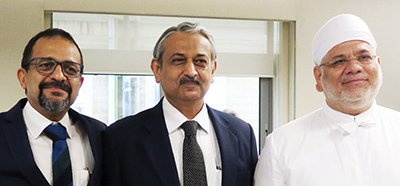
(Above, from left) Kicking off inputs to mobeds: Drs Kersi Chavda and Gustad Daver, Dastur Khurshed Dastoor
Photos: Jasmine D. Driver
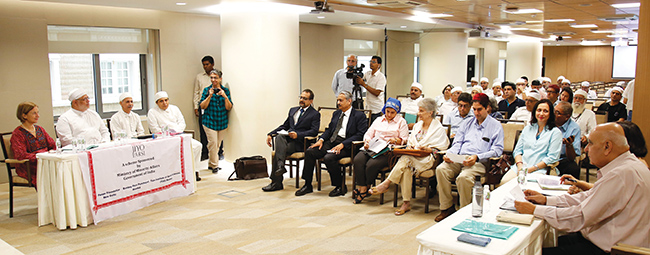
Audience (Photo: Rehan Daruwalla)
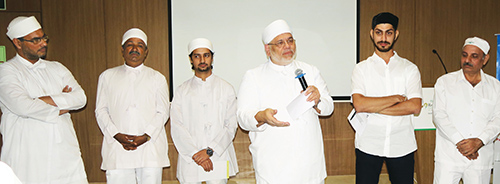
Above from far left: Ervads Kaizad Karkaria, Jimmy Panthaki, Jehan Darbari,
Dastur Khurshed Dastoor, Jamshed Sidhwa, Darayesh Katrak
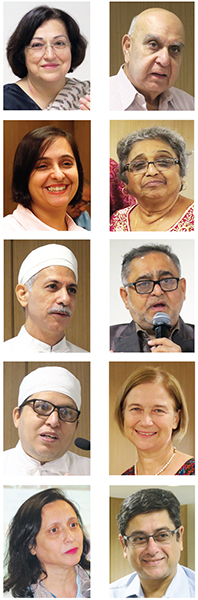
Clockwise from top left: Dr Shernaz Cama, Dinshaw Tamboly, Drs Katy Gandevia,
Yusuf Matcheswala and Almut Hintze, Farrokh Jijina, Binaifer Sahukar,
Ervads Hormuzd Dadachanji and (Dr) Ramiyar Karanjia, Pearl Mistry
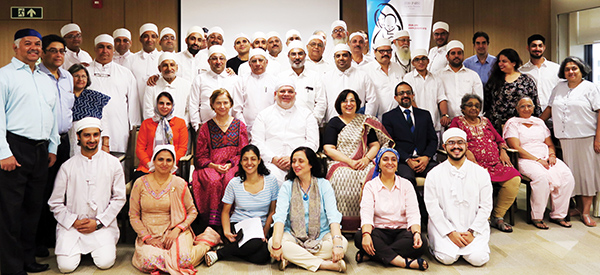
All smiles after the workshop
The government funded initiative Jiyo Parsi, to increase the community’s population through medical fertility assistance and advocacy since 2013, and implemented through the Parzor Foundation, the Bombay Parsi Punchayet (BPP) and Tata Institute of Social Sciences (TISS) now has an additional focus: "Health of the community.” Under this, Jiyo Parsi will provide assistance to senior citizens, childcare and crèche support, work out inter-generational support structures for communities and will include mechanisms for building leadership qualities among priests, according to a handout for the participants. The first workshop was held in May this year (see "Mentoring mobeds, Parsiana, June 7, 2017).
A prayer led by Ervad Kaizad Karkaria of Dadar’s Rustom Framna Agiary and a welcome by Dr Gustad Daver, dean of the Hospital, kicked off the morning. "Sessions such as these are important to tackle the stressors in society,” Daver said. In her welcome address, Dr Katy Gandevia, program coordinator from TISS, called the mobeds "friends” who would help spread the message of having larger families. "We also want to help instil leadership qualities in you,” she said.
Chairman of WZO (World Zoroastrian Organisation) Trust Funds Dinshaw Tamboly who chaired the morning’s proceedings reiterated the need to have "educated, enlightened and intelligent clergy.” Urging those present to have a positive frame of mind, he ended with a quote from verse 11, Yasna 30 of Ahunavad Gatha: "Those who have a negative frame of mind will not receive benefits, but those who have a positive mind will receive advantage,” acknowledging the assistance of Ervad (Dr) Ramiyar Karanjia of the Dadar Athornan Institute for identifying the appropriate words.
Referring to the "saféd taj (white crown)” worn by priests, in his talk "Learning never stops,” Karanjia reminded the mobeds that in the Fravardin Yasht, Zarathushtra calls himself a priest. "Should learning stop because of divergent viewpoints on any subject?” he asked rhetorically. Mobeds need to find out the truth for themselves, he said. "Be an athornan in the real sense of the term... tend to the behdin’s inner fires,” he urged. Speaking on "A young priest’s job perspective,” Ervad Hormuzd Dadachanji recommended "Gain knowledge before you can impart it.”
Dastur (Dr) Firoze Kotwal’s message in the tool-kit of the attendees read "More effort needs to be made to encourage athornan families to send their children to the madressa so that they may become the future yozdathragar mobeds of the community.”
Zartoshty Brothers Professor of Zoroastrianism at London University’s School of Oriental and African Studies (SOAS) Dr Almut Hintze provided a global view on the role of priests in preserving tradition. While explaining that "without priests, behdins lose their ability to interact with the deity,” though they can "approach Him directly,” she said that "shorter, lighter versions of the ‘inner rituals’ should be shunned... There is a lot of pressure on the shoulders of priestly families (to have their scions trained for the priesthood)... but there is a lot to be done.” She recalled the treatises written by scholar-priests like Dastur Jamaspji JamaspAsa and recommended that those present study his works.
Psychiatrist Dr Kersi Chavda, who practices at P. D. Hinduja National Hospital and Medical Research Centre and the Reliance Hospital, gave the mobeds his mantra for de-stressing. Setting aside some ‘me time’ for themselves and good time management were, according to him, the best ways to reduce self induced stress. Identification and conscious stoppage of negative thoughts were key to emotional well-being, according to the doctor. "Teach yourself positive affirmations,” he said. With a role play, Sahukar demonstrated how anger could be harnessed. "Don’t keep it with you. Let it out, gently, and after some me time,” she told the audience.
"Priests can play a key role in changing a community’s views,” Dr Yusuf Matcheswala, professor of psychiatry at Grant Medical College, Sir J. J. Group of Hospitals, and honorary psychiatrist and head of the psychiatry ward at Masina Hospital, said while moderating the talks of Chavda and Sahukar. He lauded the priests for their stressful jobs, particularly on important days (muktad). In the question and answer session that followed Chavda’s talk, Dastoor queried the psychiatrist about the problem of substance abuse among the community’s youth. "Take them to hospitals to show what can happen with over dependence on drugs,” was Chavda’s advice. Cama advocated the use of films as a medium to highlight the evils of drug abuse.
Inputs on "Listening skills” by Farrokh Jijina, erstwhile assistant director of The Samaritans Helpline that runs a telephone listening service, included some road blocks to active listening: a mindset that says "I know the answer always” or "a discussion is a competition;” a need to always impress; trying to be over helpful; instantly reacting to anything that annoys one; ignoring the body language of the speaker.
A group discussion on how Jiyo Parsi can help mobeds grow as community leaders, how to increase the happiness quotient among them and how to increase the community numbers by engaging the youth drew diverse responses. Make religious decisions binding on all in the community; make the profession more lucrative by removing the "daily wage” structure; provide training to mobeds in interpersonal skills. Some felt that mechanisms should be developed to draw more behdins to places of worship, possibly by inviting them to assist in cleaning fire temples, with others suggesting giving the Athornan Mandal more teeth.
Advocating more such programs in the future, Dastoor restated the need for more professionalism among the clergy. "If you want to be the chief executive officer of a company, won’t you push yourself very hard for that?” he questioned rhetorically.
BPP trustee Armaity Tirandaz, a member of Jiyo Parsi’s core committee was present for the workshop. A vote of thanks was proposed by counsellor Pearl Mistry.
◆ ◆ ◆
From the archive