
Cover Story
A reason to smile
For 50 years Dr Hirji Adenwalla’s medical missionary zest has eased the suffering of the poor and needy
Where his two-room cottage once stood, a mighty hospital edifice now dwarfs the spot. From performing the function of a physician, surgeon, orthopedician, anesthetist and gynecologist, Dr Hirji Adenwalla’s fame like that of the institution he serves has also grown exponentially. The winner of several international awards and a much sought after speaker, the young man who defied his father’s wishes 50 years ago and became a missionary doctor in Trichur, Kerala, has now become a medical legend.
In 2006 Adenwalla received the Joseph McCarthy Award instituted by Smile Train, a non-profit organization that funds free surgery for thousands of children as well as free training and education for over 15,000 surgeons and medical professionals. The citation noted Adenwalla had "demonstrated the highest ideals and noblest values in the medical profession and… made significant contribution to alleviate the suffering of disadvantaged children.”
The head of the Charles Pinto Centre for Cleft Lip, Palate and Craniofacial Anomalies, a member of the Smile Train Medical Advisory Board (South Asia) and past president of the Indian Society of Craniofacial Anomalies, Adenwalla, 79, has provided free cleft surgery to over 13,000 patients. "He is widely regarded as the father of cleft reconstructive surgery in India,” notes the Smile Train website, smiletrain.org
One of the most "distressing moments an obstetrician meets with in…the birth of a child (is) explaining to a mother that her child has the unfortunate deformity of a cleft lip, a cleft palate or both,” said Adenwalla addressing members of the International Women’s Organization (IWO) in Madras this June. Terming such deformities "most horrendous,” the surgeon noted they "can affect every function of the face except sight and even sight can be affected in an oro-ocular cleft.”
Speaking to Parsiana on June 26, 2009 at the Jubilee Mission Hospital (JMH) which he helped develop into the largest private hospital in Kerala, Adenwalla noted the reconstructive surgery starts with repairing a cleft lip when the baby is five to six months old, a cleft palate at the age of one, anterior rhinoplasty (correction of the associated cleft nose deformity) if required at five, a bone graft at seven if necessary, possible pharyngoplasty (speech correction operation) at eight to 10 years and an operation involving the bone structure of the face at 16. The treatment can involve the services of an obstetrician, a pediatrician, an ENT (ear, nose and throat) surgeon, a pedodontist (to care for the child’s teeth), a maxillo facial surgeon, an orthodontist and a speech therapist.
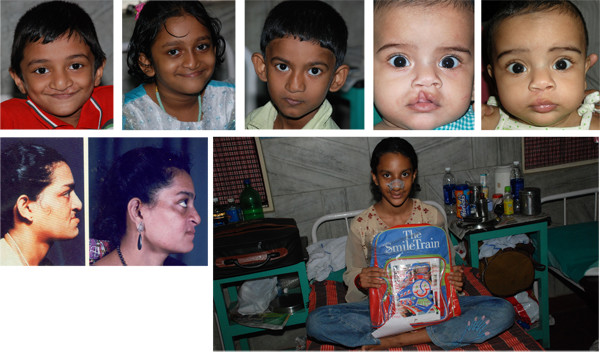
Normal appearance and functioning can be restored with corrective surgery
The commonest deformity of the face and the second most common congenital deformity (the first being a club foot), the cleft lip and palate has many variations. "Very often the tragedy does not end with just clefting. Many of these children have other concomitant congenital deformities; the commonest associated deformities are congenital heart defects,” Adenwalla told the IWO members.
"One in a thousand children born in this country manifests a cleft lip, a cleft palate or both. Forty thousand children are born in this country every year with this deformity. With the backlog of work and the badly done cases that need redoing the waiting cases would go into millions.
"The treatment for this deformity was neglected in this country till the turn of the century. Two things happened in tandem. The Indian Society of Cleft Lip, Palate and Craniofacial Anomalies came into being and Smile Train, an America based charity organization in partnership with centers of excellence in this country, started funding and supporting them with equipment and advanced training.
"Smile Train was founded by a Chinese American by the name of Charles Wang of Computer Associates and Brian Mullaney, grandson of the famous family that once owned The Gillett razor company. With them was George Bush senior, Collin Powell, former US Secretary of State, Candice Bergen, the lovely actress who played the journalist in Richard Attenborough’s Gandhi and several others. They originally belonged to an organization called Operation Smile who used to take American surgeons to third world countries and operate there. They had to carry with them all the equipment and infrastructure and house these surgeons in comfortable surroundings. All this was not cost-effective and at the end of it they could never finish the backlog of cases. Also, they left behind problems which the local doctors could not tackle. As time went, young inexperienced surgeons were recruited who were coming more for experience than for anything else and the problems they left behind doubled.
"It was then that Charles Wang at a meeting suggested that Operation Smile should find centers of excellence in India and fund them to do the work. Operation Smile would not accept his suggestion and so Charles Wang with the others broke away from Operation Smile to form Smile Train. The rest is history and culminated in the production of the Oscar winning documentary film Smile Pinky.
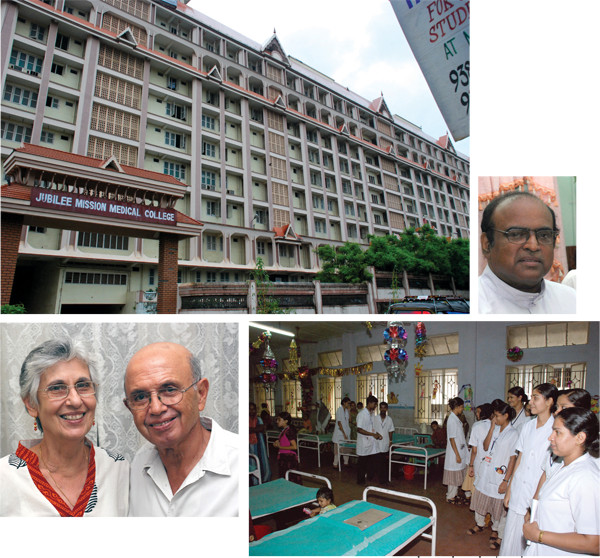
Top: The Jubilee Mission Medical College and Research Institute building is one of several such structures in the JMH complex; Alongside: Fr Dr Francis Alapatt ; Above: Gulnar and Hirji Adenwalla Alongside: The cleft ward for children
"As of today Smile Train has restituted to normal appearance and function over 4,00,000 children the world over. The total number repaired in India is over 1,50,000. There are 170 Smile Train centers in India with over 250 accredited surgeons. Smile Train first started in China in 1999 and in India in 2000. The entire funding for these programs however comes from donors in USA, UK and a couple of countries in Western Europe. I believe Smile Train India is actively working towards setting up a local company incorporated under Indian laws and hopefully in three-four months we will be in a position to accept Indian donations in rupees. The wonderful thing about this organization is that every penny donated goes for patient relief. The directors bear the expenses for the infrastructure.”
How does cleft surgery in India compare with overseas centers? we asked. Adenwalla smiled and asked his colleague Dr P. V. Narayanan, a plastic surgeon who trained in the UK to reply. "Most of it is on par,” replied Narayanan modestly. "In fact, surgeons from overseas often come to train at JMH.” Adenwalla added that initially the cleft surgeon’s skill is developed by performing a number of such operations and after a time, the numbers don’t make a difference.
The reasons for a child being born with a cleft lip or palate is mainly genetic. Malnutrition and other factors like certain drugs taken by the pregnant mother, viral infections in the first trimester and deficiency of folic acid play a part too.
"When a congenital deformity strikes the family, the whole family is devastated but the one who is most affected and who suffers the most is the mother,” Adenwalla told the IWO ladies. "In our social set-up with poverty on the one hand and ignorance on the other she is often blamed for having given birth to a deformed child, and time and time again we have seen that her husband deserts her or turns most uncaring. Crushed by these compounding calamities she does not know to whom to turn to for help; and often due to lack of money she is pushed from one commercial hospital to another and therefore I have always felt that those of us who have the good fortune and the means to take on the task of rehabilitating these families should do so with a big measure of love, care and compassion.”
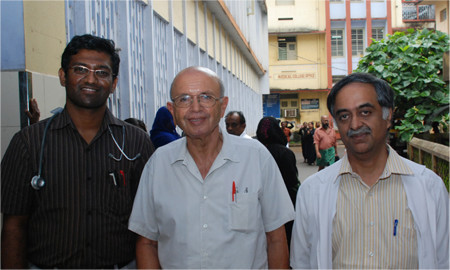
From left: surgeons Pushupathy, Hirji Adenwalla and P. V. Narayanan: saving faces
"He was happy”
It was this sense of compassion that drove Adenwalla, an only child, to disregard his father Dr Sorab’s wish that he become an honorary consultant. Originally from Ahmednagar, the Adenwalla family moved to Bombay for the sake of Hirji’s education. His father took up the post of assistant to the Principal Medical officer at the Jerbai Wadia Hospital for Children. "My love for cleft surgery came from there,” recalls Adenwalla. At first he was determined to go to Africa or Iran to work as a missionary doctor but his newlywed wife Gulnar happened to see an advertisement in a local paper for a qualified surgeon for a hospital in south India. Though he had not obtained a Master of Surgery (MS) degree at the time, Adenwalla applied and was called for an interview.
After a year or so he returned to Bombay on account of ill health and pursued his MS degree. But Monseig-neur Mathew Meringethery, the original stalwart behind the JMH who had initially interviewed and selected Adenwalla visited him in Bombay and persuaded him to return. Adenwalla asked for assurance from him that he would be able to treat deserving patients free of cost and the priest agreed.
Adenwalla’s father was upset at his son’s decision to return and would "not talk to me but a year later when he saw the work I was doing he was happy,” recalled the son.
To start with, the hospital had 20 beds, two patients and a few surgical instruments when Hirji and Gulnar arrived in Trichur (now named Thrissur). The two patients were en route to Vellore for surgery. Adenwalla tried to convince them to have the surgery performed at JMH but the duo refused admitting to one of the staff, "We could have stayed but the surgeon looks too young.” With a wry smile, Adenwalla added, "I wish somebody would say that about me today.”
"The conditions were primitive. There was no running water, no fans. We used to pull water from the well,” he recalls. Gulnar, "an unqualified anesthetist” would administer the anesthesia during the operations under Hirji’s guidance as he had trained in anesthesia. With no watchman, Adenwalla would "open the gates of the Hospital” in the mornings and shut them at night.
But with the help of a dedicated team of nurses, a compassionate priest and "above all a supporting wife,” the Hospital gradually transformed into a "large multispeciality hospital carrying along with it the founding principles of safe medicine and free care for the deserving.” There is no doubt that the glory days of missionary work "not only in Trichur but all over the subcontinent belonged to the 1970s and 80s,” says Adenwalla. It was during this period that he was "fortunate to have a dedicated and competent team of surgeons and anesthetists” such as Anil and Uma Desai from Bombay followed by Yezdi and Gool Mistry. The Mistrys joined the Hospital in 1974 and after 36 years will be returning this year to Bombay, he notes.
"Adenwalla’s loyalty, integrity and dedication guided the destiny of the Hospital…he has spared no efforts in clearing the path for its all round progress from the very primitive beginning,” noted the Director’s Tribute published in the JMH 25th anniversary souvenir.
The hospital was started to mark the 50th anniversary of the bishop of Trichur, Dr George Alapatt, with the principle that "Nobody should be turned away for want of money,” explains Fr Dr Francis Alapatt, the current director of the 1,300 bed hospital. "It’s the preferential option for the poor,” he noted. The "districts around Trichur are relatively backward districts. There were no good hospitals in the vicinity. Naturally people started coming here.” He observed while the Hospital which started as a small dispensary on December 17, 1952 was 56 years old, Adenwalla has been there for 50 of those years. Patients came and recalled that Adenwalla had operated on their grandparents, parents and their children. "We are like a family hospital. People feel secure,” remarked Alapatt.
While JMH does not receive funds from abroad, Adenwalla mentioned he received aid from Holland for cleft surgeries. The JMH has a free food center which provides nourishment to 250 patients daily and in the children’s department 150 are provided eggs and milk. "The Hospital has the best burns unit in the south,” which was started by Adenwalla under the guidance of Dr Manohar Keswani, the priest observed. "We are also the center of blood donation activity in the south.”
Did they receive government assistance, we asked? "Not even a penny,” replied Alapatt. Instead, they were burdened with "a lot of inconvenience and harassment.” They were taxed as a commercial establishment, he lamented. The Hospital has a Medical College and has six batches of 100 students each.
"Proud Parsis”
"Though there are no community fixtures in the town like an agiary or aramgah, and despite the absence of a Zoroastrian community, the Adenwallas have spontaneously sustained the concept of good thoughts, words and deeds. Concern for others has landed them with numerous house guests as for example the traveling medical rep whom Hirji recognized as a Parsi and invited home to stay. Gulnar recalls with a laugh how the gentleman took up the offer and made himself comfortable in their (former) tiny two-room residence, treating it as his headquarters while he toured the south! A penchant for tongue-in-cheek humor and repartee sometimes spills over into harmless practical jokes, and an atmosphere of gentle banter pervades the house,” noted Parsiana managing editor Arnavaz Mama writing about "Trichur’s Parsi Mission(aries)” in the June 1994 issue.
"We were a very liberal family, very proud to be Parsis. My father used to go to the agiary but we were not devoutly religious. We had no taboos… I didn’t learn much about religion,” he confesses but notes the family "are followers of Meher Baba.” The teachings of Meher Baba encompass "a broad concept of love and care for all.”
"The Adenwallas always consider Ahmednagar their hometown. Quiet faith in Meher Baba’s teachings eventually grew to envelope the whole family, though there are no outer manifestations except his photographs and books,” wrote Mama.
The family consists three children and five grandchildren. Homai, the eldest, a doctor is married to Kumar. Firdaus, a physician working in the UK, is married to Jyothi, an ophthalmologist, and Meher, the youngest, is in Singapore, married to Thomas.
Adenwalla referred to the guidance and counseling that outstanding surgeons like Dr Rustom Cooper, pioneer plastic surgeon Dr Charles Pinto, doyen of orthopedic surgery Dr Rustom Katrak, and the man who pioneered pediatric surgery in India, Dr Rustom Irani had so spontaneously and generously bestowed on their juniors.
Adenwalla regretted the commercialization of medicine and that has become a money making proposition today. A view echoed by another noted plastic surgeon, the late Dr Noshir Antia’s in his The Autobiography of a Doctor: "Five-star hospitals with their marble facades and array of sophisticated equipments, provide the ‘latest’ and the most expensive service. It has increased costs astronomically but with hardly any increase in efficiency or effectiveness. At the same time, basic and appropriate surgery is out of the reach of 90 per cent of our population.”
"What’s happened to our young people (today)? They’ve lost their sense of adventure,” bemoaned Adenwalla. Perhaps a bit of the drive that drove his great-grand uncle, Cowasjee Dinshaw and his great grandfather Pestonji Dinshaw to Aden to seek their fortune needs to be once again injected in the community.
◆ ◆ ◆
One reader wrote
A living legend, the likes of him deserve the Noble Prize
From the archive