
Religion
“Path of the Prophet”
Scholar Daniel Sheffield is researching how Zoroastrianism and its followers have adapted to many challenges from the earliest times to the modern era
Did the persecution of Zoroastrians occur more under the Arab conquerors or under the Mongols? Was Genghis Khan a Muslim? What language did the Parsis speak in India before Gujarati came into existence? In which city is the third largest collection of Zoroastrian manuscripts kept? Did the Pahlavi language evolve from Avestan?
These and other questions arose during an interview on June 3, 2009 at the K. R. Cama Oriental Institute (KRCOI) with Daniel J. Sheffield, a PhD candidate in Iranian and Persian studies in the Department of Near Eastern Languages and Civilizations at Harvard University.
The 26-year-old Kentucky resident had spent the past few months in India largely studying ancient manuscripts mainly at the First Dastoor Meherjirana Library in Navsari and the KRCOI in Bombay.
"The Cama has an incredible amount of manuscripts. It’s the single largest collection in the world. The Meherjirana is the second,” notes the scholar whose knowledge of 12 ancient languages and eight modern ones makes him amply qualified to undertake such a study.

Daniel J. Sheffield: "A wealth of sources”
The third largest collection of Zoroastrian manuscripts in the world is at the Bibliothèque Nationale de France in Paris — the manuscripts there were brought from India by Abraham Hyacinthe Anquetil Duperron and James Darmesteter. The third largest collection open to the public in India is probably that of the Bombay University Library, followed by the Bhandarkar Institute in Poona and the Khudabakhsh Library in Patna. There are also private collections in India such as the Mirza Institute in Udvada and collections of individual agiaries which are probably larger than the collection at Bombay University, notes the scholar.
Abroad, Munich is home to more than 100 Avesta, Pahlavi and Persian manuscripts picked up in the mid 1800s by the German scholar Martin Haug who held the chair of Sanskrit studies at Poona. Copenhagen has "the best Pahlavi and Avesta manuscripts,” says the Fulbright-Hays Doctoral Dissertation Research Abroad fellowship recipient.
Sheffield’s research focus is titled "In the Path of the Prophet: Sacred Narratives of Zarathushtra in Medieval and Early Modern Zoroastrianism.” His interest is in "how (Zoroastrianism) changes along with changes in the community.”
The religion and its followers underwent modification after the spread of Islam to Iran, the settlement in India, under colonialism and finally with the new diaspora (migration to the West and elsewhere).
Under Islam, one finds references indicating that the Zoroastrians attempted to emphasize similarities between their prophet and Abraham, the "old Testament patriarch regarded by the Jews as the founder of the Hebrew people through his son Isaac and by Muslims as the founder of the Arab peoples through his son Ishmael (Webster’s Dictionary).”
The mythical parallels drawn between the two showed that both were "born in times of evil kings”; Abraham’s father was an idol-carver, Zoroaster’s a magician. Both helped defeat kings, both were thrown into fires, both escaped. According to the Quran, Abraham was one of five prophets sent with a revealed message from God, while Zoroaster (according to 13th century texts) was handed a physical book (the Zend-Avesta) by Ahura Mazda which he subsequently hurled at demons killing them, states Sheffield.
The tale was to show that Zoroastrianism was a religion of the book and thereby escape persecution by the Muslims. Though Zoroastrianism is not listed explicitly in the Quran as a religion of the book, by identifying themselves with Abraham, the Zoroastrians were considered to be so by later Muslim jurists.
But the harsh persecution and forced conversions of Zoroastrians in Iran did not take place so much under the Arab conquerors, states Sheffield. As non-Muslims had to pay more taxes, the incentives to convert them were marginal. As people migrated to the cities, agricultural tax revenue dropped and taxes on trade were invoked. It was under the Mongols led by Genghis Khan that the pressure was turned up. Though Khan himself was not a Muslim — he desecrated many mosques — his sons followed Islam. Under the Mongols "the network for Zoroastrians became less and less” and they were finally concentrated in the towns of Yazd and Kerman, says the scholar.
It was during the post-Mongol period largely under the Safavid dynasty that Iranian Islam developed its Shia characteristics as versus Sunni, notes Sheffield. After the Mongols, various Turkic invasions took place but by then Zoroastrianism was of little consequence to Iran. Its story began to unfold in India.
Odyssey
The "first hard evidence” of the Zoroastrian presence in Western India are Pahlavi inscriptions from the year 1009 in the Kanheri caves near Borivali, basically graffiti scribbled probably by some Zoroastrian traders who had stopped to rest in the shade of the caves (copper plates with Zoroastrian names from Kerala have also been found dating to the late 9th), says Sheffield.
The "first real narrative text” about the arrival of the Parsis in India from Iran is the Qissa-i-Sanjan, an oral tradition committed to writing by Dastur Bahman Kaikobad Sanjana in 1599. The veracity of the contents is questionable.
Whether the Parsis came as traders or pilgrims fleeing religious persecution is not known, but "trading colonies in India during the Sasanian dynasty” existed, says Sheffield. "They may have (migrated to) where the trading colonies existed,” he speculates.
In India, Zoroastrians were drawn to mysticism in the late 1500s. Azar Kayvan, a mystic from Iran who followed a school of Islamic Sufism with Zoroastrian traditions, came to Patna. One of the central texts of this school of thought was the Dasatir, first published in 1818 which espoused a philosophic Zoroastrianism. Patna was a center for learning at the time and Kayvan may have been attracted to the mystical teachings there, states Sheffield. A "religious plurist” Kayvan was also interested in Hinduism.
His followers wrote books, mostly in Persian, which were translated into Gujarati and viewed as late as the mid-19th century as mainstream Zoroastrian literature. By switching certain letters they invented a new "made-up (cipher) language” to compose the Dasatir, drawing upon Persian, Sanskrit and Pahlavi vocabulary.
They reinterpreted the ancient history of Iran showing kings to be philosophers and drew upon the Illuminationist movement, a school of Sufism deriving from the Muslim philosopher al-Suhrawardi that demonstrated how to obtain knowledge of God spiritually. Though the British Orientalist Sir William Jones believed the texts of this school to represent the authentic teachings of Zarathushtra, the texts were shown to be late compositions in the early 19th century, and by the mid 1800s they were "expunged from the mainstream of Zoroastrianism,” says Sheffield.
The Parsis "learned Indian languages quickly,” commented Sheffield. The Parsis most likely learned a dialect of Prakrit shortly after arriving in Western India, from which modern Gujarati began to come into its own in the 17th and 18th century. "Languages undergo sound changes over time… for instance, vowels at the ends of words may be dropped, grammar may be reconfigured. It’s a complex process.”
The ancient Indian language was Sanskrit, the oldest recorded phase of which is represented in the dialect of the Vedas. In the middle Indic period the Prakrit languages emerged to be followed in the modern Indic period by Hindi, Gujarati, Marathi, etc.
"There was a variety of languages in Iran” in ancient times, observes Sheffield. Contrary to popular belief, Pahlavi did not descend from Avesta. Avesta was presumably spoken in the eastern part of the Iranian world, Pahlavi in the west. Pahlavi evolved from a dialect closely related to Old Persian, the language of the inscriptions of the Achaemenid Empire of Darius and Xerxes.
One of the earliest Parsi Gujarati poets was Mobed Rustam Peshotan Hamjiar from Surat, who composed a number of poems in the late 17th century. His Gujarati Zarathushtnamu taking a cue from Hindu writers starts with praise of the Goddess Saraswati. Earlier Zoroastrian writers, influenced by Islam who started their texts with praises of Allah and Mohammad, also began their works with praise of Ahura Mazda and Zoroaster.
Colonial encounter
Medieval Persian and Gujarati Zoroastrian texts stressed the importance of miracles in Zoroaster’s life rather than his philosophy. Though the miracles of Christ and Muhammad also played important roles in Christian and Islamic theology, respectively, by the 19th century European scholars began to question the role of prophetic miracles. The Rev John Wilson ridiculed the community for this approach. Men like K. R. Cama went to the west to learn about Zoroastrian thought to be able to counter Wilson.
Haug was the first person to talk of Zoroastrian philosophy as deriving from the Gathas. He differentiated the Gathas from the rest of the Avesta and observed that "only the Gathas were written by Zoroaster.” This line of thinking had "incredible influence on the Parsi community… by the mid 19th century learned Parsis were using the same line as Haug. The community took to the western type of philosophy.” While Wilson viewed Zoroastrianism as dualistic, as it was in the Sasanian period, Haug noted Zoroaster himself had preached monotheism.
The son of a Bavarian peasant, Haug struggled through his early life and was self taught. He was exposed to the historic Jesus debate prevalent at the time which evolved round whether Christ should be recognized for the miracles he performed or his philosophy.
There was a move to separate fact from fiction. When Haug expressed interest in the subject, his mother worried he may turn into another David Friedrich Strauss, the German scholar who advocated the position that the legends about the miracles of Jesus should be separated from the historical figure. "He did turn into another Strauss, not for Christianity but Zoroastrianism,” observed Sheffield.
Haug was "a rather nasty person” engaged in a bitter feud with Friedrich Spiegel, the first person to translate the Avesta into German on the basis of the text itself. The rivalry between the two formed the basis for a talk Sheffield gave at the KRCOI on February 20, 2009, "The beginning of Iranian philology in Europe and India: The quest for the historical Zarathushtra.”
Spiegel, born to a wealthy father, was more interested in the mythical aspect of Zoroastrianism, something common during the romantic period of German thought. Haug on the other hand was a rationalist. Spiegel’s German translation was translated into English by Arthur Henry Bleeck who was commissioned to do so by M. F. Cama, K. R. Cama’s cousin.
The enmity between Haug and Spiegel spilled out into the public domain with K. R. Cama and Dastur Hoshang Jamasp taking opposing sides. "There was a lot of name calling,” says Sheffield. Haug left India "for health reasons” and died young.
"Spiegel lived for a very long time (but) his works were never influential. His work died with him,” says Sheffield.
Both Haug’s and Spiegel’s translations held sway till James Darmesteter’s translation of the Avesta and Lawrence Mills translation of the Gathas appeared in the Sacred Books of the East edited by the German scholar Friedrich Max Muller.
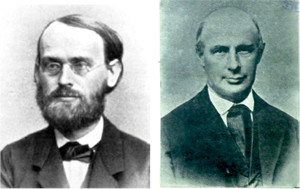
Martin Haug and Friedrich Spiegel: pioneering scholars of Zoroastrianism
Scholarly interest
The late 1800s was a golden period of Zoroastrian scholarship, replies Sheffield when asked to state a date. There were many Parsi and western scholars. "Today there are few Parsi scholars, (and) many western scholars, who are concerned only with ancient languages and texts, don’t know what is happening (to the community and the religion) in India. However, things are changing in Zoroastrian studies. Philologists, linguists have been more interested in ancient languages, but are now realizing that the connection between ancient and modern texts is more complex than previously assumed. Scholars are getting interested in later texts.”
Sheffield’s own interest in Zoroastrian studies germinated when he was a Harvard University undergraduate archeology student digging in some Romanian ruins. He came across Persian empire artifacts namely, pot shards. His interest was further fuelled by reading Gore Vidal’s Creation, a novel about Zoroastrianism centered around a mythical nephew of the prophet. In his second year Sheffield studied old and modern Persian and other languages. He also came across Parsi students such as Yuhan Vevaina. "There is a wealth of sources,” says Sheffield. "It’s a fruitful field for researchers.”
As to the date of Zoroaster, Sheffield states that if we assume the prophet composed the Gathas then linguistically one would place the date between 1500 to 1200 BC. But there is a scholastic debate over whether the right kind of evidence exists to examine Zarathushtra as an historical figure or not.
One school of thought led by scholars such as the late Mary Boyce and Italian Gherardo Gnoli believe he was "a historic figure” and one can "obtain historic facts from the Gathas.” In the Gathas the narrator speaks in the first person and it is assumed he is Zoroaster. But scholars like Sheffield’s advisor Oktor Skjærvø view the Gathas as "ritual texts” which cannot be used as historic data. Zoroaster’s existence would then be an assumption.
What about the Greek writers who refer to Zoroaster? "Zoroaster lived before the Greek historians. They reported stories they heard,” says Sheffield. There is wide divergence in the date of Zoroaster according to the Greeks, ranging from 6000 to 600 BC.
But for Sheffield the argument is academic. What is important is "who is Zoroaster for the Parsi community, (rather than) who he was not. What role does he play in people’s lives? (People) search for the historic Zoroaster and lose track of what Parsis believe in.”
After completing his PhD around June 2011 Sheffield will have to look for openings in departments of Near Eastern Languages and Civilizations. "These are few and far between in the States,” he notes. Alternatively he could seek appointment in the religious studies or language departments. Zoroastrianism, though "a growing field,” had been absent from the American academic field "for a long time” till Prof Jamsheed Choksy came along. Choksy is a professor in the department of Central Eurasian Studies and adjunct professor in the department of Religious Studies at Indiana University. There is no Zoroastrian panel on the American Academy of Religion, the largest body of religious studies in the United States, says Sheffield. "We have to make our presence felt.”
A raised Lutheran, Sheffield describes himself as "a spiritual person, not religious.” His mother is a retired professor of mathematics education at North Kentucky University and his father a businessman.
In contemporary India he believes the Parsis/Iranis "must find a modern voice. Embrace modern times… Zoroastrianism is really unique. It reacted in different times (with) different forms of expression.”
From an imperial religion (in Sasanian times) to a minority religion in Iran, to a diasporic religion in India, adjusting to colonialism, then the modern global diaspora, Zoroastrianism has adjusted to all the changes.
As for the future and the declining population? "Zoroastrians have adapted to so many challenges,” notes Sheffield. "They’ll adapt to this as well.”
◆ ◆ ◆
From the archive