
Seminar
“A journey of discovery: I”
A two day PARZOR seminar acquaints the community with the most recent research findings on Parsis/Iranis in India
"No community can go on age old studies. You need constant elevation with new methods…What is the position of the family in this urbanized community with 98 percent literacy? How is the assertion of individualism impacting the family? What is the physical and psychological status of your senior citizens?”
Tirlochan Singh, former chairman of the Government of India’s National Commission for Minorities (NCM) who has taken over as president of the Parsi Zoroastrian (Parzor) Foundation after the demise of Lt Gen Adi Sethna, gave a brief insight into the program ahead at Bombay’s Y. B. Chavan Centre on December 13 and 14, 2008.
The research by social scientists and medical professionals into the current status of the Parsi community and the reasons behind it, was an intellectual orgy of arguments and statistics. The baseline however was the shrinking size of the community. And apart from the usual advice like early marriages, larger families, greater subsidies, etc, generously given by the generation that has done the opposite, there was no real plan of action. The youth who are expected to shoulder the burden of undoing the mistakes of their elders and revert to a more simplistic lifestyle, were notably absent.
Guest of honor Mohammad Shafi Qureshi, the current chairman of the NCM, spoke about the NCM’s concerns for the depleting community and noted that it was working with the state governments to restore Parsi property to the community in the 12 areas where anjumans are defunct. He referred to the collapse of the vulture population, so essential a part of the dakhmenashini system, noting that NCM member Dr Mehroo Bengalee’s letter to the Prime Minister’s office had resulted in the ban on diclofenac for veterinary use. The drug had been identified as the cause of the death of vultures. Qureshi spoke of the need to relax admission norms for Parsi students in government colleges and stated that the NCM had interceded with the Gujarat government on this issue.
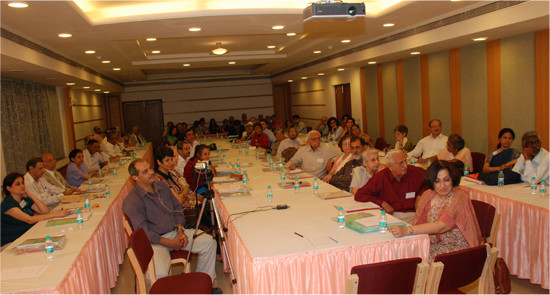
The seminar in session: day one
Former chairperson of the University Grants Commission and Parzor director Dr Armaity Desai, in her introductory speech referred to the predicaments of progress (where increasing affluence leads to lifestyle changes in favor of comfort and pleasure as against a sustained work ethic) and the inverted demographic pyramid which signifies a small child population and a large number of elderly. "We have no child labor and a small number in the working age group, no figures on unemployment or underemployment.” She recalled how the research projects had started with a discussion in 2001 and the help and commitment of Russi Lala of the Sir Dorab Tata Trust and Minoo Shroff who was then chairman of the Bombay Parsi Punchayet (BPP). The two institutions had donated Rs 55 lakhs and Rs 18 lakhs respectively to the project, she noted in her vote of thanks.
Parzor had been established with a small grant from UNESCO and has been examining all facets regarding the Parsi Zoroastrian community in India since 1999. It had begun with documenting research in community culture, as noted its director Dr Shernaz Cama. "It is for the first time in UNESCO history that a community has been studied in such close detail from the cellular to the clinical level medically and through studies of the family, the aged and the youth,” stated Cama, adding, "This is only because the Parsis are very small in number and yet show a wide range of socioeconomic and educational standards, carry within themselves medical paradoxes such as longevity with a great deal of infertility, large range of cancers, neurological disorders, genetic deficiencies, etc.”
Familial/Marital study
"Many see marriage as incompatible with other issues. Saying ‘no’ to marriage is facilitated by social acceptance (of the single life). Bombay youth have a preference for live-in relationships.”
Prof (Dr) Shalini Bharat, professor in the School of Health Systems Studies at the Tata Institute of Social Sciences, noted as she presented a summary of her findings on the first day of the seminar. Her qualitative study of the familial/marital and socio-psychological dimensions to ascertain the causes that dog the community’s demographic decline, has been based on 35 informant interviews and 143 in-depth interviews in key locations where Parsis live. The informants were selected from baugs and non-baug areas of Bombay, in Baroda and rural Gujarat ranging in age from 18 to 75 years, including couples as well as unattached individuals. Assured of confidentiality, the interviews proceeded only after the participants’ informed oral consent, stated Bharat. The data was then analyzed under eight broad heads. "Bringing together the voices of average Parsis was a journey of discovery for us,” Bharat told the gathering.
In contrast to the tremendous pride in being a Parsi, Bharat found that the community though very grateful to Indian society for its openness and acceptance, has an undercurrent of frustration, "that nobody speaks for them or fights on their behalf.” Battling the enormous competition for a few unreserved seats in educational institutions – often unsuccessfully – has bred frustration. There is also resentment at being the butt of jokes in Bollywood presentations and on TV.
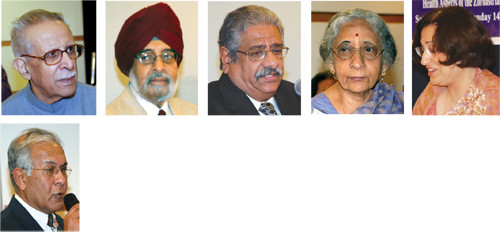
From left: Mohammad Shafi Qureshi, Trilochan Singh, Dinshaw Mehta, Dr Armaity Desai, and Dr Shernaz Cama. Alongside: Wajahat Habibulla
Bharat noted that the self-perception of the community was caste-based with closed cultural practices.
"That the community which appears to be so homogenous is stratified, was a discovery for us,” noted Bharat who found it living in three camps: the traditionalists, the liberals and those who are indifferent. They differ in their response to the various issues that face the community, there is discord even on the issue that the community is shrinking, with the orthodox camp arguing that "quality is more important than quantity.”
"It is a paradox that a community known to be gender fair has a bias,” said Bharat referring to the tension of women who marry out of the community. "There is a general feeling among the intermarried Parsis that the negative and non-supportive attitude of the community is basically to preserve Parsi wealth from going out and gender is used as an instrument to uphold and justify the economic interests of the community.”
From left: Dr. Shalani Bharat and Dr T. S. Saraswathi
"The community’s tolerance towards men marrying out is a source of great heartburn to women and a proof of its patriarchal double standards… Many parents eventually (accept) the women married out. But the communal aspect is a source of great angst…They shared their experiences of being denied the right to enter the agiary, the right to see the face of their dead parents, perform the initiation ceremony of their children or benefit from the various charities and housing schemes,” notes her report. Most intermarried Parsi women however reported satisfaction with their marriage and the matrimonial home and continue to practice their religion, states the report.
This emphasis on intra-communal marriage has other implications. Women who do not find their mate and are too intimidated to find a spouse outside the community face frustration, despair, anxiety and loneliness. This psychological dimension is not adequately recognized by the community, states the report.
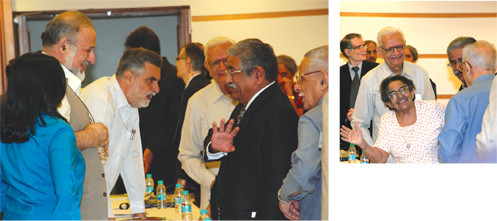
Above: Dr Mehroo Bengalee, Dr R. K. Bhathena and Dr J.V Undevia (behind); left: BPP Trustees Khojeste Mistree, Rustom Tirandaz in conversation with Undevia, Mehta and Qureshi
Marriage and fertility being important links in the demography debate, the attitude towards marriage was a revealing part of the data. Regarded as important but not a must, the attitude is to defer the event in the interests of economic and career stability, housing and space issues especially among the 25 to 30 year age bracket. With the question of maintaining their parents often on their mind, marriage they feel, "may not be a change for the better.” Marital discord within one’s family or social circle seems to discourage some youths while happy marriages seem to have a positive influence on the decision to marry.
With the boys marrying outside the community not provoking adverse reactions, the pool of eligible men is seen to deplete. "Those still to be married feel they have to contend with the ‘residue’ as one young female said, and staying single is preferred to marrying someone from the ‘residue.’” Disinterest in marriage could be a way of rationalizing the inability to get married, but it could also be a thin and veiled attempt at escaping the realities of married life, states Bharat. Cousin marriages, once so popular, have lost ground because of the knowledge of genetic defects they breed and the girls have accepted the Hindu custom of raksha bandhan, tying a rakhi on their cousins that eliminates ideas of marriage and promotes brotherhood.
While male expectations from marriage as per Bharat were trust, a loving, caring, nurturing nature, with good looks as desirable, female expectations of the attractive spouse were numerous and included good educational qualifications, a ‘decent’ income and financial security, a high standard of living, ownership accommodation, as well as compatibility, unorthodox views, intelligence, understanding, a trusting, encouraging, sensitive nature apart from being smart and good looking. "A great deal of dissatisfaction” came to the fore when the participants were asked for their views of the opposite sex. The boys were said to be lagging behind in education, job profiles, earning capacity, entrepreneurial and social skills. The girls were perceived as too demanding, aggressive, choosy … "Men from semi-rural areas had a particularly negative perception of the girls in their community,” states the report. And there are those Parsi youths, mainly in Bombay, who consider marriage to be an ‘obsolete’ instititution, "something that is rigid and binding and holds no charm. The option of live-in relationships is more appealing to them for it will not restrict their freedom.”
The attitude of most parents is that the youth will find their own partners. They prefer not to interfere as they do not want to be blamed if anything goes wrong. This shores up the general feeling of the youth, "it’s my life, my decision.”
Not all respondents felt that children were central to their existence or essential in marriage. There were those who felt that parenting children in the extended family could be as satisfying as having one’s own and lack of social stigma has supported childlessness, as notes Bharat. Even those who do have children opt for only one saying, "It’s an intelligent decision” to have one child, the motive being to provide the best for the child.
The BPP’s scheme to provide (Rs 1,000 per month) for the third child has only a few takers from the lower income group. Others believe that having a child is a lifelong responsibility and you cannot raise it on community charity. They do not accept that community issues can be solved by burdening individuals. Also, the national concept of the small family as a happy family appeals to them.
Bharat found that while the baugs helped to encourage marriage within the community to some extent, she has observed the walled living areas as a sign of the community’s sense of insecurity in a fiercely commercial and competitive environment. "The ghettoization of the community is …making it increasingly inward looking…A few non-baug respondents reported people in baugs are reluctant to marry those living outside the baugs.” She also noticed the development of the perception that baug housing and Parsi charities are creating high levels of dependency, among the youth and males in particular.
A general dissatisfaction with the community’s leadership is pervasive. Inadequate representation at the state and national levels, mismanaged charities and benefit schemes, misplaced philanthropy that elevates the building of agiaries over the housing need of the poor were some of the areas of discontent.
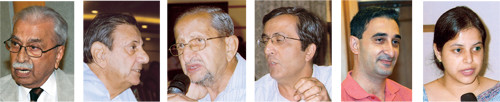
From left: Dr Noshir Wadia, Jam-sheed Kanga, Aspi Moddie, Tehmasp Bharucha, Adil Nargolwala and Dr Kainaz Dotiwala
Suggested action
Bharat’s report recommends an increase in child care services as well as the organization of trained domestic staff in child care and house management and concerted marketing of the two-child concept as "good for the community but better for you.” Greater advocacy, more advertising of the infertility treatment provided by Dr Anahita Pundole is also recommended. Support structures for the elderly would free their progeny to start their own families, argues Bharat.
Global networking to increase the pool of available mates would increase the odds in favor of marriage within the community, she feels. Simultaneously people need to be better informed about the provisions of the Special Marriage Act which allows the parties to the marriage to maintain their own religion and its practices so that there is less fear of losing one’s privileges on finding a partner from another community. This she feels is a task that the Association of Inter-Married Zoroastrians could undertake. It could help mitigate the loneliness and despair for want of companionship among many unmarried men and women.
Special efforts and scholarship schemes to encourage boys to pursue professional degrees and careers, special loans for entrepreneurship are Bharat’s suggestions to improve the cross-sex perceptions. Among the alternate solutions to housing colonies she suggests that the Punchayet lobby for the release of community housing from the overview of the rent act; provide the community loans for the purchase of housing at nominal interest, perhaps stand surety for loans from commercial banks.
Seeking reservation for the community in educational institutes founded by Parsis at all levels from the kindergarten up, as well as representation in the Rajya Sabha – once offered to the community and not considered necessary then – be actively sought. It would help to safeguard community interests through democratic means, she says.
It would also help to create greater transparency in the management and utilization of charities and trust funds as it would generate greater community confidence. Lessons from international best practices in the administration of such funds and/or the induction of non-Parsis at the decision making level are other suggestions. Better media communication so that the history, philosophy and contribution of Parsis to the country is better known in all parts of India would boost hope and optimism and help find other creative solutions to the community’s problems.
"The Parsi community is facing an exceptional and unique problem. It therefore requires an exceptional and unique solution. But the solutions must be found and actions mounted urgently; not at some point of time in the future. A problem of this scale requires a scaled up effort and response from all of us,” concluded Bharat.
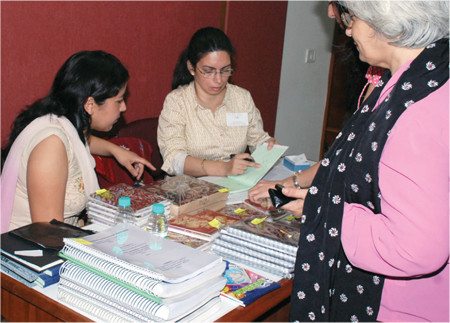
At the registration desk: Perin Pandey (center)
Ensuing discusssion
In the discussion chaired by Prof T. S. Saraswathi, Jamsheed Kanga wondered if the antipathy to mixed marriage was based on the fear that the non-Parsi spouse would bring in other non-Parsi family members. This was the argument mobeds used in their fight against mixed marriages, he said. Bharat said such comments had been made but not by the majority. The non-Parsi wife was often more worried about what would happen to her and her children.
Neurologist Dr Noshir Wadia noted that there had been no reference to sex. "Is there a reduced sexual drive (among Parsis) which makes them comfortable with living alone?”
Bharat conceded that though they had not approached the topic of sexuality directly, "some women did talk of ‘men not being men enough.’ They cited men in other communities as more attractive. We also found hints of homosexuality.”
Tehmasp Bharucha, trustee of the Poona Parsee Panchayat (PPP) wanted to know if the participants were in favor of nuclear or joint families. Bharat said most were living in nuclear families and though they appreciated the positive aspects of joint families, young people preferred nuclear families because it gave them the privacy and space — mental and physical — that they desired. Bharat reiterated the growing mental health problems in the community because of loneliness and want of companionship, especially in rural Gujarat, after the parents die.
Aspi Moddie felt the study should have covered attitudinal changes over time and with the Parsi diasporas in the West. "Which communities are happiest, which least so?” Bharat countered that such studies come after at least two decades while what they were presenting was a recent all-India coverage.
Sociologist Roxan Vakharia acknowledged the privacy and confidentiality maintained by the non-Parsi researchers but felt that Parsi researchers would have probed deeper. "We found that Parsis are not willing to speak to Parsis. I got to know many facets only because I am not a Parsi,” replied Bharat.
Cama noted that the Delhi community refused to speak to Parsis. Bharat explained that in a small community the need for anonymity is very great as it is easy to identify people.
"Is there a hidden message of breakdown of family values? If so, future generations will have more problems,” noted psychiatrist Dr Kainaz Dotiwala from Ranchi. "Is it costly and bothersome to raise children? Is the need to look after parents becoming a burden?” Bharat couldn’t say. But "economic dimensions are weighing on people’s minds. Parsipanu is being lost,” she conceded.
"Is it not a reflection of what is happening in the larger community?” wondered Prof Saraswati, Bharat’s mentor and a former student of Dr Armaity Desai who chaired the discussion.
"Do these seminars influence leaders of the community to play constructive roles? Or do fears of brickbats keep them bound?” asked Delhi Parsi Anjuman (DPA) trustee Adil Nargolwala but no one hazarded an answer.
To be continued
◆ ◆ ◆
From the archive