
Comment
“Alexander gajastak — the accursed”
Despite his invasion of Persia and cruelty to its people, it is shocking and surprising that some poets and historians in Iran laud the Macedonian conqueror
Alexander tops the list of nationalist heroes in history about whom exaggerated reports have been written in order to aggrandize them. Although he was a Macedonian, one can understand why the neighboring Greeks were proud of him, for he brought them into prominence. We can even accept with a smile the fact that the Europeans, especially the English, Dutch, French, Portuguese and Spanish colonialists and imperialists, lacking in any brilliant history of their own and relying on Greece and Rome to be proud of their so-called "European” past, should portray Alexander as first the "European” conqueror of Asia and Africa.
One can even forgive the Arabs and the Afro-Asian peoples who praise Alexander for his accomplishments, because they harbor bias against the Iranians. But when one sees Iranian historians and poets praising Alexander, one is surprised and shocked. How could a person recorded in Pahlavi literature as "Alexander gajastak — the accursed,” suddenly turn into a brave, admirable, even a saintly person? Are they blindly following the European trends? Let us look at Alexander’s life, which is rife with rumors and reports.
The Achemenians, though Indo-Iranian by race and broad-minded Zoroastrian by religion, modelled their grand court on the Elamite and Babylonian pattern. The Elamites and Babylonians had large courts with counselors, warriors, opportunists, flatterers, queens, eunuchs and other servants. This resulted in disorder. There was infighting among courtiers. Queens of different tribes and cultures, each supported by her eunuch guardian, feuded with the others to remain close to the King-of-Kings.
The rivalry between the royal consorts gave rise to increasing power for the eunuchs who enjoyed a special status with their queens. The queens’ rivalry were not for the royal favors alone; each wanted her own son to succeed the king. Fratricidal murders started from the time of Artaxerxes II. Bagvas became the king-maker by poisoning members of the royal family, before he himself was poisoned by Darius III whom he had installed as his next stooge.
Meanwhile, the royal court grew more corrupt. This affected the army, with the loyal guardians of the King-of-Kings being slowly replaced by Greek mercenaries during Artaxerxes II’s reign (424-404 BCE). Aware of the growing weakness of the fighting force, many satrapies, especially those on the border, became rebellious, adding to the mounting problems that were causing the collapse of the now 220-year-old structure.
It was at this time that Philip II, who had pushed aside his nephew to become the King of Macedonia, conquered Greece. In 335 BCE, Philip was murdered while preparing to invade the Greek territories in the Persian confederation. His 20-year-old son, Alexander, came to the throne.
Alexander or Alexandros III, son of Philip II and Princess Olympia, was born in 356 BCE in Pella, the capital of Macedonia. His father appointed Aristotle, a Macedonian renowned for his mastery of Greek philosophy, to be his teacher. Aristotle taught the boy philosophy, literature, medicine and other contemporary sciences. Alexander learned war tactics from experienced warriors and music from well-known musicians. Meanwhile, Philip had another son from a mistress, resulting in strained relations between him and Princess Olympia and Alexander. This took such an unpleasant turn that some see the hand of Olympia in Philip’s sudden murder and Alexander’s ascension to the throne.
Early in his reign some of the Greek groups rose against Macedonian supremacy, but Alexander was quick in suppressing them. He invaded the rebellious Thebes, killed 6,000 of the inhabitants, demolished their city and sold all of the survivors as slaves. This resulted in all the Greek cities, including Athens, giving in to Macedonian domination.
Alexander blamed the Persians for his father’s murder and the subjugated Greeks urged him to invade the Persian confederation. In 334 BCE, he marched with a force of some 35,000 Macedonian and Greek soldiers, crossing Hellespont into Asia. The Persians had 20,000 Iranian soldiers and 20,000 Greek mercenaries. While the Iranians put up a good fight, the Greek mercenaries showed reluctance in battle, resulting in a disaster for the Persians. Alexander released some Iranian soldiers so that they could return and tell their people that he had killed 18,000 mercenaries and made slaves of another 2,000 whom he sent back to Macedonia. This served as a warning to all mercenaries in the Persian army. The victory gave Alexander control over all of Asia Minor.
One can even forgive the Arabs and the Afro-Asian peoples who praise Alexander for his accomplishments, because they harbor bias against the Iranians. But when one sees Iranian historians and poets praising Alexander, one is surprised and shocked. How could a person recorded in Pahlavi literature as "Alexander gajastak — the accursed,” suddenly turn into a brave, admirable, even a saintly person? Are they blindly following the European trends? Let us look at Alexander’s life, which is rife with rumors and reports.
The Achemenians, though Indo-Iranian by race and broad-minded Zoroastrian by religion, modelled their grand court on the Elamite and Babylonian pattern. The Elamites and Babylonians had large courts with counselors, warriors, opportunists, flatterers, queens, eunuchs and other servants. This resulted in disorder. There was infighting among courtiers. Queens of different tribes and cultures, each supported by her eunuch guardian, feuded with the others to remain close to the King-of-Kings.
The rivalry between the royal consorts gave rise to increasing power for the eunuchs who enjoyed a special status with their queens. The queens’ rivalry were not for the royal favors alone; each wanted her own son to succeed the king. Fratricidal murders started from the time of Artaxerxes II. Bagvas became the king-maker by poisoning members of the royal family, before he himself was poisoned by Darius III whom he had installed as his next stooge.
Meanwhile, the royal court grew more corrupt. This affected the army, with the loyal guardians of the King-of-Kings being slowly replaced by Greek mercenaries during Artaxerxes II’s reign (424-404 BCE). Aware of the growing weakness of the fighting force, many satrapies, especially those on the border, became rebellious, adding to the mounting problems that were causing the collapse of the now 220-year-old structure.
It was at this time that Philip II, who had pushed aside his nephew to become the King of Macedonia, conquered Greece. In 335 BCE, Philip was murdered while preparing to invade the Greek territories in the Persian confederation. His 20-year-old son, Alexander, came to the throne.
Alexander or Alexandros III, son of Philip II and Princess Olympia, was born in 356 BCE in Pella, the capital of Macedonia. His father appointed Aristotle, a Macedonian renowned for his mastery of Greek philosophy, to be his teacher. Aristotle taught the boy philosophy, literature, medicine and other contemporary sciences. Alexander learned war tactics from experienced warriors and music from well-known musicians. Meanwhile, Philip had another son from a mistress, resulting in strained relations between him and Princess Olympia and Alexander. This took such an unpleasant turn that some see the hand of Olympia in Philip’s sudden murder and Alexander’s ascension to the throne.
Early in his reign some of the Greek groups rose against Macedonian supremacy, but Alexander was quick in suppressing them. He invaded the rebellious Thebes, killed 6,000 of the inhabitants, demolished their city and sold all of the survivors as slaves. This resulted in all the Greek cities, including Athens, giving in to Macedonian domination.
Alexander blamed the Persians for his father’s murder and the subjugated Greeks urged him to invade the Persian confederation. In 334 BCE, he marched with a force of some 35,000 Macedonian and Greek soldiers, crossing Hellespont into Asia. The Persians had 20,000 Iranian soldiers and 20,000 Greek mercenaries. While the Iranians put up a good fight, the Greek mercenaries showed reluctance in battle, resulting in a disaster for the Persians. Alexander released some Iranian soldiers so that they could return and tell their people that he had killed 18,000 mercenaries and made slaves of another 2,000 whom he sent back to Macedonia. This served as a warning to all mercenaries in the Persian army. The victory gave Alexander control over all of Asia Minor.
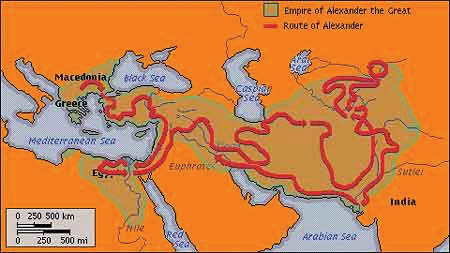
Meanwhile, Darius III marched against Alexander with a force of 600,000 soldiers, again comprising both Iranian soldiers and Greek mercenaries. The two armies met at Issus. The Persian defeat was such that Darius reportedly fled leaving behind his mother, wife, two daughters and an infant son. The Persians are said to have suffered a loss of 1,10,000 soldiers.
Alexander next conquered Egypt and a year later, in 331 BCE, led his 40,000-strong infantry and 7,000 cavalry to Babylon. He again engaged with Darius at Guagemala. The Iranians fought well but their cowardly King-of-Kings fled the field and ran to Ecbatana. Alexander entered Babylon and marched on to Susa, where he looted 270 tons of gold and 1,200 tons of silver. His next goal was Persepolis. An Iranian general, Ario-barzan, held him back at a Zagros pass, but a traitor showed him another way. Alexander entered Persepolis, looted it of 3,600 tons of silver and gold, told his soldiers to kill all the men, enslave the women and demolish their houses. Known to enjoy imbibing liquor, one night at a drinking party Alexander was seduced by the Athenian beauty Thias who incited him to set fire to the entire structure. This was to avenge the fact that Xerxes had earlier set fire to Athens. Alexander pursued Darius to Ebatana, but the latter had fled to Gorgan, east of the Caspian Sea, and was murdered by one of his own officers.
With the King-of-Kings gone and the entire confederation fractured, Alexander undertook a personal survey of the area. He passed through Parthia, Herat, Marv, Sistan, Bactria, Sogdiana, Gandhara and Indus in 325 BCE after six years. The people of the Indus Valley engaged him in battle. Although victorious, Alexander was severely wounded, a wound which reportedly festered until his death. The Macedonian’s soldiers were disheartened and, in the spring of 323, Alexander turned back to Babylon. A few months later he came down with a fever and died at the age of 33. In the space of two years, he with his infantry and cavalry traversed 20,000 miles, which works out to 30 miles per day. He may be likened to a tornado starting from Macedonia and after rushing, roaring and devastating a very vast and prosperous area petered out at Babylon.
Although Aristotle had trained Alexander to be a patriot and accept Greek culture as being the best, the Macedonian conqueror was surprised to find that the Persians were far ahead of the Greeks in culture and administration. He, therefore, retained the Achemenian administration, merely replacing the local satraps with his Macedonian officers. He paid tribute to Cyrus the Great when he visited the latter’s tomb and followed his principle of revering the local deities. In Egypt, he was acclaimed as the son of God Amun, which made him think he was divine. Having heard rumors that he was not Philip’s son but a child of his mother’s friend, being hailed as God’s son was comforting. Despite the killing of so many Iranians, he rewarded those who surrendered before him. He wore Iranian garb and encouraged his Macedonian and Greek officers to marry Iranian women and learn their culture.
Alexander showed no desire to return to Macedonia and it was perhaps this that prompted his feuding generals to stay behind and divide the Achemenian confederation among themselves.
This brief account of the rise and fall of Alexander is devoid of all the narratives, legends, myths, and racial and political aggrandizements to be found in the writings from Plutarch and Arrian to modern day authors. Alexander was brave, a strategist, an adventurer, temperamental, a good commander, conqueror, vanquisher, bloodthirsty, ruthless, a plunderer, destroyer, killer of friends, a pleasure-seeker and a drunkard, qualities which have been repeated with pride by Greek, Roman and still later, European biographers.
The Iranian system, wracked by internal feuds, was weakened to such a point that no one could rise and expel the invaders though the latter were weakened by the death of their leader and the disputes of the generals over succession.
 A founder director of the Zarathushtrian Assembly and a founder trustee of the Cyrus Society, Dr Ali Jafarey’s fields of specialization include Indo-Iranian history, geography, culture, religion, linguistics and literature. Author of 16 books in Persian and English on the Zarathushtrian religion and Iranian culture, Jafarey has taught at various universities and institutions in Iran and Pakistan.
◆ ◆ ◆
From the archive