
Books
A Zoroastrian odyssey
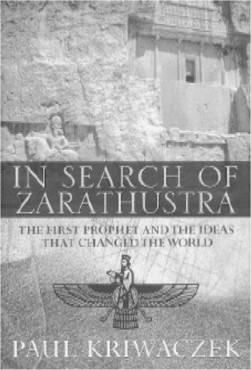
In Search of Zarathustra: The first Prophet and the ideas that changed the world by Paul Kriwaczek. Published in 2002 by Orion Publishing Group Limited, Orion House, 5 Upper Street, Martin’s Lane, London WC 28-9EA. Pp: 244. Price: £ 20.
"Aspi, here’s a book for you to read in your Bhimtal retreat,” said my good friend, Pesi Choksey. It looked inviting, but I had no idea it would be such a Hemingwayish "moveable feast” in the search for Zarathushtra: beginning in Acquitaine, France, reaching to the Danube and the Balkans, stretching to the steppes and deserts of Asia to Babylon, Yezd and Bactria, the original home of Zarathushtra over three millennia ago. It was a double moving feast: of the "Voyage of personal discovery” of Paul Kriwaczek, BBC’s travelling filmmaker and writer, from the European intellectual centers of Vienna and London; and of the amazing story of the spread and interfusion of religious ideas across almost the entire far-Eastern lands to China, permeating Judaism, Christianity and Islam and producing the kindred faith of Manichaeism. It is a panoramic education of Zarathushtra’s global influence, especially when the gaze of most Zoroastrians does not stretch beyond Iran and recently, to neo-Zoroastrians in the Islamic Caucasian republics freed from the former USSR.
As a travelogue alone, it is a more fascinating flying carpet than any travel agent’s tour plan. It would be a unique addition to the bookshelves of educated Zoroastrians and their institutions of learning. It would widen the minds of both priests and laity. For a historian, it is a joy to read beyond the usual archaic, starched-shirt literature on Zarathushtra and Zoroastrianism.
Working backward to the fountainhead of Zarathushtra, Kriwaczek's story begins with the German writer Friedrich Wilhelm Nietzsche’s famous, Thus Spake Zarathushtra, followed by Richard Strauss’ tone poem Also Sprach Zarathushtra. No Westerner or non-Zoroastrian has so popularized the name of Zarathushtra as Nietzsche. As a child, he himself was smitten by the problem of good and evil. But in his Thus Spake classic, he and his Superman belied Zarathushtra’s message. Nietzsche claimed to undo the damage of morality caused to humanity by Zarathushtra’s original teaching. So, his Superman turned into a ‘blond beast’ with the will to power, and became the inspiration of Hitler, Mussolini, Stalin and distant Mao, the Fascist dictatorial curse of the 20th century — so contrary to Zarathushtra’s democratic ‘Vohuman’ for each person in the choice of good and evil.
Then to Acquitaine in Roman Catholic France, which nursed the Manichaean "Great Heresy” of the two forces in the world of good and evil. Like a painter who saw light and darkness vividly Mani spread his mission east and west, coming "closest to turning Zarathushtra’s mission into a world faith,” notes Kriwaczek. That central idea of the two forces of good and evil spread on the horseback of the rushing flood of Goths, Visigoths and Orthgoths from Central Asia who devastated the old Roman Empire.
Earlier, the Roman legions had transported the cult of Mithra as far north as Hadrian’s Wall in Scotland. Remnants of a Mithraic temple by the Walbrook were unearthed in London after World War II bombings, and of the Carronburgh Mithraeum at New Castle. How many Zoroastrians have known and seen these amazing remnants related to their faith, so far from Iran? Kriwaczek indicates important features of Mithras, the Mediator, "patron of contracts, of friendships, of courage, probity, honesty, justice, and fair dealings.” Mithraism declined with the decline of Roman power from the fourth century. The author believes Christianity prevailed over this Zarathushtra-derived faith, because Christ was a comparatively more believable historical figure.
Next we come to Daniel, "the one who first united the prophetic traditions of Moses and Zarathushtra,” a Jewish prophet whose tomb was in Susa. Daniel’s prophecy of the end of time when God will overcome evil is a remarkable Jewish approximation of Zarathushtra’s teaching. Another amazing conjuncture was in the Dead Sea Scrolls, with "two spirits in which to walk, the spirits of truth and falsehood,” as also the End of Time mar-ked by a ‘War of the Sons of Light’ against the ‘Sons of Darkness’ and, as in Zoroastrianism, the good will be victorious. Moreover, the Dead Sea Scrolls speak of the adoption of the sun-based calendar used in Persia under the Achae-menian rule, when the moon-based one was an ancient inheritance of the Jews. Kriwaczek finds Zarathushtra’s teaching, having made a mark on the world in the millennium before Christ, "gave shape to the whole of the next two millennia, — and, of course, is still with us.”
In the long search for Zarathushtra, the author’s magic carpet now descends on the greatness of the house of Cyrus, his liberal example of rulership after the conquest of Babylon, outdoing even the latter day Akbar; his restoration of the Jerasulem Temple to the Jews, a generous contrast to Alexander’s destruction of Persepolis and the Zoroastrian scriptures. "Cyrus the Great had gone down in Greek history as the paragon of everything a good ruler should be.” Kriwaczek significantly points out that there is no historical evidence of Cyrus himself being a Zoroastrian. That was left to Darius and the later Achaemenids. Yet Herodotus confirms that the Persians worshipped no idols then. The Hebrew prophet Isaiah calls Cyrus his ‘Messiah,’ (the first so called in the Old Testament); and the prophet Ezra recognizes his building of the temple in Jerusalem. At Pasargadae, the tomb of Cyrus where "the sun comes over brown hills and washes the white tomb’s roof with the color of pink Persian roses,” the author pours over the verses of unmatched beauty of these Old Testament prophets.
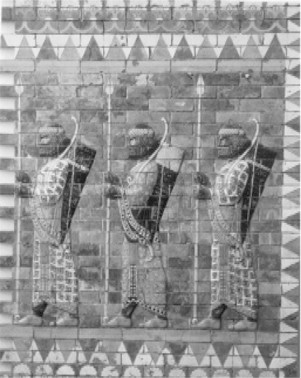
Achaemenian soldiers as seen on the walls of Persepolis
Then he visits the rock cliff in Behistun where Rawlinson, breaking the code of the script, revealed the record of the art and greatness of Darius and Xerxes, and the first clear imperial recognition of Zarathushtra’s Ahura Mazda. This Zoroastrian vision, says the author, was "transmitted first through Jewish, then Christian theology — part of the patrimony of both, the Western and Islamic worlds.” It was only after Cyrus’ release of the Jews from Babylonian captivity that the Jews began to recognize the Zoroastrian belief in the force of evil, and a being named Satan appeared in the books of Job and Zachariah. He finds the notion of heaven in the Persian concept of Paradise, a garden in the holy Quran, revealed to Prophet Mohammad.
And now, in the last lap, he seeks a time before Islam, Christianity, Judaism, and even the Achaemenids, a time before recorded Iranian history to find Zarathushtra himself in Bactria, between the Amu Daria and the Hindu Kush. Here, he finds the remarkable closeness of language between Zarathushtra’s Gathas and the Sanskrit of the Vedas. This philological clue makes him conclude "the Prophet must have lived sometime around 1200 BC,” the time of Moses. He recognizes however that some place him earlier — 1700 to 1500 BC, the time of Abraham. It was the heroic Bronze Age, the age when Moses found God in the burning bush and people saw the divine in fire. The author finds the oldest lingering fireplace in Yezd dates back to 470 AD. He also finds an old social pre-Islamic link, the spring festival, of the Persian ‘Noruz’ observed down to our time. When he heard the story of ‘Kerbala,’ of the good and evil in that context, the author thought he was listening to a Zoroastrian, not a Muslim.
And so, the writer of this remarkable book listens to "the reverberations of a spiritual explosion that happened more than 3,000 years ago, the most ancient revolution of all. The words were of the man who can truly be called the first Prophet.” Prof Mary Boyce referred to this long presence as "a shadowy but powerful presence,” through Hellenism, Judaism, Christianity and Islam. Not surprisingly. It contained the fundamental moral theme of good and evil, and man’s hard choices.
The Search of Kriwaczek makes a remarkable contemporary odyssey of a modern seeker of the spirit in the ancient world. We can follow his footsteps by reading his book, and share an imaginative exploration of inter-religious history.
Aspi D. Moddie
◆ ◆ ◆
From the archive