
Zoroastrians Abroad
Achemenids in the news
A celebration of history on the one hand as the British Museum, London, mounted its exhibition, "Forgotten Empire: the World of Ancient Persia,” and apprehension for the possible loss of a heritage site kept the spotlight on Achemenian Iran through the months of September and October 2005. While a truculent international nuclear establishment bayed for the dismantling of Iran’s nuclear programs, its Seevand Dam, nearing completion in southern Iran, sent shivers of fear down the back of the international Zoroastrian community which protested that the dam’s waters would erase Pasargade, the capital city of Cyrus the Great, the founder of the Achemenian dynasty and the concept of multiculturalism, who gave the world its first cylinder of human rights.
An on-line petition addressed to the United Nations and the people of the world sought the intercession of the international community to save the site of the ancient city, the road linking Pasargade to Persepolis, the celebrated capital founded by Cyrus’ successor Darius – also referred to as ‘the Great’ — and the tomb of Cyrus. An austere monument of stone, there the man, who had defeated the might of Babylon and set its enslaved Jews free, had had inscribed, "I am Cyrus, who founded the Empire of the Persians. Grudge me not therefore this little earth that covers my body.” The simple message had paused the invading Alexander of Macedonia in his rampant annihilation of the Persian empire to have a Greek translation carved alongside. Incidentally, Cyrus is the only non-Jew to be mentioned in the Bible as a deliverer.
In Bombay, the Parsi Punchayet trustees met the consul general for Iran, Mohammed Shokrani, and deputy consul general Kashni Nezhad and wrung from them the assurance that the tomb of Cyrus and the monuments of Pasargade would be safe from the waters of the dam which would be nine km away and 45 meters below the base of the tomb, reports Manoj Nair in the Mumbai Mirror of September 28, 2005. The impact of the dam, not only in terms of submerging monuments but also the humidity resulting from the collected water, has been raised by the Delhi based UNESCO-Parzor project. It was stated that the dry desert air has had a substantial part to play in the preservation of the 2,500+ year-old monuments.
When the British Museum had asked the Iranian Government for help in staging the exhibition, "Islamists and nationalists came together to denounce the plan,” states The Economist (September 19-25, 2005) according to whom "For modern Iranians, few subjects are thornier than their imperial, pre-Islamic past, and few nations less trusted than Britain, their more recent, neo-colonial tormentor.” The magazine nonetheless records that "the exhibition was saved, thanks to the energy of its curator and the diplomacy of Iran’s ambassador to Britain” so that the exhibition opened in the second week of September with "80 artifacts lent by Iran…on display.”
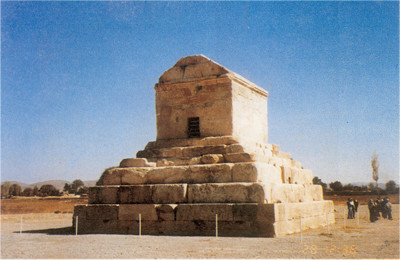
The tomb of Cyrus: "Grudge me not this little earth...”
The Economist records that "Muhammad-Reza Kargar, who heads Iran’s National Museum, speaks for a younger generation of bureaucrats …(and) regards Iran’s past, along with oil, as its greatest resource…Younger Iranians have reacted against an unrelenting diet of Islamic history and culture by seeking out pre-Islamic glories. But they mostly have to content themselves with reading books; many of the most glorious artifacts were sold to foreigners by 19th century shahs looking for ways of raising money.”
In contrast to the often unflattering description of Greek writers who chronicled the Greco-Persian Penopolesian Wars from the Greek viewpoint, the magazine notes, "As the exhibition shows, the Achemenids were relatively humane and their empire a marvel.”
Casting a sidelong glance at the current Iranian ethos, it adds, "Even some Islamic hardliners seem to have absorbed this lesson. When he ran (unsuccessfully) in this summer’s presidential election, one such hardliner put an image of Persepolis on his election poster.” The candidate in question, Ali Larijani, now Iran’s chief nuclear negotiator, in his earlier avatar as head of state television had "lauded a purportedly scholarly book which claims the Achemenids had no civilization to speak of,” recalls The Economist.
A full page article by Tara Pepper "Taking on the Greeks,” in Newsweek (September 19, 2005) notes, "Persia’s empire lasted two and a half centuries, compared with a mere 50 years of Athenian rule. The exhibit explores Persia’s highly sophisticated administration – including the world’s first postal service which allowed the emperor to make swift contact with far-flung regions. Cyrus determined how far a horse could comfortably travel in one day, and established a network of stations, one day’s ride apart, covering 13,000 km. Flexibility, it seems, also helped keep differing cultures together. At the heart of the exhibit is a clay cylinder inscribed with an account, written in Babylonian cuneiform, of Cyrus’ conquest of Babylonia. It also describes the reforms he advocated, assuring his new subjects the freedom to practice whichever religion they chose. In 1971, the full text was translated by the United Nations into all the organization’s official languages, and hailed as the earliest example of a charter of human rights.”
Detailing the beauties of Persepolis as reconstructed at the exhibition, the impressive architecture and monumental reliefs, Pepper goes on to say, "The Greeks are also portrayed in an unfamiliar light. The fragments on display…are testimony to Alexander the Great’s wish to annihilate a civilization. ‘Alexander gratuitously destroyed the main Persian centers even after he had captured them,’” Pepper quotes curator John Curtis. "A cup, decorated with a cartoonish picture of a captured Persian, highlights Greek triumphalism…It’s rare for a single exhibit to rewrite history. But this challenging show fires a new salvo in an ancient battle, opening up an enlightened and little known civilization far removed from the Greek myth.”
Parsiana is grateful to its readers Aspi Moddie and Rashid Khosravi for respectively bringing The Economist and Newsweek articles to our notice.
◆ ◆ ◆
From the archive