
10WZC
Such a long journey
After its nine-month tour of five museums in USA, the Cyrus Cylinder is currently on view in Bombay
"Father” to the Iranians, "Liberator” to the Babylonians, "Law Giver” to the Greeks, and the "Anointed of the Lord” to the Jews, King Cyrus II (circa 600 to 530 BCE) was supposedly the first monarch to be conferred the title of "The Great.” The seventh king in the Persian Achemenid dynasty, he is best known for the Cyrus Cylinder that over 2,600 years ago recognized the rights of people to freely practise their religion and beliefs. For the last nine months the Cyrus Cylinder, one of the world’s most iconic objects preserved at the British Museum since 1879, toured five museums in the United States. With a funding of Rs 1.3 crore from the Sir Dorabji Tata Trust and the Sir Ratan Tata Trust, the exhibition "The Cyrus Cylinder and Ancient Persia: A New Beginning” was brought to Bombay’s Prince of Wales Museum (now called Chhatrapati Shivaji Maharaj Vastu Sangrahalaya) and has been on view since December 21, a week before the inauguration of the 10th World Zoroastrian Congress in the city.
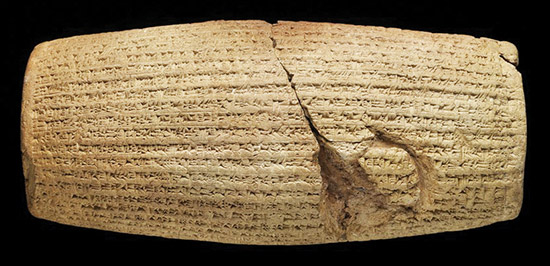
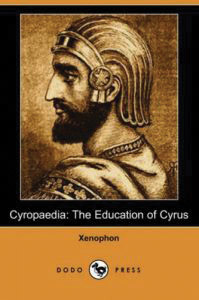
Cyrus Cylinder and an English translation of his biography Cyropaedia.
The unpretentious, baked clay icon admeasuring 21.9 cm in length and 10 cm in diameter at the center, is shaped like a rugby ball. Inscribed in the Babylonian-Akkadian cuneiform script, it records Cyrus’ victory over Babylon on October 12, 539 BCE and his divinely ordained authority to bring freedom and justice to his conquered subjects. Whilst the proclamation is in three parts, it is the last part that has universal appeal for it reinforces that an empire can be built without subjugating those who are conquered. His edict proclaimed that no citizens be harmed or terrorized, that the oppressed and the enslaved be freed from bondage, that civil works and buildings in ruins be rebuilt, that temples be restored to permit people to worship freely.
The Cylinder was discovered in the ruins of the ancient city of Babylon in Mesopotamia (in the center of Iraq) in early 1879 by a team of archeologists led by Hormuzd Rassam, an employee of the British Museum. When the broken fragments were reassembled at the British Museum, it was noticed that some pieces were missing. The restored cylinder bore 35 lines of text. It was nearly a century later, in 1970, that it was realized that one of the missing pieces found at the Yale University amongst its Mesopotamian archeological fragments admeasuring 8.6x5.6 cm contained lines 36-45 of the Cylinder’s text, thereby enhancing the value of the Cylinder. The discovery of similar Mesopotamian fragments and tablets from different sites proved that Cyrus’ edict was distributed in several regions.
"It would be wrong to call the Cyrus Cylinder a charter for human rights or a paradigm of religious liberties. The fact that such noble aspirations have firmly fastened themselves to this ancient artifact, and that millions wait in line to view it, witnesses to the human need to anchor our highest ideals in objects that are physical and concrete, objects that have been retrieved from the ruins of a past civilization and that we can touch and see. Ironically the attribution of these ideals to the Cylinder is due in large part to the Hebrew Bible… against the backdrop of the biblical The Book of Isaiah and The Book of Ezra, which portray this conqueror as a great liberator of the Jewish exiles,” commented Jacob L. Wright, professor of Hebrew Bible at Emory University in Atlanta, in his blog on The Huffington Post.
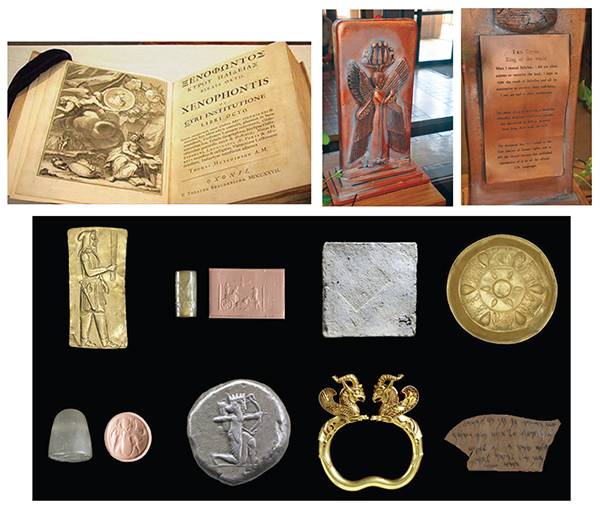
Articles from the Oxus Treasure and other exhibits from the British Museum traveling with the Cyrus Cylinder;
(above) philosophers and statesmen inspired by his edict (translated in English)
Although the Cylinder relates that Cyrus paid his respects to the Babylonian god Marduk who asked him to depose the Babylonian king Nabonidus who was neglecting his duties, many scholars have deliberated on whether Cyrus was a Zoroastrian. Those who prefer to link him with Mazda worship mention that there was a fire altar in his palace similar to the one maintained by later Zoroastrian kings. Another factor was his naming his first daughter Atossa, who is known in the religion for being the first great female convert to the Zoroastrian religion. According to Cyropaedia, a biography of Cyrus by Socrates’ student Xenophon, three people were pivotal in his upbringing: his mother Mandana, father Cambyses and maternal grandfather Astyages, King of the Medes. Xenophon also describes a procession directed by the magi (who officiated in religious duties) where Cyrus’ chariot was preceded by a chariot carrying the sacred fire on an altar.
According to Prof Jamsheed Choksy of Indiana University, "archeological evidence indicates Cyrus worshiped Ahura Mazda…most likely following in the footsteps of his Persian and Median ancestors.” Likewise Dr Jenny Rose of Claremont Graduate University commented that in the absence of Iranian texts and going by the contemporary Babylonian and Biblical accounts it appears that Cyrus propagated the idea that the Persian king stood in opposition to the lie and his role was to combat evil and restore order to the world. Articles by both these authors were amongst the many featured in the Summer issue of FEZANA Journal, the quarterly publication of the Federation of Zoroastrian Associations of North America, that was devoted to the Cyrus Cylinder. In fact, the interest generated resulted in this issue being brought out in Spanish too, reports the FEZANA website.
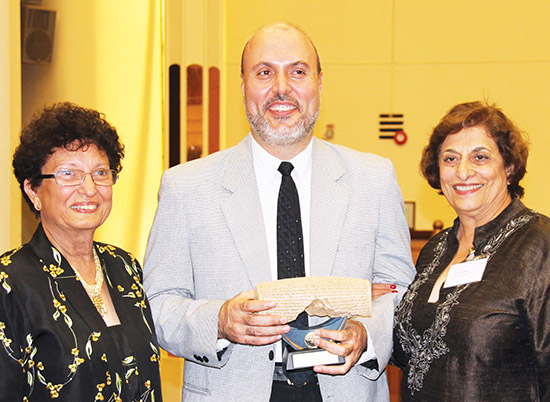
Dr Dolly Dastoor (left) and Aban Rustomji present Cylinder replica to Malcolm Deboo
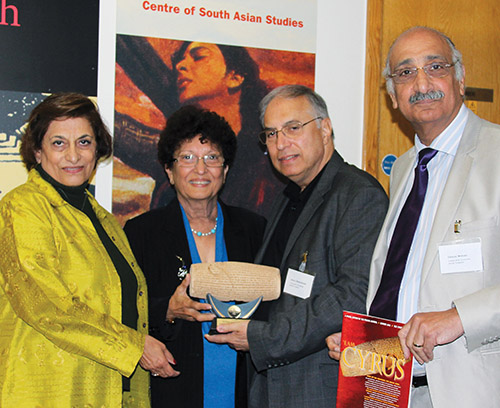
Dr Dolly Dastoor (left) and Aban Rustomji present Cylinder replica to Sammy Bhiwandiwalla and Darayus Motivala
Awareness in America
The Zoroastrian community in USA, elated with the arrival of the Cylinder on their shores, arranged a series of programs to acquaint the community with its Iranian history. As commented FEZANA Journal editor Dr Dolly Dastoor, "We know about Cyrus from both a historical and religious perspective specially from classical Greek and Hebrew sources (he is mentioned 22 times in the Old Testament) but what… made him particularly ‘great?’ What is his legacy for humanity? What was his world vision and was he motivated and inspired by a divine and supreme creator Ahura Mazda?” Referring to the efforts of North American Zarathushtis "to actively honor history and educate themselves” FEZANA president Katayun Kapadia appreciated the efforts of Ervad Soli Dastur to broadcast a tele-class on the "Cylinder of Cyrus and its Universal Appeal,” tracing the monarch’s life and education and alluding to the Cyropaedia that served as a reference when the third President of USA Thomas Jefferson was helping draft the US Constitution.
The five-museum US tour of "The Cyrus Cylinder and Ancient Persia: A New Beginning” started on March 5 at the Sackler and Freer Galleries at The Smithsonian Museum in Washington and drew to a close on December 8 after an extension of a week, having attracted more than 300,000 visitors. From Washington the exhibition travelled to The Museum of Fine Arts, Houston, The Metropolitan Museum of Art (MET) New York, the Asian Art Museum, San Francisco and the J. Paul Getty Museum, Los Angeles. The exhibition was organized by the British Museum in partnership with the Iran Heritage Foundation (IHF) and the Arthur M. Sackler Gallery, Smithsonian Institution, and supported by an indemnity from the Federal Council on the Arts and the Humanities, as mentioned on the website www.cyruscylinder2013.
The IHF that played a key role for the last seven years to bring the Cylinder to USA arranged for a "send-off” event — a favorite Persian tradition — at the Brisith Museum in February. The curator of the exhibition Dr John Curtis, an expert on the ancient history of the Middle East and the Keeper of Special Projects at the British Museum led the team responsible for the safe packing and transporting of the Cylinder as also the accompanying objects, including artefacts from the Oxus Treasure (found in Tashkent).
Whilst the Cylinder was on tour, the local museums and Zoroastrian associations organized satellite programs to generate interest: In Washington there was a panel discussion and celebration by the Center for World Religions, Diplomacy and Conflict Resolution, FEZANA and the National Iranian American Council with a specially laid out table displaying the combined items of the Jewish Passover and Haft-sheen table. A concert on Handel’s Belshazzar based on the Biblical account of the fall of Babylon at the hands of Cyrus the Great and the subsequent freeing of the Jewish nation was also one of the highlights. In Houston, workshops for students, adults, the visually impaired as also those suffering from Alzheimer’s were conducted by senior docent at the Museum Vehishta Kaikobad. She reported the spontaneous responses of first graders who on viewing the Cylinder were reminded of "corn on the cob,” "a cactus,” "a drum,” "a coffin,” "a barrel.” "Cyrus, Human Rights and the Politics of the Past in Iran” was the topic of a lecture delivered by Dr Daniel J. Sheffield during the "Zarathushti Day at the MET” in New York.
San Francisco witnessed a panel discussion on "The Cyrus Cylinder: Uses, Misuses and Contemporary Iran,” and the San Francisco Philharmonic Orchestra performed Loris Tjeknavorian’s King Cyrus Symphonic Suite. On August 22, a replica of the Cyrus Cylinder was donated to the De Anza College in Cupertino, California by Dr Mehravar Marzbani. In Los Angeles, the novel features were the culinary workshop as also a session on writing your own cuneiform as did the scribes in ancient Persia!
The Zoroastrian community in USA, elated with the arrival of the Cylinder on their shores, arranged a series of programs to acquaint the community with its Iranian history. As commented FEZANA Journal editor Dr Dolly Dastoor, "We know about Cyrus from both a historical and religious perspective specially from classical Greek and Hebrew sources (he is mentioned 22 times in the Old Testament) but what… made him particularly ‘great?’ What is his legacy for humanity? What was his world vision and was he motivated and inspired by a divine and supreme creator Ahura Mazda?” Referring to the efforts of North American Zarathushtis "to actively honor history and educate themselves” FEZANA president Katayun Kapadia appreciated the efforts of Ervad Soli Dastur to broadcast a tele-class on the "Cylinder of Cyrus and its Universal Appeal,” tracing the monarch’s life and education and alluding to the Cyropaedia that served as a reference when the third President of USA Thomas Jefferson was helping draft the US Constitution.
The five-museum US tour of "The Cyrus Cylinder and Ancient Persia: A New Beginning” started on March 5 at the Sackler and Freer Galleries at The Smithsonian Museum in Washington and drew to a close on December 8 after an extension of a week, having attracted more than 300,000 visitors. From Washington the exhibition travelled to The Museum of Fine Arts, Houston, The Metropolitan Museum of Art (MET) New York, the Asian Art Museum, San Francisco and the J. Paul Getty Museum, Los Angeles. The exhibition was organized by the British Museum in partnership with the Iran Heritage Foundation (IHF) and the Arthur M. Sackler Gallery, Smithsonian Institution, and supported by an indemnity from the Federal Council on the Arts and the Humanities, as mentioned on the website www.cyruscylinder2013.
The IHF that played a key role for the last seven years to bring the Cylinder to USA arranged for a "send-off” event — a favorite Persian tradition — at the Brisith Museum in February. The curator of the exhibition Dr John Curtis, an expert on the ancient history of the Middle East and the Keeper of Special Projects at the British Museum led the team responsible for the safe packing and transporting of the Cylinder as also the accompanying objects, including artefacts from the Oxus Treasure (found in Tashkent).
Whilst the Cylinder was on tour, the local museums and Zoroastrian associations organized satellite programs to generate interest: In Washington there was a panel discussion and celebration by the Center for World Religions, Diplomacy and Conflict Resolution, FEZANA and the National Iranian American Council with a specially laid out table displaying the combined items of the Jewish Passover and Haft-sheen table. A concert on Handel’s Belshazzar based on the Biblical account of the fall of Babylon at the hands of Cyrus the Great and the subsequent freeing of the Jewish nation was also one of the highlights. In Houston, workshops for students, adults, the visually impaired as also those suffering from Alzheimer’s were conducted by senior docent at the Museum Vehishta Kaikobad. She reported the spontaneous responses of first graders who on viewing the Cylinder were reminded of "corn on the cob,” "a cactus,” "a drum,” "a coffin,” "a barrel.” "Cyrus, Human Rights and the Politics of the Past in Iran” was the topic of a lecture delivered by Dr Daniel J. Sheffield during the "Zarathushti Day at the MET” in New York.
San Francisco witnessed a panel discussion on "The Cyrus Cylinder: Uses, Misuses and Contemporary Iran,” and the San Francisco Philharmonic Orchestra performed Loris Tjeknavorian’s King Cyrus Symphonic Suite. On August 22, a replica of the Cyrus Cylinder was donated to the De Anza College in Cupertino, California by Dr Mehravar Marzbani. In Los Angeles, the novel features were the culinary workshop as also a session on writing your own cuneiform as did the scribes in ancient Persia!
Interest in Iran and India
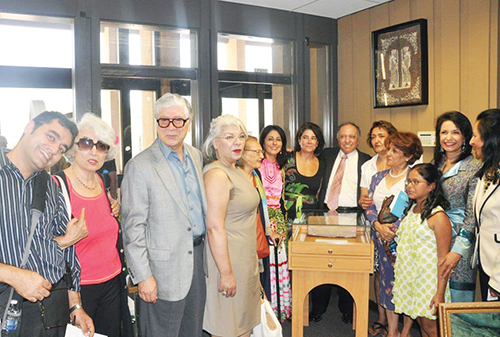
Cylinder replica gifted to De Anza College (Photo: Rusi Sorabji)
Before the tour of USA, the Cyrus Cylinder was loaned to the Iranian National Museum in 2008-09. Originally intended for four months, the loan was further extended by three months, giving the Iranian people a special Navroz gift and centerpiece for their Haft-sheen table. "With crowds exceeding 2,200 visitors daily, museum hours were extended from their normal nine hours a day to 21,” it was reported in FEZANA Journal. In an article in the Time magazine of July 1, 2013, Robin Wright, joint fellow at the US Institute of Peace and the Woodrow Wilson International Center for Scholars, states, "I’ve covered Iran since 1973 and interviewed royals during the monarchy and four Presidents of the theocracy… But nothing made me understand how Iran sees itself — or why it’s so tough at the negotiating table — more clearly than the Cyrus Cylinder. Whatever their politics, Iranians assume that after contributing so much to the world over so many centuries they have the right to a prominent place in the world today too.”
In 1971 the then Shah of Iran sent a duplicate of the Cyrus Cylinder (also known as Farman-e-Kourosh) to U. Thant, then secretary general of the United Nations (UN) to celebrate the 2,500th anniversary of the Persian monarchy. Whilst this was believed to be a ploy by the Shah to link his rule to the ancient monarchy of Cyrus the Great, this Cylinder continues to be on display at the United Nations with a translation in all six official languages of the UN. Even a postal stamp issued by Iran in 1971 bears an image of the Cyrus Cylinder.
A replica of the Cylinder specially commissioned for "The Everlasting Flame” exhibition at the School of Oriental and African Studies in London from October to December and financed by Tata Sons director Farrokh Kavarana, as acknowledged the accompanying catalog, will find its resting place at Bombay’s Alpaiwalla Museum along with some other treasures that are due to arrive from London.
When FEZANA representatives, Dastoor and Aban Rustomji, were in London in October, they brought with them replicas of the Cylinder that were separately presented to the president of the conservative Zoroastrian Trust Funds of Europe, Malcolm Deboo as also to the president of the liberal World Zoroastrian Organisation, Sammy Bhiwandiwalla, a gesture that would have found favor with Cyrus the Great.
◆ ◆ ◆
From the archive