
Comment
“The Hackers and Freezers Company”
Most people believe pathology is for losers, but this branch of medicine is a crucial diagnostic tool
"You want to become a...what? A thook pisaab (sputum-urine) doctor?” my mother screeched in genuine dismay, anguish and grief. "Why? Why Path.. ow..logy? When you can become a famous gynecologist, or a surgeon or a physician, why do you want to be a lab person like a backstage worker? Look here. You don’t worry at all. I will set up a big nursing home for you, and you will practice with dignity and style. Not like a technician. Taara maa akaluch nathi (you lack good sense)? Pathology! You never were practical in your life. Nonsense.”
Mother’s violent reaction was like a jolt into reality. What was it about pathology that evoked similar reactions in the minds of the lay public? People are convinced that a pathologist’s work is grim, smelly and unattractive. They see us holding malodorous test tubes of urine, sniffing petri dishes of spit, cutting up the still bleeding dead, and doing jobs which are never to be spoken about.
Mum, and a majority of the public associate the profession of medicine with an aura of potential limelight, good money, name, fame and glory. Pathology, they feel, is for losers.
A little introspection was needed here. Why did the world see the pathologist as a "thook pisaab doctor?” What was missing? Was it ignorance? Was it just that the glamor of the clinical world overshadowed all else? I dare say, some of it is ignorance, perpetuated by our own clan of clinicians who also view pathologists as servile lab technicians who must do as they are told and stay away from their patients.
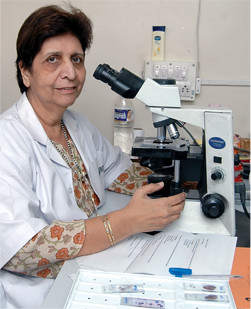
Dr Roshni Chinoy: providing diagnostic labels to diseases Photo: Chetan Mistry
I beg to differ. A pathologist, particularly a histopathologist, is an exciting form of "arm-chair detective” who traces clues, looks at cells, patterns and designs of cells under the microscope, and ascribes diagnostic labels to diseases.
Let’s take a day out of my life, or the life of any histopathogist in a lab.
I am hurrying helter-skelter to work as I have to do an urgent unexpected "frozen” on a patient already under anesthesia. My technician had phoned me a minute ago with urgency in her voice, "Doctor, the tissue has already arrived. Please come fast. The surgeons are waiting.”
I break two traffic signals, park my car in a disgracefully shabby way and race up to the lab. Huffing and puffing with my bags, coat and camera, I find a tiny, dark red bit of liver tissue, one centimeter in size, waiting to be frozen. In less than a minute, it is clamped into place in our lab freezing cryostat which is a machine that freezes tissues in seconds at -200 centigrade. My technician then cuts the frozen tissue expertly, producing a paper thin strip of liver tissue which she picks up on a thin glass slide. After staining it rapidly with a number of dyes, the newly colored pink and blue tissue is now ready for a look under the microscope. I snap it in place on my microscope stage. I have already read the case notes. The patient has a rectal cancer, and the decision to do a limited or extensive surgery will depend on the diagnosis of the liver. My surgeon is already on the phone, "What is it Roshan? If this is spread of the cancer, I am going to have to just do a by-pass. Otherwise I will be doing an extensive surgery. I hope, for her sake, this is tuberculosis (TB).”
"Guess what, it is a calcified old parasite. Nothing to worry about. Go ahead with your surgery. The patient does not have cancer here, nor is it TB.”
"Are you very sure?” asks my doubting Thomas surgeon friend.
"Of course I am. Go ahead and cut out the bad stuff,” I say with a big grin on my face.
Everyone heaves a sigh of relief. The surgeon happily cuts away at the diseased tissue to make the patient healthy. My technician goes back to her routine job. I sip a cup of steaming coffee and catch my breath. All this has happened in a 10-minute span.
In the early morning "frozen” section duty, before the hour is over, come in the breast frozens, the margins of resections, and all sorts of strange tumors and surprises which the body throws up at the operating surgeons. All the surgeons want rapid answers from the pathologist. Histopathologists and surgeons are part of the company I irreverently call "The Hackers and Freezers Company Limited.” They hack. We freeze. We provide answers. Rarely, if we don’t know the right answers, we tell them so and they understand. They wait for a final report after regular processing. After all, nature hates to reveal all her secrets to us.
So much for this exciting "hot-seat” part of our job.
However, much of our work is routine — looking at the tissues removed during surgery (which do not require a frozen section). Every possible organ or diseased tissue needing a diagnostic label, removed by the surgeons, is sent to us. We examine specimens. We cut them precisely, put tissues into machines to dehydrate them, and process them for examination. We give our microscopic diagnosis and our inputs about the stage of the disease and the grade of the tumor. We delight in looking at odd tumors, rare diseases (which sometimes really do look beautiful under the microscope) and we are happiest for the patients when the diagnosis is "No evidence of malignancy.”
So where did my Mum and the public get the idea of the "thook pisaab” part being the dominant part of my job?
There is a certain amount of truth in that, though. We examine the thook or sputum for germs, cancer cells and other inflammatory lesions. We also examine the urine for sugars, for bugs, cancer cells and blood. Our clinical pathologist colleagues play a big role in aiding us with values of sugars, cholesterol, urea, etc so that a complete picture of the disease emerges. We try and unravel the steps taken by a disease from its inception to the time it gets diagnosed. Further, we may be able to predict its future behavior too.
What of our sister profession of clinical pathologists? Their role is vital for information about our bodies. What is the sugar level? How much fat does the patient have circulating in his blood? What are the marker levels for a potential prostate cancer? So on, and so forth. Machines do a great deal of automated work, but interpretation is always to be done by a knowledgeable pathologist who knows how to sift the chaff from the wheat, so to speak. They know your blood picture, how much iron you have in your system, what is the stuff your bones are made of. They are truly aware of your "insides.” They know your blood group and will find a perfect God-given match for you when needed. A good clinical pathologist is worth his or her weight in gold.
Pathology is a profession which does suffer from a lack of visibility, but this is changing with the times. The fact that even pathologists are getting sued by patients means that patients are becoming aware of the role played by us.
A word of caution is needed to bring things into the proper perspective. The lay public is incredibly understanding when mistakes are made by humans in other professions. But when it comes to doctors, the public expects perfect, accurate answers. They have an unrealistic conviction that medicine is like math. After all, clear, correct answers and treatment is what they are paying for.
Yet the reality is that there are grey zones in all work areas. Doctors, too, are not infallible and neither are they gods. Whilst a lot of knowledge is there for the medical world to garner, nature still has some tricks up her sleeves. We can be fooled and even make mistakes. Patients may feel that doctors are careless. Most often, nothing can be further from the truth. Most doctors care a great deal for their patients, as also for their own reputation.
Patients, bear with us. We aspire to do our best. We also hope you understand and respect both our limitations and our strengths.
Next time you meet a pathologist, please do not call him or her a "thook pisaab doctor.” Mum, I hope you are listening up there.
◆ ◆ ◆
From the archive