
ART
A potter’s pride
Auroville based artist Adil Writer’s recent exhibition celebrates the amalgamation of pottery, painting and photography
Inspiration for Adil Writer’s art comes from unexpected places. The many sagan ceremonies of his childhood in Bombay’s Dadar Parsi Colony and the little forest shrines in Pondicherry where he trained as a potter, occasioned ‘The Red Dot’ series. Smearing the vermillion tilo on a host of ceramic works — pillars, bowls, urns, etc — there is an unabashed ritual symbolism in Writer’s pottery. Yet his creations need not be approached with the same deference as the sacred shrines from which he draws inspiration. At his most recent solo exhibition Threshold held at Bombay’s Gallery Art and Soul from October 17 to November 4, 2008, Writer mentions that he wants his audience "to touch the work,” perhaps even cross the threshold. There are surprises — an impression at the bottom of a pot, or a single wing of the farohar symbol lining the inside of a bowl. He emphasizes both the texture and the tactility of his art, whilst warning us with a smile that any damage while handling will be borne by the (mis)user. With the ceramics, photographs and paintings on display priced at Rs 15,000 upward one treads the exhibit space keenly yet carefully.
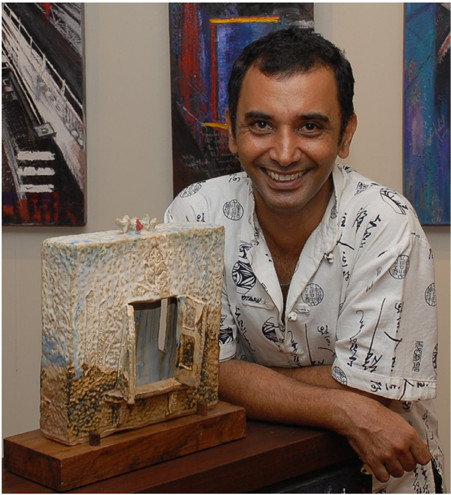
Adil Writer at the recent Threshold exhibition in Bombay
In keeping with the sacred imagery of his work is the impressive ‘Farohar’ series. The almost randomly placed red tilos dotting the classic farohar motif on olive toned ceramic bowls and panels give the pieces a folksy Parsi appeal. In an interview with Simin Rishahr, Writer explains that his earliest farohar work was exhibited in 2005 at a show at a Parsi owned gallery in Bangalore. "And boy! This imagery connected well with the bawaji crowd! So I decided to delve further into this aesthetic.” A visit to Iran in 2005 offered further inspiration: "The beautifully weathered farohars, cracks, holes, flaws included, were magnificent. I left a part of me there on the steps of the plateau of the Persepolis.” In Writer’s sculpture the farohar is carefully fragmented with wing after wing lining the outside of a bowl or the frequent use of the partial disc. Asked about the liberties he takes with the symbol he declares that he "was not going to be constricted by some ‘puritan’s’ views that the farohar has to face only this direction, or should not be represented only in this way.” With many of the farohar pieces already sold during the exhibition (a red dot again to mark their purchase), Writer’s aesthetic seems far from offending.
The exhibition’s ‘Dream Pillow’ series was inspired by the ceramic pillows Writer noticed in museums in China, while participating in the International Teapot Invitational Show in 2008. Hoping to capture the "softness and seductiveness” of a pillow on solid ceramic, Writer creates a convex upper surface with occasional folds. The pillows, like most of his pieces, have lines of text running through them. He often quotes from the work of the revolutionary Sri Aurobindo whose vision inspired the international township of Auroville in Tamil Nadu where Writer resides. In his paintings, the textual component adds another layer to the complex, multi-medium production. In an interview with the Jam-e-Jamshed, he mentions that his work ‘Devi’ began as a photograph he took of a temple in South India which he had printed on canvas and painted upon. "On this, I then inlaid a ceramic panel which has a Devi image, glazed with a liquid glaze.” Shanti Pillai reviewing Writer’s work in the brochure of the Threshold exhibition observes, "If anything is to characterize this enticingly tactile cacophony it is one word: promiscuous. With abandon, Writer declares his polyamorous right to love architecture, sculpture, photography and painting equally alongside the ceramic work with which he seemed monogamously involved for so long.”
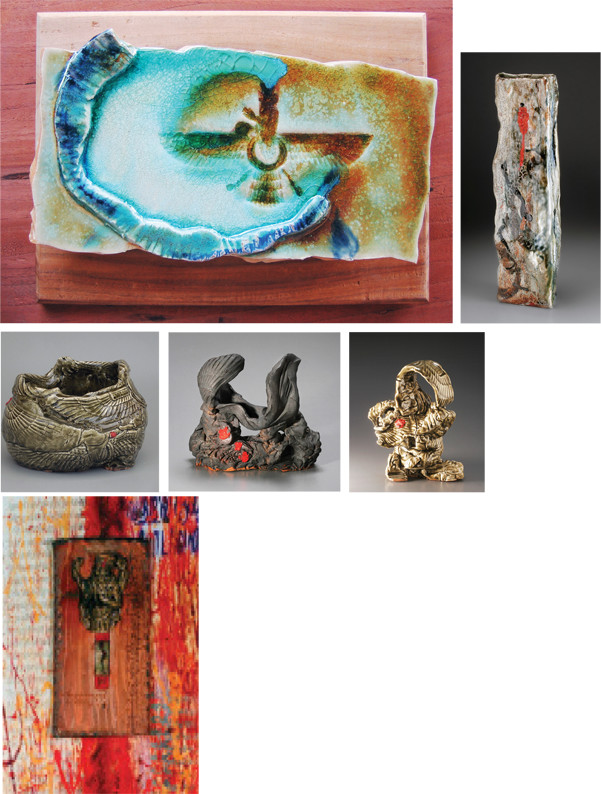
Top: Farohar panel on wood; (left) Pillar Vase, Anagama and fired. Alongside (L to R): Farohar Bowl, Farohar Impression Matt Black, Farohar Olive Bottom: Devi Detail
With a Bachelor and Master’s degree in Architecture from the Sir J. J. College of Architecture, Bombay and the University of Houston, Texas, respectively, Writer worked as associate architect with Bombay’s T. Khareghat and Associates and Talati and Panthaky Associates Private Limited. In 1998 he enrolled for a course at the Golden Bridge Pottery in Pondicherry, co-founded and run by Deborah Smith and Ray Meeker. Recalling their time together, Meeker mentions in a write-up on Writer’s website http://www.adilwriter.com, "The whole of our first seven months together at the Golden Bridge Pottery was a battle of wills. Next year Adil came back for more and by round two Adil had changed. His ideas were still way ahead of his technique, not uncommon for those who have already had a successful career, but now he was ready to admit that he did need to understand the basics if he wanted to get beyond the myriad technical pitfalls inherent to high-fire glazed ceramics.” After the two-year training at Pondicherry, Writer moved to neighboring Auroville joining artists Chinmayi, Anamika and Krishnamoorthy at Mandala Pottery. Auroville, he explains, is an experience in community living where "nobody judges me nor me them.” Children from the community are taught pottery by Writer and his colleagues, as they are other arts. Lamenting that pottery has not been encouraged as an art form in India, he suggests that school-going students should be made to work with clay.
Having participated in 10 exhibitions in 2008, including two in China, Writer says he travels wherever his work takes him. Son of the late Bomi Writer and Pilloo, Adil visits Bombay frequently to meet family and friends as well as for work. Writer confirms he is still a "Bombay boy,” despite spending the last 10 years in the South. However, with each stay at the Dadar Parsi Colony, he is alarmed by the number of old buildings been torn down to make way for towering skyscrapers. The Colony would do well following Pondicherry’s example in preserving its heritage, he believes.
Writer can be contacted at Auroville on +91 413 2622685; e-mail: adil@ auroville.org.in
◆ ◆ ◆
From the archive