
Cover Story
Arzan’s aesthetics
Whether fusing metal into a work of art or just unwinding, Arzan Khambatta believes in being accessible to his audience
"I talk a lot,” says sculptor Arzan Khambatta. One keeps up with both sentence and step as we make our way through his studio in Bombay’s Sewri locality. The renovation work temporarily disrupting the studio’s façade, the clutter and flutter of the inner space, installations hung in mid air or springing unexpectedly at one’s heels — the workshop keeps visitors interested and alert. Not surprising, given Khambatta’s own buoyancy. He spends at best two hours a day in the studio’s air-conditioned office cabin; the rest, outside, among the pieces of iron, wood and steel he sculpts into dolphins, horse’s heads, chess players, Mughals and Bollywood film actors.
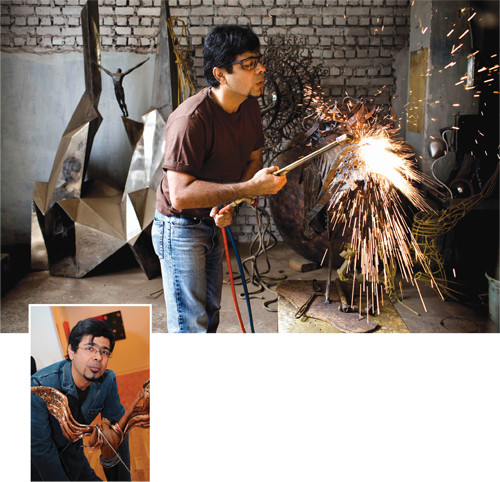
Top: The artist at his workshop (Photo: Kainaz Amrolia) and at the opening of his London show in 2008 (inset)
He confesses that the months following his exhibition "Comfortably Numb” at Bombay’s Jehangir Art Gallery in December 2008 have been a slump period. Perhaps he took a cue from the exhibition’s title. But the 44-year-old artist’s dry spells would qualify as busy periods for many. He enrolled in a movie making workshop, was working with old Parsi stage actors on a short film on noise pollution and renovating a bungalow in Alibaug he inherited from architect Dara Mistry. All this, and cycle rides from his home in Dadar Parsi Colony to the workshop and back. "As an artist it’s very seldom that you get bored.” In case he does, the 8,000 piece jigsaw puzzles in his office are a good distraction.
While Khambatta may sculpt less during these times of creative blues, commissioned projects for various national and international clients have stricter deadlines. He points to two sculptures on their way to Chicago, others for clients in Poona, Hyderabad and Calcutta. A holiday to New York City with his wife Khushnuma and children Tianna and Pezanne inspired a series of "pods” — concave and convex shaped compositions symbolizing both the immenseness of the city and man’s relative insignificance within it. "The city overtakes and man is lost,” the artist explains. In Bombay however, Khambatta is far from meeting his protagonist’s fate. Featured often in the Page 3 entertainment sections of the Indian media, Khambatta’s persona is often as "public” and popular as his installation art. He says that the Press coverage helps audiences to know both the art and artist. He much rather be available to his audiences than play the inaccessible moody maverick.
Khambatta notes that sometime during late 2003 and early 2004, the Indian Press "made a conscious decision to highlight artists as a social group.” He attends the same number of exhibition openings as he did before the media spurt. "After seven o’clock everyone knows what we are doing, but before seven we work very hard.” At his studio before nine every morning, Khambatta tries to keep his evenings freer. Post the Page 3 splashes, residents of the Dadar Parsi Colony took to Khambatta and his work. The "orthodox ones,” who had in the early years designated the artist as the colony’s "bhangarwalla” (carrying around Dadar the scrap he sculpted with bruised hands and dirty clothes), now show "a lot of respect. The level of talking changes.”
Feedback, be it positive or negative is important, especially from clients, Khambatta stresses. Among his first clients and critics was Mistry, his father Rusi’s close friend. Mistry bought his first work for Rs 700 in 1982. Khambatta’s second piece Aspi-Siya "Horse Head” featured on the cover of Parsiana (see "Breaking the metallic mold” by Gustasp Irani, Parsiana, September-December 1993) was sold for Rs 2,000 in 1983. Over the years several of Khambatta’s pieces adorned Dara and his wife Ursula’s home in Alibaug. Coming full circle, the Mistrys bequeathed their home, with its art collection to Khambatta.
At his last exhibition in 2008, the sculptures were priced between two-and-a-half to 15 lakh rupees. Khambatta regards the pricing as "sensible;” weary of artists and art aficionados who hike prices only to find themselves stranded in these times of a global recession. Though sales were slower at his exhibition in 2008, he remarks. A little less than 50 percent of the work was sold by the last day as compared to the 60 or 70 percent that is usually purchased in the first day itself. He mentions that an exhibition of his sculptures scheduled in Dubai has been postponed due to the credit crisis. Smaller galleries in Bombay are also shutting down. Those that have been more consistent with their pricing have been better off. "Forget the recession,” Khambatta exclaims, more people are interested in art, that’s the important thing. He regards his solo show at the Arndean Gallery in London in May 2008 as his big break internationally. London’s Queens College has commissioned Khambatta to adorn their courtyard with a permanent installation.
Khambatta confesses that he is "shocked by the amount of public art” in Mexico City, and to a lesser degree in the UK, New York and Paris. While New York was a "live wire,” Paris he considers "a city without current.” Given that both Khambatta and his art often appear larger than life, his preference for New York is expected. In Bombay, Khambatta hosts and participates in a number of workshops that instil an interest in sculpture and public art. At the 2005 Kala Ghoda Festival he created a skeleton of a life size horse which 3,000 children (visiting over the week long Festival) filled with biodegradable material. Among the host of his workshop participants were street children, adults and students of the J. B. Petit High School for Girls. "Working with children is exhausting. In three hours I’m finished,” he says. And finishing the sculpting, socializing and cycle-riding is not easy for Khambatta.
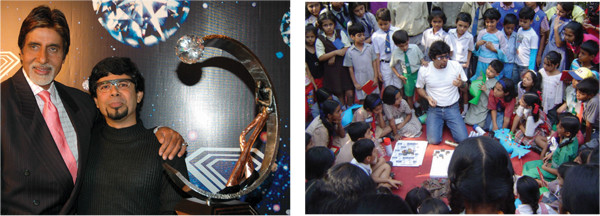
Right: With Bollywood icon Amitabh Bachchan and (far right) conducting a children’s art workshop
Asked about the training available to students of art in India, Khambatta remarks that "Even our best design schools cannot match the ones abroad. Milan produces phenomenal work. Aesthetics are high in Italy be it for cars, fashion or product design.” In India, most art faculty tend to teach an aesthetic as rigorously as the technique itself. Thus often at exhibitions at the Jehangir Art Gallery, Khambatta can pinpoint the school and often the professor the artist studied under. The idea of visiting faculty rather than housing only permanent staff at art institutes is preferable, he explains, since the faculty are more likely to be practising artists.
A trained architect from the Rachna Sansad’s Academy of Architecture, Khambatta says he is a self taught sculptor. He practised carving, experimented with media, visited galleries and after a master welder in a workshop in Bombay dismissed his request to fuse together strips of scrap metal to make a horse’s head, learnt how to weld. Khambatta stresses that the initial encouragement came from his parents Zarine and Rusi "who were always going out of their way to see that I got the maximum exposure possible to pursue the arts.” They took him to a retrospective of acclaimed sculptor Adi Davierwalla’s work. "That was my first charge.” After completing his schooling from the Dadar Parsi Youths Assembly High School (his early education was at the Jamnabai Narsee High School), his parents got in touch with Davierwalla’s wife Melba and daughter Zarin who suggested that Davierwalla’s studio be used for a summer course on sculpture. Melba asked Bombay based Goan artist Anand Mohan Naik to guide Khambatta through the course. "My sisters also joined in, it being the summer holidays and not having much else to do.”
"No doctors, lawyers, engineers,” Khambatta says of his own children. Pezanne, 14, a student at the Bombay Scottish School, is inclined towards animation, where both his drawing and computing skills can be utilized. While her brother is more impulsive, Tianna, 11, also at Bombay Scottish, is more of a planner and prefers art to sculpture. Their mother Khushnuma has the business sense Khambatta says he lacks. From keeping accounts (she completed a course on financial management in 2004) to paying the phone and rent bills (Khambatta worked in several studios before settling in Sewri) to following the market for Indian art, Khambatta’s glad that her acumen is not wasted on housework. A qualified fashion designer, Khushnuma has recently started designing saris. She was to exhibit 10 of her creations at the Kala Ghoda Festival in February 2010.
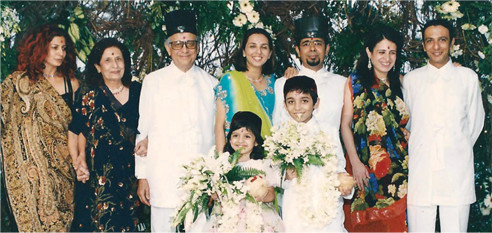
The Khambatta family at Pezanne and Tianna’s navjote (from left): sister Ferzine, parents Zarine and Rusi, wife Khushnuma, Arzan, sister Ferruzan and brother-in-law Rashid Surti
Tianna takes her cues from Khambatta’s younger sister Ferzine’s "wonderful life” of road trips, costume design and keeping a dog. His older sister Ferruzan is a beauty and acupuncture therapist. "Everyone in the family is very enterprising,” Khambatta remarks. Zarine, his mother, has been running a children’s nursery in Dadar for the past 40 years. His father Rusi heads the respected architecture firm Rusi Kham-batta and Associates, which Khambatta joined the day after graduating from Rachna. He explains that his father’s firm specializes in "pure architecture,” often of "the less glamorized kind” — town planning, the designing of factories, railway stations, hospitals. Kham-batta mentions that recently he helped place many Parsi youth in Bombay’s top architecture firms, but most of them quit, unable to cope with the work pressure. "Nothing can be achieved without hard work; they want the easy way out.” Busy about town on their motorbikes, Khambatta wonders why the youth don’t ride cycles, as he still does.
◆ ◆ ◆
From the archive