
Cover Story
Cast in a different mold
Whilst pursuing her paintings Shiraz Gandhi’s art has also found expression in murals
"Art is such a field you always feel you could have done something different, something better,” says upcoming artist and muralist Shiraz Gandhi. In retrospect, she often thinks that there was room for improvement, that a change in color could perhaps have altered the face of her painting. Her works may have been selected for exhibitions, for awards, for display at private residences and grand functions, but the 26-year-old continues to be her unassuming self, speaking in deferential tones of her seniors who have encouraged and patronized her, content to be "always learning.”
On viewing images of the murals she has designed, prospective clients have a look of disbelief on their face, wondering "whether I am capable of such work,” candidly admits Gandhi who hails from Surat, a tad nervous in this her first interview. Their visible satisfaction when she completes her project, brings her a sense of accomplishment, notes the artist who says she has always managed to deliver her assignments on schedule.
Having just completed a series of four oil and charcoal paintings for a client in Indore, she considers herself fortunate that she has never had to go beseeching assignments because soon after she completes one, there is demand for another. She is thankful to her architects and clients like Ratan Batliboi, Jimmy Mistry, Kersi Kapadia and Zarir Bhathena who recommend her name, ensuring that she has a steady stream of work. For supporting her and introducing new ideas to her work in murals she gives credit to her partner Subrojyoti Bhattacharya.
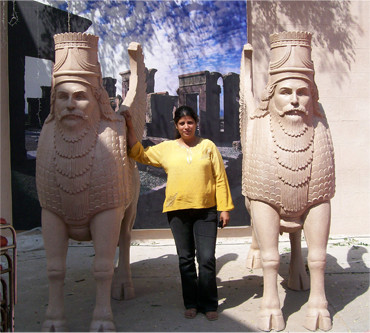
Gandhi with stylized bulls that she fabricated for architect and interior designer Jimmy Mistry
The time she spends on her paintings depends on the material and work commissioned. On an average an abstract oil on canvas takes her 15-20 days, and if it is done in acrylic, it could be finished in less time because acrylic dries faster, she explains. A figurative painting takes 20-25 days. Her smaller paintings are in the 4’x4’ size and the larger ones are 6’x10’. Some clients are particular about their color preferences and may even insist on use of a particular color which may jar Gandhi’s sensibilities. She then gives her suggestions and recommendations but if they insist on something, she feels obliged to honor their wishes.
Depending on her "mood” she may paint continuously for hours, staying up through the whole night. There are other times when she does not feel like holding a brush but such phases luckily last for only some hours, she clarifies. "Aai tau maari roji roti chhè (painting is my source of livelihood),” she smiles. Earlier after an animation course she thought she would try her hand at advertising but not deriving sufficient satisfaction from it later opted to launch her own independent business as an artist on the rationale, "Why work for someone else?” In fact she now has others working for her as her assignments as a muralist require her to engage craftsmen. As a muralist, once the client expresses his/her concept, the responsibility is hers to design the figure or abstract work, decide on its dimensions, perspective and medium. When dealing with design professionals like Mistry however, she may only execute the client’s design. Once the design is approved the paper drawing has to be transferred onto plywood after which it is given shape on clay. Rexin, matte, waste material are used to fill out the shape. The mold — which could be either made from durable fiber for a long-term assignment or cheap Plaster of Paris that would only last until a particular film backdrop is dismantled — is then reversed when it has almost dried. To handle the mold at this stage when continuously soap water has to be poured to ensure that it does not stick or dry, she has to depend on help from her craftsmen. The final finishing, with different effects and coloring, is done by her. While some of the artisans are Maharashtrians, from the fraternity who specialize in the making of Ganesha idols, others are Bengalis, she reveals.
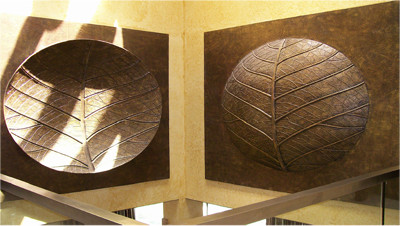
Mural done by Gandhi in 2007 for a client of Ratan Batliboi
Her interest and aptitude for art was evident from the time she was in fifth grade but Shiraz had not decided on pursuing art then. After school, she did a five-year Bachelor in Fine Arts course from Surat’s B. A. Mehta College during which time she sent her paintings for exhibitions hosted by the Bombay Art Society, Poona Art Society, Nagpur Art Society. In fact one of her paintings selected for exhibition at the Jehangir Art Gallery when yet in her first year was bought by a foreigner for Rs 15,000, she relates. The painting titled Good morning — a tender feeling, depicted a yawn emanating from some gent’s footwear. This positive feedback convinced her that her future lay in the field of art.
Her interest and expertise in murals was self cultivated. Fascinated with the murals that she observed at some railway stations she started making enquiries, pursuing her interest and learning from her experiences. The mural of Zarathushtra at the newly renovated M. J. Wadia Agiary in Lalbaug is a reflection of Gandhi’s creativity. The entire mural was cast in one mold and not done in segments, she explains. The reason that there are no crevices and cracks is thanks to the superior quality of the material used, she mentions.
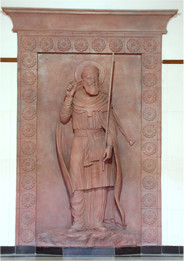
Mural at entrance to M. J. Wadia Agiary at Lalbaug commissioned by architect Kersi Kapadia, builder Zarir Bhathena and trustees of the Agiary
As demand for her work started growing, she moved out from her paying guest accommodation and rented a flat in Dombivli [River Wood Park, Bldg No 12, Flat No 201, Dombivli (E), Tel: 9821804415/9819901044] which now serves as her residence cum studio. The tribulations of her early days followed by subsequent recognition and rewards, makes her recall her late father Perviz’s words: "If you are willing to work and struggle, Bombay is sure to reward you.” Gratefully acknowledging the help received from Bombayites, whether fellow commuters on the train or work colleagues, she is happy that she made the transition from Surat to Bombay to make a career for herself. She is particularly appreciative of the encouragement and support received from her elder brother Farokh, eight years her senior, who holds a ground job with Jet Air in Surat and has been serving as a father figure to Shiraz since she lost her dad, a real estate broker, when yet studying in Surat’s J. J. Tots school. The cooperation of her mother Freny, who spends half the month with her daughter in Bombay and the other half with her son in Surat, she values too.
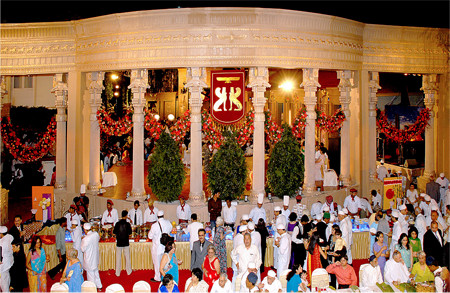
Above: Stage backdrop fabricated for the navjote reception of Mistry’s daughter
The choice of her marriage partner she has left to her mother and brother, trusting their good judgment. Willing to settle anywhere in the world, she does though feel the need "ké Parsi maa panvu joié (must marry within the community).” She may not go to an agiary daily but nevertheless believes that "my religion is the best.” On the subject of dakhmenashini, having seen the pictures in circulation of the innards of the Bombay dakhmas, she feels "koié kai karvu joié (somebody should do something to improve it).” But she does not consider cremation as an option, saying she would prefer to abide with the decision taken by the trustees.
The last mural project the artist undertook was in Vashi where her creation covered two walls, she relates. Preferring to respect the privacy of her clients, Gandhi says many of them commission her works for their gardens and their entrances. She does not know of other Parsi muralists and believes there are sufficient openings in this line if the artist is willing to strive hard. As she observes, "Struggle is inevitable in any chosen line of endeavor. But only some manage to make a name for themselves.”
◆ ◆ ◆
From the archive