
Cover Story
Alight at Andheri
The Seth Pirojsha Ardeshir Patel Dar-e-meher marks 100 years of its consecration with well-attended felicitations and release of a commemorative coin
Celebrating its centenary in style on April 24, 2008 (roz Adar, mah Adar) was the Seth Pirojsha Ardeshir Patel Dar-e-meher at Andheri (West) in suburban Bombay. The prettiness of its structure was enhanced by the fragrance of flowers — orchids, carnations, gladioli, tuberoses — on the sweep of its steps. The colors of its stained glass — depicting mythological birds, flora, winged bulls, Zarathushtra — shone bright and beautiful and as evening turned to twilight, little lights came on along the path up to the steps, while five regal flames glowed on its terrace. At the rear, the tenanted, illuminated Bai Ratanbai Patel Building exuded the old-world charm of its solid, 99-year-old stone structure set amidst tall trees.
"My grandfather Ardeshir Bhikhaji Patel built this Dar-e-meher in memory of his younger son Pirojsha who died at the tender age of eight years,” the agiary’s chairman Adi Patel told the gathering at the felicitations that followed the jashan conducted by the agiary’s panthaky Ervad Kersi Katila and 16 priests. The fire temple was originally consecrated on roz Adar, mah Adar, which fell on May 19 in the year 1908. "Our agiary faced a tremendous shortage of income during the earlier decades. However in 1995, the trustees decided to develop the open area behind the fire temple and built 56 flats for the use of the Zoroastrian community only. This Society has been named after my father Manecksha Ardeshir Patel who expired in 1935 aged 28,” the founder’s grandson narrated.
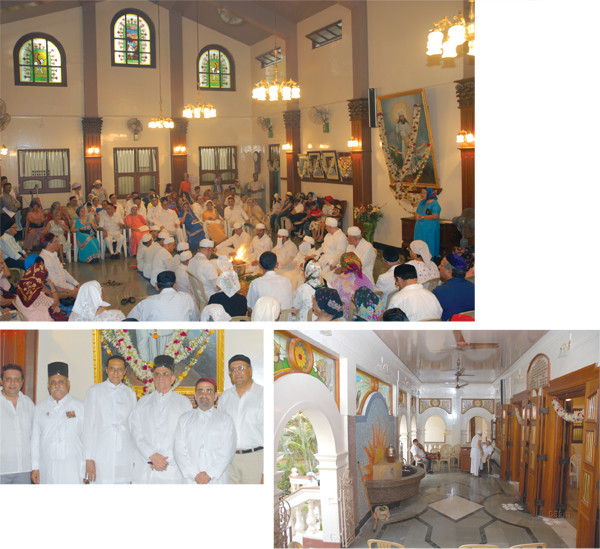
Top: Centenary congregation in the main hall. Bottom: The trustees (L to R): Viraf Irani, Sam Patel, Hoshang Mirza, chairman Adi Patel, Maneck Patel and Shaharouk Irani; Alongside: Stained glass and sun mosaic on the verandah.
By developing the land, the trustees put the agiary on a firmer financial footing, the chairman added. "Today with the grace of the Almighty our agiary stands independent and financially strong. Despite the ever-increasing cost of maintaining the fire temple, we are able to meet these expenses from our funds,” Patel stated. In the late 1990s, the old building was razed to the ground as its foundation showed signs of sinking and large cracks had appeared in the walls. The structure was rebuilt, costs being met "partly from donations from our Zoroastrian community but mostly from our own funds,” said Patel.
"A unique feature of the new structure is its beautiful stained glass. Not many fire temples in Bombay have stained glass. Earlier we too had plain, round glass.”
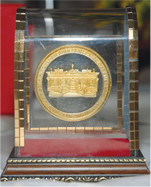
Agiary facade on centenary coin
A year after he built the agiary, the founder (Ardeshir) constructed a residential building for Zoroastrians of the lower income group, in memory of his wife Ratanbai. "This is the first time we have undertaken major repairs to the tenanted building. It is so solid that it had remained untouched all these decades, requiring nothing more than just routine maintenance. This year however we redid the roof and that was a major expense,” Patel told Parsiana later. "The Patel building has about 14 rooms,” explained his wife Arnavaz.
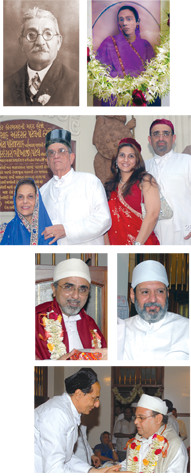
(Top) Founder Ardeshir and wife Ratanbai. (Second row) The Patel family: Arnavaz and Adi, Khushmede and Maneck. (Third row ) Ervads Pervez Bajan (left) and Kersi Katila (Above) Hoshang Mirza felicitates Ervad Aspi Katila
On the board of trustees with Patel is his son Maneck, advocate Hoshang Mirza, retired assistant commissioner of police Sam Patel, and businessmen Shaharouk Irani and Viraf Irani. The demise of two trustees in recent years, retired deputy commissioner of police Jal Contractor and seniormost Dhunjisha Moos who was an optometrist, necessitated new inductees.
Invited as guest speaker on the occasion of the centenary was scholar priest Ervad Pervez Bajan who spoke on "The importance of Srosh Yazad in our daily lives.” "There are three other fire temples celebrating their salgirah (anniversary) on this day — the Iranshah in Udvada, the Banaji Limji Agiary and the Maneckji Sett Agiary at Fort in Bombay,” Bajan informed the audience. Stressing the importance of Srosh Yazad, Bajan stated that fareshtas also have duties, like priests and chairmen. Srosh is a guardian angel appointed to guide and protect the souls of men while living and even for three days after death when it (the soul) is still within the precincts of this world. Srosh protects the material world, particularly after sunset. Srosh is the angel presiding over obedience to the laws of nature, the vice regent, so to speak, of Ahura Mazda in this world. One prays the Srosh Yasht vadi (the larger Srosh Yasht) particularly after dark. Srosh Yazad will help and protect you, provided you call him or invoke him in your prayer, Bajan stated.
A steady stream of worshippers proclaimed the agiary’s popularity. Large pockets of Parsi/Irani population reside in the area — in Bharucha Baug, Panthaki Baug, Cama Park, Manecksha Patel Society, etc, while Jogeshwari’s Malcolm Baug and the Salsette Parsis Colony at Andheri (East) are not too far away, though the last two have their own places of worship. "Our agiary has grown on its own. Youngsters have taken to the religion and have started coming in a big way and that is very heartening,” Patel tells us.
News of the centenary celebration brought back nostalgic responses, even from those far distant from Indian shores. "When I was a student of the M. F. Cama Athornan Institute from 1945 to 1954, we used to go to this agiary at least once a month, all 75 students in a two-by-two line, walking. When I was in my last year in SSC, I went there for five Gatha days to pray as a priest and got Rs 100, a huge sum for a 18-year-old priest and bought the first big purchase of my life — a wristwatch with radium dial so it could glow in the night!” wrote Ervad Soli P. Dastur of the US in an e-mail to Patel’s Florida-based son Nash and his wife Anahita. "I cannot believe what a wonderful renovation has been done to that agiary…When I am there (in Bombay) in November, I am sure to visit it.”
"Personally, I have been familiar with the Patel agiary for the last 60 years. I was very close to some of the priests and panthakies who worked there. A friend of mine by the name of Jamshed Sanjana was the head priest there for a long, long time. My nephew Hoshang Karkaria too was a regular fixture there. It all brings back fond memories,” wrote Darab Unwalla to the founder’s great-grandchildren.
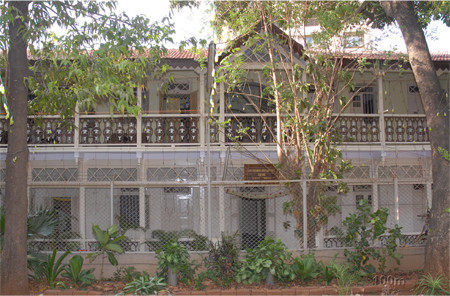
Ratanbai Patel Building — old world charm
Adi Patel is also chairman of the Seth Ardeshir Bhikhaji Patel Dadgah (inaugurated on June 23, 2000) at the Salsette Parsis Association housing complex (see "Salsette’s spiritual sustenance,” Parsiana, March 2000). "There are over 2,000 Zoroastrians residing in the Salsette Parsis Colony,” says trustee Eruch Hodiwalla. "There are five buildings on ownership basis, plus one building on leave and license, as well as a dadgah and community hall. There is full security, ample car parking, cafetaria, etc. We have recently cemented the main internal road of the colony. It’s a fantastic place for Parsis.”
The old dakhma on site built in the 1920s had over the years fallen into disuse. "Due to its under-utilization, it unfortunately fell into a dilapidated state and areas around it were encroached upon. After several years of negotiations, law suits, etc, the land was developed into this beautiful housing complex,” describes Arnavaz. Undertaking the project on this vast, undulating plot despite its difficulties was developer Hosang B. Mistry who completed it on schedule, including building the dadgah and community hall free of cost.
Arnavaz shows Parsiana a copy of a citation in Gujarati dated October 29, 1910 signed by the Parsis of Mahuva (about 35 km from Navsari in Surat district) commending and thanking Ardeshir Bhikhaji Patel for the new dar-e-meher building he constructed in Mahuva and consecrated on roz Srosh, mah Ardibehesht 1280 AY (October 29, 1910). "Taking pity on our poverty, you also constructed the building named Manekwadi and a well (to be used) for performing last rites and ceremonies. Besides spending such large amounts for our poor village, you spent a lot of your precious time in doing all the above for which we do not know how to thank you,” states the translation in English.
In October 2002, the Mahuva agiary building was renovated by the Zoroastrians of Mahuva and 29 surrounding villages, reported the Jam-e-Jamshed Weekly in January 2003. "Five mobed sahibs were invited from Navsari. They performed a jashan and then the atash was enthroned…in the presence of 225 humdins who were much delighted on the occasion… To add to their happiness the family members of the late Ardeshir Bhikhaji Patel were present on the occasion… Patel gave a fresh donation…and all members of the Patel family were then thanked and honored with flowers,” the Jamé noted.
Being a trustee is time-consuming and often thankless, Patel notes. "I seek the blessings of Lord Zarathushtra to grant our community peace, harmony and happiness…” he told the centenary gathering.
◆ ◆ ◆
From the archive