
ART
On the wings of a farohar
A depiction of a farohar with 101 names of Ahura Mazda receives recognition 18 years after conceptualization
The icon of a farohar with the proverbial four layered wings and the three layered feathery tail below the waist, precisely divided into 101 boxes bearing the 101 names of Ahura Mazda was viewed extensively a few months ago on social media. The image flew across continents on WhatsApp and was hastily dispatched to email subscribers as well. We traced this image to late Eruch Hormasji Patel’s home in Kharegat Colony. As you enter, you spy the original which has pride of place at the entrance. Patel conceptualized this and executed his graphic in 1998 in Gujarati, his family recounts.
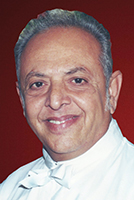
Late Eruch Patel
The artist’s creative indicates the farohar symbol emerging from the outline of a flaming afarganyu — the differing size of each 101 name adapted to uniformly sized boxes. The farohar, a symbol embraced by the Parsis of India, as representational of the Zoroastrian faith, features as a talisman on cars, vehicles, cupboards, as tattoo on young girls, even on imported shoes and on any objects that need His "protection.” Farohar is Pahalvi whilst in Avestan the same symbol is called fravashi meaning each person’s guardian symbol which protects that person. The labor of love was forwarded by Patel’s daughter Maharukh Dastur to Ervad Soli Pirojshah Dastur, Maharukh’s husband’s paternal uncle, as a Navroze e-card greeting in 2000.
A few months later Soli invited volunteers who could convert the Gujarati script to English. He placed this on a Z-list group he belonged to when Ervad Pashin Madan from Dubai responded to the request and touched up the original, digitally erasing the Gujarati script and re-writing the 101 names in English. It was then that interest was kindled and has now burgeoned. As in the original, the names start on the first layer of the wings, reading left to right as in English for all the layers beginning from the wings to the third layer of the feathered tail which is said to represent kunashni (good deeds). The dado of the afarganyu bears the Gujarati words "Pak Dadar Ahura Mazda ni madad (Seeking the help of Ahura Mazda).” These Gujarati words have been retained in the English version as well.
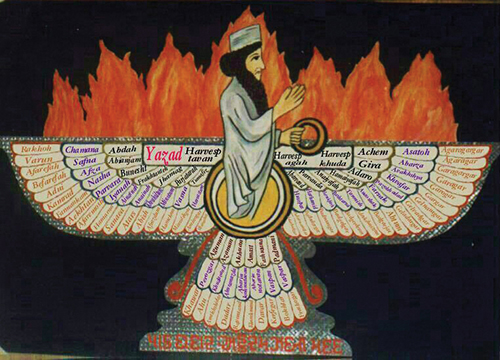
The farohar digitally transliterated in English
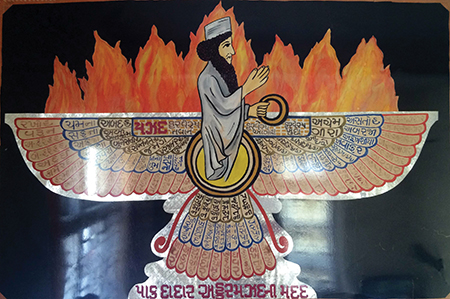
The original farohar in Gujarati
One year Ervad Cyrus Dastoor, Maharukh’s brother-in-law, who has founded Frohar Foundation, enlarged the image to poster size and used it as a backdrop for the Zoroastrian Saga exhibition at Allbless Baug.
Talking to Patel’s wife Silloo, we realize that Eruch was absorbed in all things artistic. She states matter of factly, "It (working with his hands) was his relaxation. He came home from a full day’s work and then poured over his passion well after midnight.” One of the family members animatedly informs Parsiana, "He had superb handwriting.” Silloo and her two daughters — Maharukh, a technology manager in a bank and Kashmira Vazifdar, a speech and drama trainer — reminisce about the frames Eruch painstakingly made of plywood, cardboard, collages with photographs juxtapositioned into a predetermined pattern. He used any tangible scraps he could lay his hands on. Vazifdar states, "Any material, even old cards or images lying about, were given creative expression with complete ease and precision.
Often, owing to rudimentary materials, something he had created would just collapse while constructing it,” the younger offspring narrated. However both the daughters have memory of nothing deterring him — in fact challenging him to innovate a new methodology. Once he finished conceptualizing an idea, he executed it with aplomb and determination. Vazifdar recalls how he designed articles and finished them without any specialized equipment or tools. One such was a glass jar full of colored marbles made into a lamp. Commercial birthday cakes were brought to life as with oldest grandchild Parzaan’s first birthday. The figure one was carved in plywood, glued with pictures of the birthday boy taken in the course of that year by Eruch and then hard laminated to a professional finish. His only granddaughter Ruhdabeh missed out on granddad’s innovations as she was born two months after his passing away in June 2000.
Next to this 18 year-old farohar image hangs a cross stitch clock that Eruch presented to Silloo for their 25th silver wedding anniversary in January 1990. The initials ‘E’ and ‘S’ are embroidered at the center of the face of the clock with Roman figures. Eruch roped in the daughters to fill in the cross stitch after working out the detailed grid.
Another of his relaxants was photography. Photos taken by him were laboriously chosen to form the initials of a grandchild’s name with the cutwork not eating into the posed image. As Vazifdar proudly proclaims, "in the pre-digital age, everything was manually executed.” All the preserved "family albums have no photo corners (that were used formerly for sticking photographs.) Each photograph is framed holding them in greeting cards,” Maharukh points out.
A Roliflex, a Pentax, a range of lenses and filters were his prized possessions to cannon into capturing every childish nuance and expression — first of his two children and then of his three grandsons. With a limited budget, these prized photography possessions were invested into with scarce, hard earned money.
Silloo proudly informs us he was termed ‘the doctor of Fiat cars.’ This skilled mechanic worked at the Bombay Cycle Motor Agency and was their star diagnostician for Fiat cars. Silloo laments though, how he never charged appropriately when they sought Patel’s expertise privately, "like other mechanics who became lakhopatis (very rich).” Maharukh narrated how distraught Fiat owners knocked at the Patel door at any time to get their cars road worthy again and deal with car breakdowns no other mechanic could determine. He was unable to pursue further studies after his school leaving as a boarder at the Sir J. J. English School at Surat. Vazifdar adds "He may not have been able to pursue his academics owing to financial constraints, but his mechanical acumen and creative fervor flourished without any teaching or training.”
◆ ◆ ◆
From the archive