
Cover Story
Patel’s perspectives
Though Dr Gieve Patel’s plays are peopled by Parsi characters he views himself as a playwright who happens to be a Parsi rather than a Parsi playwright
"She gave bleating moans, her legs stretching, trembling… She opened up. She was slippery red inside the rim of her cavern, with thick matter dropping out and sucked into the ground.” This vivid description of the birth of a goat in the recently launched Mister Behram and Other Plays captures every aspect of the author’s multifaceted personality: the doctor, the poet, the painter and, of course, the dramatist. It was a fascinating experience to see versatile actors, who in their youth had played principal roles in Dr Gieve Patel’s plays, read extracts from these same works more than 20 years later at the book launch at Crossword last October.
The plays, written by Patel between 1970 and 1987, are peopled with Parsi characters. Viewing himself more as a playwright who happens to be a Parsi rather than a Parsi playwright, Patel explains, "There are possibly all kinds of little details which are undeniably Parsi and which get into the very texture of the play and it is very difficult to say that this is Parsi and that is universal. I think that with any really fine piece of literature the two, the local and the universal get enmeshed in a very organic way. The atmosphere in a play is also created by the director and the producer of the play. The set, the costumes, all of these contribute to the atmosphere of the play. Therefore I did not want to exaggerate the atmosphere by bringing in an unnecessary and excessive Parsiness. I thought I would stay with an optimum amount of Parsiness and the rest would flow with the production.”
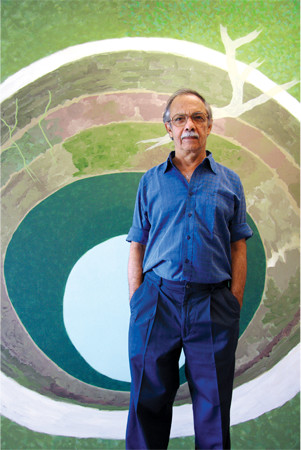
Dr Gieve Patel: moving to a mystical dimension
Photo: Cyrus Dastur
The theme of power is very near to Patel’s heart and runs through all the plays: political power, the use of power within the family. He believes power is "all pervasive in society and in any situation you come across. It is something you can’t avoid. If you are observing a situation it just comes at you, whether it is a classroom or a family dinner or a board meeting. In every situation power operates and unless the persons concerned are very keenly aware of themselves, power is often misused.”
Linked with the theme of power is the portrayal of the relationship between the Parsis and the Warlis in his plays. Based on his personal observation of the way his grandfather’s generation related to the Warlis, and subsequently the sons interacted with the locals, Patel admits, "There must have been several generations before my grandfather that I know nothing about. Some of the earliest encounters may have been pretty brutal for all we know when the Warlis were first, in a sense, colonized. By the time my grandfather comes on the scene the relationship settles into a kindly feudal relationship and, then, by the time the sons come into the picture, the feudal relationships are shaken and younger men are at a loss as to how to control the labor with a result that there is again a certain amount of alienation and brutality.”
The women characters in all his plays appear to be much more powerful and memorably etched: holding the fort in their own quiet way in Savaksa and Mister Behram; showing a more dominant personality in Princes. Patel notes, "I think that may have something to do with the fact that Princes goes right back to my childhood experiences when, in my village, being a little child at home, I was very aware of the solid women around, their extraordinary presence; the men were often not at home; they would be working in the fields.”
When crafting a play, with reference to the characterization and construction, Patel says two perspectives are to be kept in mind: "An authentic background for the character should be created to make him or her behave in a way that matches that background. On the other hand there are demands that the play itself makes, the trajectory of the plot, the trajectory of the larger picture you are projecting and sometimes the playwright will make a character do something that is intentionally out of character because the trajectory of the play demands it.”
With reference to the construction, Patel elaborates, "Every play uses a mechanism of echoes. There are a certain set of themes, four or five very often, in each of the plays just as a piece of music will have certain themes which keep on recurring with variations… an inner structure or web which holds it together. So the theme of causing harm is one of the themes of Mister Behram, echoed throughout the play, not necessarily only by Behram. In the same way in Princes, the theme of stealing is very central because both the families are trying to steal the child from each other, the servants steal from the kitchen and the neighbor Sheroo also comes to steal things.
Several playwrights have influenced Patel’s writing over the years: from Strindberg he learnt how power operated in different circumstances and from Eugene O’Neill he acquired the fine art of depicting family relationships. From Chekhov he learnt how to manage a large number of characters in one scene at the same time as in Princes.
On the subject of the strong physical-emotional undercurrent between Behram and his son-in-law Naval in Mister Behram where both the characters seem to feed off the admiration and the affection of the other, Patel insists, "There is no physical relationship between the two men but there is definitely a homoerotic background to the relationship,” especially in the scene where Behram asks Naval to wear the traditional costume of the Warli consisting of a vest and a G-string. But, Patel maintains, "I was keen that this homoerotic aspect should not appear in the play as what one might call or consider ‘a problem.’ One does not say that Romeo and Juliet is about a heterosexual relationship; one takes that for granted, and basically what is important is that it is a strong relationship between two human beings. In the same way I would like a reader of Mister Behram not to isolate that particular aspect as a case study but to see it as a strong relationship between two human beings.”
As to why Savaksa’s eczema was introduced in the play, Patel recalls, "The play comes from my experiences as a medical officer at a primary health center in Sanjan where I worked for about two years. Sanjan is a railway station town. It is quite scruffy and most of the year it is dry and dusty. When I was writing this play I wondered how I could capture this in one image, and then the idea of the eczema arrived as something which is dry and itchy. So I planted it on my character’s arm and once that was done I found it very useful. I could use it as a dramatic focus for all sorts of things. Yes, certainly to suggest something rotten about the man, his life and the source of his great wealth. But again, there is a lot to his character, many positive things about him as well. He is very charming, and he must be a very attractive man to persuade an 18-year-old girl to come and visit him at his home.”
Patel’s medical profession surfaces more prominently in his poetry than in his plays with constant references to the body and death in poems like Post Mortem and Old Man’s Death in the first collection of published poems entitled Poems (published by Nissim Ezekiel). By the time he is halfway through the second book, How Do You Withstand Body much of this has been worked out and only traces of it appear later. He moves very well from the body to a mystical dimension in the later poems like Mirrored, Mirroring (Oxford University Press), The Difficulty and God or where he conveys that "the body is a metaphysical thing. It’s not merely material; it’s a vehicle with which we move through life and it holds not only our physical functions but our spiritual ones as well.”
Translation of Akho’s poems, Patel confessed, is proceeding very slowly "partially because painting is taking up so much of my time. Translation is very difficult and challenging and for that reason also a lot of fun, particularly if you like the original poem that you are translating. Akho observes human beings and their behavior in society in a sharp and acerbic manner. He expresses this in polished crystalline verse.”
Sixty-eight-year-old Patel retired from medical practice about two years ago after nearly 40 years in the profession. Following his education at Bombay’s St Xavier’s School and College and subsequent graduation from Grant Medical College, he started as medical officer in charge of the Primary Health Centre in Sanjan and later worked as a general medical practitioner at his own private clinic. Over the years he has been awarded a Woodrow Wilson Fellowship at Washington, a Rockefeller Fellowship at the University of Chicago and Nirman Foundation Fellowship at the University of Pennsylvania.
His time is now split largely between painting and writing, with painting currently demanding most of his time. Patel views Jehangir Sabavala, Mehli Gobhai and Homi Patel as important contemporary artists of the community whilst not forgetting to mention the late sculptors Adi Davierwalla and Piloo Pochkhanawalla. The community authors that come to mind are Cyrus Mistry, Rohinton Mistry, Boman Desai, Meher Pestonji and the Parsi poets he admires are Keki Daruwalla, Adil Jussawalla, the late Kersy Katrak, Jimmy Avasia, Darius Cooper. He refers to being "involved in a poetry workshop project with students of Rishi Valley School in Andhra Pradesh for the last 14 years,” an outcome of the initiative being Poetry With Young People, edited by Patel and published by the Sahitya Akademi in 2007.
For those keen to see a new play from him Patel ends on a cheerful note of suspense, "There is a play in my drawer that I pull out occasionally but I absolutely cannot say when I will be ready to start working on it.”
◆ ◆ ◆
From the archive