
Medicine/Health
Wildlife vet
Dr Kazveen Umrigar’s career choice is to nurture wild animals in zoos and forests as well as to work toward reversing the decline in the vulture population
"I find the prospect of treating wildlife more challenging than treating people’s cats and dogs,”candidly declares Dr Kazveen Umrigar, director of The Rajiv Gandhi Zoological Park, popularly known as the Pune Zoo. Hoping to change the public’s perception of a zoo, the 34-year-old wildlife veterinarian believes her present job "is an incredibly challenging one and I hope that I will be able to contribute to making that difference.”
Her earlier stint in Poona was as in-charge of the Peshwe Park run by the Pune Municipal Corporation shortly after she had completed her masters in Wild Animal Health from the Royal Veterinary College, London. Many are the wild beasts she has befriended over the years "but the one that is etched in my mind was when I was working at Peshwe Park. I looked after an orangutan named Bini. She was so human. Once we became friends, she allowed me to groom her. One day she fell ill and I needed to anesthetize her to diagnose her illness.” Knowing that she would have to dart Bini from the rear or else she would pull out the anesthesia dart and throw it away, Umrigar threw water on her to scare her. As the frightened Bini turned her back, Umrigar darted her from behind. "So far Bini had associated me with good things but after this incident she refused to let me come near her. It was as though I had betrayed her. It took me a week to get back to our normal routine.” By this time Bini was diagnosed with tuberculosis, the treatment for which is a six-month course. "Since it was difficult to give her oral medicines and since she liked Mangola, we mixed the medicine in the drink. But the smart Bini smelt it and refused to touch it. Another beverage that Bini liked was tea but the medicine was so bitter that it curdled up the milk. Then we tried Pepsi which she thankfully drank by the glassfuls with her medicine dissolved in it. So Bini recovered thanks to Pepsi,” Umrigar underplays her own role.
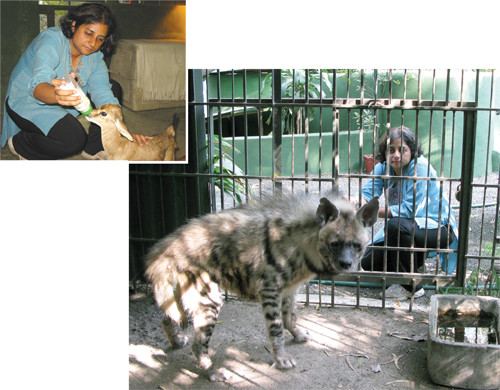
Dr Kazveen Umrigar tending her charges Photos: Khursheed Dinshaw
After three years at the Peshwe Park she opted to work for the Goa Forest Department as she was more interested in looking after free-living wildlife. Responsible for all wildlife health matters of the state, her new job entailed living in a forest! On completion of her contract there she decided to seek another adventure.
This time she chose to work with the endangered bird, Houbara Bustard, on a captive breeding center in Morocco. She was fascinated by the experience, learning about recent advancements in the field of breeding birds in captivity as well as living in "a totally different culture where the customs, language and religion were alien to me.” The Houbara Bustard in flight "would often break their legs and wings…Once I couldn’t repair the leg (of one bird) and I had to amputate it,” Umrigar recalls whilst appreciating, "the training at the Royal Veterinary College gave me lots of exposure of working with wild animals and opened me to the world of mammals, reptiles and birds. It gave me a good grounding that I would not have otherwise had in India.”
Subsequent to her schooling at Bombay’s Auxilium Convent and bachelor’s in veterinary science from the Veterinary College at Parel in Bombay she was fortunate to receive numerous scholarships from charitable trusts and organizations that enabled her to study abroad. She appreciates too the support of her parents Dinyar and late Freny, and elder brother Kaevan.
Currently Umrigar is working on an issue that concerns her both as a Zoroastrian and as a conservationist: the alarming decline in the number of vultures in India making it difficult for the dakhmenashini system of disposal to function efficiently. On learning that a veterinary drug diclofenac is causing toxic effects and ultimately death of vultures in India, she along with her colleague Dr Percy Avari (who has worked in a vulture captive breeding facility in India) and an expert interpretation artist and planner Dhun Karkaria are endeavoring to put together an interesting and interactive traveling exhibition to educate the population. The Government of India has banned the future manufacture of the drug, but the existing stock is still being sold in the market, resulting in vulture deaths even today, points out Umrigar.

Umrigar: making a difference
The trio’s intention is to educate using creative methods that will not bore the prospective audience, knowing the common aversion for attending lectures or power point presentations. The traveling exhibition will comprise 20 vinyl panels (3 ft x 2 ft) that will create awareness through the English and Gujarati medium of the different types of vultures found in India, their ecological importance in the food chain, the reasons for their becoming a critically endangered species, how Zoroastrians can help and why it is extremely important to act now. Even the lay members of the community can "spread awareness about diclofenac so that we don’t use it at all or force the government to totally ban diclofenac (especially when) the pharma companies are bent on pushing the drug for their own benefit. Another way of supporting this cause is to fund the activities of NGOs that are running vulture breeding centers or monitoring vulture population, she believes.
Ideally they would like to set up these exhibitions at community centers within Parsi colonies where members regularly gather or organize small events in coordination with the local Zoroastrian youth associations. Along with the exhibition they could "show a couple of short films on the vulture crisis in India and conclude with a contributory dinner. Knowing the community penchant for food, we hope it will be a crowd puller,” states the optimist. "Our long-term goal is to set up a professionally managed vulture breeding center in order to replenish the declining numbers,” conveys Umrigar who describes herself "as a Zoroastrian who follows the principles of the religion.”
"Music, cooking, eating and watching foreign films” are Umrigar’s other interests. Her prime passion though is nurturing animals. The wilder, the better!
◆ ◆ ◆
From the archive