
In Memoriam
Karanjia’s crusades
Died: Russy Khursedji Karanjia, 95, feisty editor of the erstwhile weekly Blitz and Bombay’s first English morning tabloid, The Daily, on February 1, 2008 in Bombay.
"They called him the father of yellow journalism but he was really the country’s first investigative journalist,” remarked Olga Tellis, resident editor of The Asian Age, acknowledging his "terrific sense for news.” His credo was "Publish and be damned. And publish again.” When dragged to courts all over India, he apologized, and published again. Keeping the reader interest in mind, Karanjia would impress on his writers, "Give them news, give them news analysis but also give them occasional entertainment.”
In those days copies of Blitz which were available to the readers every Friday evening (priced at 25 paise a copy) were sold out within minutes of hitting the stands, recalls V. Gangadhar who for nearly 20 years submitted his column "Topsy Turvy” in Blitz. Karanjia’s paper was known to run campaigns for the causes he believed in, among the most notable being the Commander Nanavati case, collecting signatures for the mercy plea of the naval officer who was convicted for murdering his wife’s paramour. Apparently Blitz’s efforts did succeed in earning clemency for the naval officer.
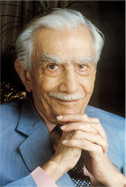
Russy Karanjia
The reason for the popularity of Blitz was "Karanjia’s unique brand of tabloid journalism — irreverent and investigative in news (readers used to wonder how Karanjia routinely attacked the Congress party and its government and yet managed to be on such friendly terms with Jawaharlal Nehru, Indira Gandhi and Rajiv Gandhi), radical and idealistic in views (with an unmistakable leftist and pro-Soviet orientation which was the intellectual flavor of the time) and never lacking in a little bit of titillation…” acknowledged The Sunday Express columnist Sudheendra Kulkarni who had earlier worked as Karanjia’s deputy. In the last phase of his journalistic career he was disillusioned with the Communists’ anti-Hindu stance and "became a sympathizer of the Bharatiya Janata Party and boldly supported the Ayodhya movement,” commented the leader of the Opposition, L. K. Advani. "His outstanding achievements as a media personality set many new landmarks in the field of journalism,” the Prime Minister of India Dr Manmohan Singh was quoted in the Afternoon Despatch and Courier of February 2.
"You may hate him or love him, but nobody could ignore Karanjia and Blitz…The editor and his weekly feared none…Karanjia spared nobody, including VIPs and Cabinet ministers. The paper took a pro-people line and hence Karanjia came to be known as the people’s editor,” wrote businessman Raghavan Nair in the Hindustan Times of February 5. Giving him credit for being "India’s first investigative journalist,” Nair added, "In those days there were no hidden cameras or sting operations. Instead one had to use all the tricks of the trade to get news.”
Blitz however "could not adjust itself to the changing political scene and competition from television channels. In failing health…Karanjia, for a brief period, supported Charan Singh at the Centre, and horror of horrors, even the saffron brigade…The end neared for Blitz as daughter and heir Rita Mehta was more focused on Cine Blitz (a film magazine started by Karanjia),” observed Gangadhar.
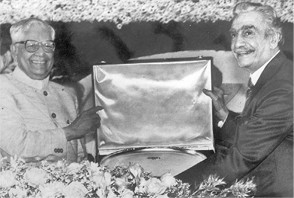
Russy Karanjia and (far right) receiving memento from R. Venkataraman
Many noted journalists of the present times have got their breaks from Karanjia and they all appreciated him because Karanjia allowed them to make mistakes, he pulled them up, shouted them down but never penalized or sacked anybody for anything. The editor’s cabin was reportedly always open for his juniors where new ideas were hotly debated. He is also known to have paid his columnists liberally and on time. Popular cartoonist R. K. Laxman was reportedly first spotted by Karanjia who encouraged him to experiment with the Blitz before he became a morning fixture for The Times of India (TOI). Explaining how Behram Contractor got his trademark sense of humor, wife Farzana was quoted in the Hindustan Times of February 2, "It was Russy who got Behram Contractor to write Busybee the way he wrote it. He just introduced him to the work of Art Buchwald who at the time would write these side splittingly funny pieces for the International Herald Tribune.”
"While other newspapers were dull and boring, Blitz was bright and energetic. While the Press was uniformly respectful of the rich and powerful, Blitz was deliberately iconoclastic and irreverent…A picture of Harold Wilson, the then British Prime Minister, was captioned ‘Wilson: hypocrite and humbug,’” recalled Vir Sanghvi who had worked as a columnist for the Blitz for a couple of years. Till the end of his career Karanjia was "gutsy, daring, driven by passion and entirely supportive of his journalists. Because he owned the paper he had no bosses. Because Blitz’s economics were subscription driven, he didn’t give a damn about advertisers…He also had a heart of gold. His biggest rival D. F. Karaka of Current found himself out of a job after selling his weekly. Others would have gloated. Russy gave him a column,” added Sanghvi.
"While Blitz defined Karanjia’s brand of journalism, he also gave to the city of his upbringing, Bombay, a morning tabloid, The Daily, launched on March 23, 1981,” declared Maneck Davar who had served as city editor for The Daily and prior to that had worked under Karanjia on BomBlitz, the forerunner to The Daily when "not only was I writer-editor-layoutman-peon rolled into one, but I also had to contend with Karanjia’s famously flaring temper and impatience. It was truly his love for the city that saw him invest his hard-earned profits from Blitz into The Daily which had to fold up, being financially unviable.” Conceding that The Daily was "sensational,” Davar added, "It was irreverent, strident and hard hitting, but compassionate where it counted. Not only did the paper raise lakhs of rupees in those days for people in need of life-saving surgeries, but we literally gave shelter to runaways, paying for their meals out of our pockets…It had the image of a bulldog in a corner of the masthead, with a strapline, ‘We are on your side.’ On the other side was ‘Good Morning, Readers,’ a positive thought for the day from various scriptures and inspirational authors…Below the masthead, in huge black headlines was one excoriating attack after another on various agencies responsible for the city’s welfare…All this and more was possible because Karanjia gave us direction and gave us room. He drove us to use unconventional methods, including a spate of public interest litigations to focus on people’s problems and the overall development of the city…”
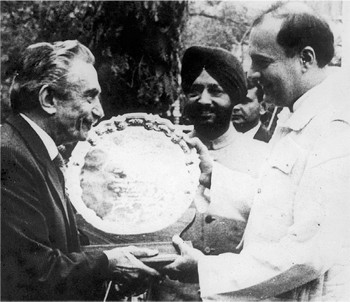
Rajiv Gandhi (right) presenting plaque to Russy Karanjia
He delighted in presenting spoofs on the front page of The Daily every April 1 to mark All Fools’ Day. When one make-believe story described the takeover of Ramnath Goenka’s Indian Express by then Maharashtra chief minister Abdul Rehman Antulay, Karanjia was served a notice by the Goenkas, much to his amusement. Described variously as a self-publicist, a self-declared atheist and Marxist, there was a time when Karanjia’s favorite target was Sathya Sai Baba of Puttaparthi. But after he was given rare access and interviews by the guru, Karanjia proclaimed him as a living god, becoming his follower.
Being a natty dresser, Karanjia was chosen to model for Vimal Suitings. As wrote columnist Bachi Karkaria in The Times of India (TOI) of February 2, "Russy was a Clark Gable look-alike who wowed women effortlessly and chased his professional prey unflaggingly.”
Born in Quetta, he displayed a penchant for writing from his college days, contributing to and editing his college magazines. He pursued his interest by regularly writing letters to the editor of the TOI, and then responding to them under different names! When the editor came to learn of this he offered him a job. As a cub reporter of TOI he was asked to procure a report on the highly confidential conclave of Indian Princes at the Taj Mahal Hotel. Disguised in princely regalia he arrived in a limousine and confidently strolled into the closed door meeting where the princes were deliberating on their post-Independence future, related Gangadhar. By the time he was discovered and thrown out, he had obtained sufficient material for a major scoop!
Blitz was started by him in 1941 (coincidentally the same day, February 1, when he breathed his last) when he was not considered for the post of editor of the TOI. Over the years he earned fame and foes interviewing world leaders like Gamal Abdel Nasser of Egypt, Sukarno of Indonesia, Josip Tito of Yugoslavia and Fidel Castro of Cuba. For using his paper and personal persuasive power to cement Arab unity and work for reconciliation between Egypt and the Soviet Union, Nasser personally decorated Karanjia with the highest honor of the then UAR, the Republic Order of Merit (Grade I) in 1965. He had also been conferred the Soviet Union’s highest prize for outstanding achievements in international journalism in 1988, and a Saropa, the highest honor conferred by the Sikhs.
On the occasion of his completing 75 years of age and 50 years in the field of journalism Karanjia had been specially felicitated at a function in Bombay in 1988, attended by then President of India, R. Venkataraman who had described the septuagenarian as a "crusader for social justice.”
The enigmatic editor is survived by his daughter Rita Karl Mehta.
◆ ◆ ◆
From the archive