
In Memoriam
Katrak’s quest
Died: Kersy Dadyseth Katrak, 71, poet, author and copywriter who was considered the father of creative advertising in India, on December 28, 2007 at his residence in Bombay.
"An icon for advertising people from the 1960s to the 1990s” at the age of 29 Katrak founded Mass Communication and Marketing (MCM) "the advertising agency that has been the training ground for most of the leaders of the Indian advertising industry over the last four decades,” summed up a tribute by colleague Anand Halve on the advertising portal agencyfaqs. "It was Kersy’s view of advertising as a business of ideas, and that of exhilarating, exciting creative expression as the celebration of the idea that attracted the most extraordinary collection of advertising genius ever found under one roof in India.” They did work for clients like Laxmi Vishnu Mills, Mafatlal, Swish blades, Godfrey Philips and others before MCM closed down in the ’70s. In the late 1980s when Alyque Padamsee needed to give a resurgence to Lintas, he brought in Katrak to restructure the creative department at that agency. For a while he took on a consultancy role at a private airline, advising them on inflight branding options.
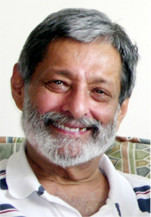
Kersy Katrak: creative standards
"For almost half a century Katrak challenged those he worked with...to produce work that you were proud to say was yours. Today his legacy lives on at The Republic. The agency is his youngest child and at five it is a joyous place, full of energy and utterly devoted to the idea,” noted Halve saluting Katrak for having "started the creative revolution that has brought us to this day when we seek inspired creative advertising as the norm, not the exception.”
"Kersy Katrak was a pirate with the heart and halo of a priest… everything I wanted in a guru,” acknowledged Josy Pail, chairman of the advertising agency BBDO, adding, "Kersy was crazy and his madness was our inspiration. We worshipped him for the way he set us free. We felt invincible when he was around…Kersy was a cathedral I continue to worship, humbled by the experience.”
"By raising creative standards to unprecedented heights…he could make a mundane machine tool look as desirable as chocolate as it were,” credited Bobby Sista, founder of Sistas Advertising.
In her column in the Mumbai Mirror of February 28, 2008, Eunice de Souza wrote, "Katrak began writing and publishing at the age of 16 and with Nissim Ezekiel was one of the first poets to be published in The Illustrated Weekly in the early post-Independence years. He was a fine poet whose forte was the long, reflective poem, sometimes shot through with irony, and sometimes a wicked sense of humor. Many of the poems are about a spiritual quest…” At the Kala Ghoda Festival in early 2008, one of the sessions was dedicated to the memory of poets who died recently and "Katrak figured significantly that evening,” remembers Parsiana reader Rashid Khosravi. The poet had two collections of verses to his name: A Journal of the Way and Diversions by the Wayside.
"The craft of poetry and writing is a demanding thing…A good poet is no different from a good carpenter,” Katrak had conveyed in an interview with Geeta Doctor in Parsiana, April-May 1974, adding, "A poet has to make out of his life meaningful connections that may be of use…Any of the arts can only be regarded as a poor mystical substitute for the real thing…Modern poetry is obscure…reflecting an obscure universe…Basically poets are talking to each other. They are like alchemists in Medieval Europe who kept alight little flares of knowledge through which they could understand each other.”
Actively involved in theater in his younger days he worked with Ebrahim Alkazi’s Theater Unit. "To each of his performances at the Theater Unit he brought an intellectual depth and subtlety which enriched one’s understanding of the play,” noted Alkazi, director of the National Institute of Drama in his condolence letter. Later this interest in drama led Katrak to write three plays, Avadhoot, A State of Emergency and Nightbirds, the last of which was produced and directed by the late Pearl Padamsee and starred Hosi Vasunia and Vijay Crishna.
He wrote regularly for The Illustrated Weekly and The Sunday Observer under the pseudonym of Sarosh Demavand (an obvious reference to Sarosh Yazad and Mount Demavand) and later even for Outlook magazine. He managed to persuade A. D. Gorwala, the editor of Opinion, to start the Opinion Literary Quarterly which he edited with poet Gauri Deshpande.
In one of his pieces for Outlook Katrak conveyed his admiration for Bombay: "When I was packed off to study at the Cathedral and John Connon School, I was still a subject of His Majesty, King George the VI. The battle for Stalingrad was at its height and Gandhi was about to launch the Quit India movement. It was a unique and interesting way of growing up: feet planted firmly in Girgaum mud, head full of Shakespeare and Edmund Burke. That was the Bombay I grew up in…It is an impossible city to live in, but once you have been seduced by its essence, it is impossible to live in any other city…”
Nevertheless "he was at his happiest away from the city in the mountains of the Kumaon with close family, his days spent reading in the sun and walking in pine forests and his nights in animated conversation over a fire with a glass of fine old whiskey in his hand,” reveals his daughter Maia referring to his varied passions that covered Western Classical music, homeopathy, astrology..."Katrak manages to combine the rugged masculinity of a pocket-size Hemingway with the kindliness of Santa Claus,” is how Doctor described his physical attributes.
"My father’s chief feature was a deep and abiding interest in the life of the spirit…His focus was clearly more on the inner life than on the outer. He was a voracious reader and his taste in books reflected his passion. His extensive library is packed with books on philosophy, religious history, theosophy, poetry, the environment, alternative therapies, astrology, yoga and biographies of saints and yogis…” added Maia.
Brought up by a very devout Zoroastrian mother, he considered himself fortunate to have been sent for his priestly training under Dastur Framroze Bode at the Fasli Agiary where he was first exposed to books on theosophy and philosophy. The progressive Dastur aroused in Katrak a great curiosity that extended beyond the rituals of the religion to the guiding spirit that lies at the heart of it.
As Katrak had conveyed in his interview with Parsiana three decades ago, "I was ordained as a priest but it is not my religion any more. The Parsis are a distinct community but they don’t have a meaningful religion…I have very warm feelings towards the Parsis. As for myself, I treat the fact of my birth and the Parsiness of it as an accident…”
Although Katrak later gave up "the outer trappings and rituals of the religion he never lost his great love for the Prophet Zarathushtra, for the Gathas and for the simplicity of his teaching,” states Maia. "And he never forgot the prayers — until the end of his life he could recite them flawlessly in his rich baritone, recite them with such feeling that the air in the room would be charged, and his own face utterly still and at peace.”
The creative copywriter is survived by his mother Bachchi, wife Usha, daughter Maia, brother Cooverji and sister Meher Pinto.
◆ ◆ ◆
From the archive