
Books
Being Burjor
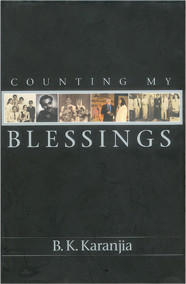
Counting My Blessings by B. K. Karanjia. Published in 2005 by Penguin Books India Private Limited, 11 Community Centre, Panchsheel Park, New Delhi 110017. Pp: 297. Price: Rs 495.
Counting My Blessings by B. K. Karanjia. Published in 2005 by Penguin Books India Private Limited, 11 Community Centre, Panchsheel Park, New Delhi 110017. Pp: 297. Price: Rs 495.
Pioneering editor of film magazines, author of a slew of books including biographies of notable personalities, chronicler of 100 years of Godrej enterprise, Burjor K. Karanjia has, at the urging of family and friends, written this account of his own life and times. His flowing narrative style keeps the reader eagerly awaiting the next turn of events. His writing is understated, interspersed with gentle humor. Enhancing the value of the memoir are photographs of his family and connections from the film world.
Once a writer, always a writer… It is no mean feat that Karanjia has, at the ripe young age of 86, penned this life story. Even more amazing is the fact that he continued to be hands-on editor of Change, the Godrej house magazine till recently. Writing an autobiography is necessarily a subjective exercise, and Karanjia has depicted his early years through a series of anecdotal reminiscences. Brief and entertaining, they are guaranteed to hold the interest of readers such as the chapter on how he dealt with his testosterone-driven but abortive encounter with a prostitute during his teen years.
Born in 1919, according to the rasi Karanjia’s name should have begun with a ‘Y.’ His parents wanted to name him Yuzud (which is what Karanjia has named his own son), but his maternal grandfather, Khan Bahadur Burjorji Patel, the merchant prince of Quetta, expressed the wish that he’d "like the little fellow to have my name’’ — resulting in him being Burjor. Karanjia’s grandfather became the little boy’s ideal of what a man should be. So, when he expressed a wish that young Burjor appear for the Indian Civil Service (ICS) exams, the course of his future was decided for him.
Khurshedji, Karanjia’s father, was an opthalmic surgeon with his practice at Dhobi Talao. Hot-tempered and a strict disciplinarian, his sons Russy (founder editor of Blitz), Sawak and Burjor, had to be on their best behavior when he was at home. Their mother, Temina, indulged her brood, but within strictly defined limits. Quetta House, their home at Chowpatty, was a wedding gift from her parents. Theirs was an unusual family, Karanjia recalls, where the mother paid the bills, but the father laid down the rules. Naturally, Temina, or Na as they called her, became their confidante, a go-between for the paterfamilias and his sons.
The highlight of Karanjia’s childhood was the annual visit to his grandparents’ magnificent home in Quetta. The orchard on their grounds was full of trees groaning under the weight of fruit — peaches, pomegranates and apples. Strawberries grew in vast beds, waiting to be picked and there were big, juicy grapes to gorge on. Sikander, their grandfather’s retainer, would take the boys around the grounds, teach them how to cycle and cater to their hearty appetites with rich foods, unlike the simple fare they were accustomed to in Bombay. Loyal to the family, Sikander sadly vanished when Quetta was devastated by an earthquake in 1935.
Karanjia’s years at Wilson College helped him to plumb the rich depths of the English language and literature, to hone his public speaking skills in debates, to participate in plays and to make new friends. It was here that he met his life partner, Abad (née Allbless). Their marriage, lasting over six decades, was a strong partnership which weathered many ups and downs in their personal, family and professional lives. Karanjia credits her unflinching faith in Zoroastrian prayers for the miracle that saved the eyesight of their young son.
"Change is a stimulant. For me it is the breath of life,’’ writes Karanjia. Nothing illustrates this better than the unpredictable trajectory of his career.
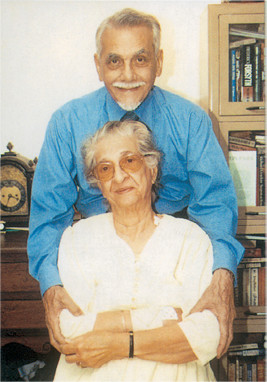
Burjor and Abad Karanjia
Photo: Vishwanath Salian
Karanjia passed his ICS examination with distinction in 1943, after a grueling period of preparation, studying for as many as 16 hours a day as the exams approached. He was assigned to the Supply Department of the Government of India at the then princely salary of Rs 450 per month. Though on the threshold of marriage, and in need of a job, he quit after two days as he found the work unsuitable. Jobs were not easy to get and, unable to face his parents, he went to Sir Rustom Masani, his father’s friend, to explain his predicament. To his astonishment, Masani congratulated Karanjia and offered him a job as his assistant in the National War Front which he had just started.
During the years spent working with Masani, Karanjia’s literary inclinations were awakened. After concluding his assignment with his mentor, Karanjia launched two film magazines: Cinevoice, a monthly, and Movie Times, a weekly, which he edited, with the help and constant support of his wife, between 1947-53. It was his conviction that "Indian cinema would come to play a tremendous role in the education and entertainment of the people. For this purpose, however, the industry would need to be aided by journals of the right type in voicing its problems and, if necessary, in fighting its battles.’’ They had many firsts to their credit — the first film awards, the first stars’ gala nite, the first celebrity cricket match. Unfortunately, both magazines closed down. Karanjia ruefully confesses: "Frankly, my own lack of business sense was probably the main reason for the financial straits in which we found ourselves.’’
Karanjia then served as publicity manager for the Godrej Group from 1953-61, forging close ties with that family which in later years resulted in his becoming the official chronicler of 100 years of Godrej enterprise, as well as authoring biographies of Ardeshir, Sohrab and Naval Godrej.
In 1961, when Karanjia was offered the editorship of Filmfare, a Times of India publication, the lure of film journalism proved irresistible. He also needed to prove to his mother that he was not a failure on that front. Karanjia remained editor of Filmfare for 18 years, during which he was appointed honorary chairman, Film Finance Corporation (FFC) from 1969-76. He recalls with passion his years as head of FFC which funded small budget films of talented directors, ushering in the era of meaningful — read ‘art’ — cinema in India.
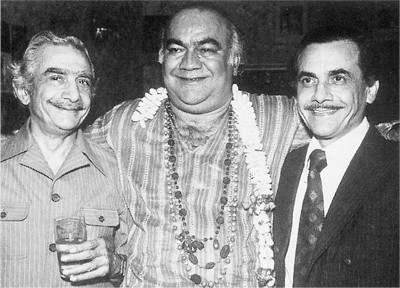
From left: Brother Russy, actor Premnath and Burjor
During his 40 years in film journalism, Karanjia also edited Screen, an Indian Express Group publication (1978-88) and became chairman of the National Film Development Corporation (NFDC) from 1988-91. He was member of the advisory committee of the Film and Television Institute of India and the National Film Archives of India. He has also served in various national and international film juries. Karanjia has used the vehicle of this book to set the record straight about his abrupt departure from Screen — without even the promised farewell party! — over a professional disagreement with the management. He resigned as chairman of the NFDC following sharp differences with the then information and broadcasting minister, V. C. Shukla, whose dictatorial ways were impossible to stomach. Though Karanjia says he does not hold any grudges against those who sought to harm him, his annoyed petulance which comes through is understandable.
Valuable insights into the inner workings of tinseltown are provided in over six chapters reprinted from Karanjia’s earlier book, Blundering in Wonderland (published by Vikas Publishing House Private Limited), which has been out of print for several years.
Having found fulfillment in his work as a writer, great happiness in the love of his (late) wife and children, Rutton, Delshad and Yuzud, discovering the joys of fitness and good health (post a heart attack), Karanjia finds himself in harmony with nature. In the evening of his life, he lives alternately in Saudi Arabia and London where his two daughters reside.
Overall, this is the story of a man who had the courage to turn tack when faced with tricky professional dilemmas, turning his back on lucrative options and venturing into new fields, working hard for poor returns initially because he believed in what he was doing, and making a success of it. Having maintained a low-key profile throughout (unlike his flamboyant brother Russy), he has now convincingly put on record his achievements without resorting to false modesty. The reader is invited to witness the working of the mind of a man who is both impulsive and courageous, aloof and forthright, adventurous and foolhardy. A story that needed to be told, for a deeper understanding of his varied and interesting achievements.
Sherene Vakil
◆ ◆ ◆
From the archive