
In Memoriam
Exacting editor
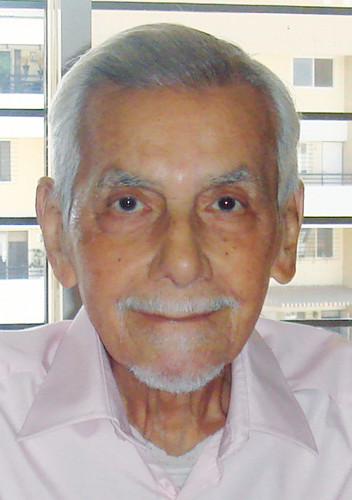
Died: Burjor Khurshedji Karanjia, 92, author, chronicler and veteran film journalist who was editor of magazines like Cinevoice, Movie Times, Filmfare, Screen, and former chairman of the Film Finance Corporation (FFC) on June 22, 2012 at Poona’s Jehangir Hospital following aspiration and pneumonitis.
"As I grow older I begin to realize how to find happiness in the little things of life,” Karanjia had written in an incisive article "Encountering old age,” specially penned for the August 7, Navroz issue of Parsiana last year. "I have discovered the joys of good health and of living in harmony with nature. I have learnt to be tolerant and understanding and never to sit in judgment. I have begun to listen, really listen to what other people are saying. I have learnt to control the random thinking in my head and the brazen depredations of my ego. I have learnt the humility of recognizing my limitations and in doing so, discovered the inner strength and fearlessness one needs to emerge from old habits and set patterns, and recognize difficulties for what they are — just obstacles. And obstacles by their very nature have a way of vanishing when confronted,” noted Karanjia to whom writing was "a form of prayer.” Besides Parsiana he continued to write for Harmony, Sunday Guardian and Diplomat.
Until he was 86 years old, Karanjia would regularly attend his office at Godrej Bhavan from 8 a.m. to 4 p.m. to oversee the progress of the Godrej house magazine Change of which he was founder editor, to write his biographies of Godrej stalwarts and chronicle the 100 years of the organization where he had spent the last 20 years of his eventful career. As Karanjia had written in his memoir, Counting My Blessings, "It was with Godrej that I became a full-time, full-fledged writer and felt fulfilled as never before.” There was also a spell from 1953-61 when he had served as publicity manager for the Godrej Group.
As he had earlier related, his "strictly disciplined life” involved a routine that commenced at 6 each morning, bathing, reciting his kusti prayers, and reading The Times of India and The Indian Express to keep himself well informed. Another fixture each day was a glass of beer with a papad at 11.30 a.m., a practice that had been started during his days at Godrej when before going to the Ripon Club for lunch each afternoon he would treat himself to beer.
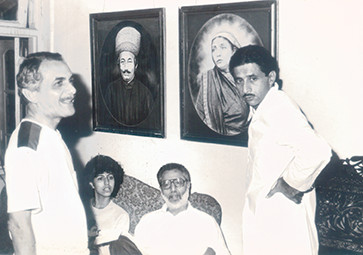
Burjor Karanjia (top and alongside) with Naseeruddin Shah (standing) and Farrokh Mehta on the sets of Pestonjee in 1988
Having spent four decades in film journalism, Karanjia is known to have had "excellent relations with all producers, directors and actors…(but) was rarely seen at glitzy film parties which did not fit his serious disposition…(He) always managed to keep himself disciplined and controlled. This was why he held a highly respected and honored place in the industry,” reminisced Sukumar Shidore, former general manager of the government run FFC, in his article in Loksatta. "There was chaos and indiscipline in the film industry after independence. Black money was pouring in and the ‘star system’ had gone haywire. Making formula films for a quick profit appeared to be the main intention of producers… It was during this phase of the Indian film industry that the FFC was created in 1960 to offer financial assistance at low interest rates for making sensitive art films… The government was convinced that (Karanjia) would make this organization do constructive work,” added Shidore referring to the 36 art films like Saara Aakash, Maya Darpan, Swayamwaram, made during Karanjia’s chairmanship and the Aakashvani auditoriums that were opened to screen these low budget films.
Several years later he was appointed chairman of the National Film Development Corporation but resigned from his post due to differences with the information and broadcasting minister, V. C. Shukla. He was additionally a member of the advisory committee of the Film and Television Institute of India and the National Film Archives of India and served on various national and international film juries.
Realizing that Indian cinema would need the assistance of the print medium in its efforts to educate and entertain the people, Karanjia launched his own monthly film magazine Cinevoice in 1947 followed by Movie Times, a weekly, a few years later. He had the support of his wife Abad in both these ventures but the magazines were wound up. As he candidly confessed, "Frankly, my own lack of business sense was probably the main reason for the financial straits in which we found ourselves.”
Some years later when he was offered the editorship of Filmfare, a Times of India publication, Karanjia gladly accepted the challenge and continued as editor for 18 years. For a decade later he was editor of Screen, published by The Indian Express Group. His experiences of tinseltown were recounted in his book Blundering in Wonderland. In his autobiography Karanjia admitted, "Throughout my tenure in Filmfare and then in Screen, I had the constant feeling that it was not I who was being honored, it was the chair I was occupying. This was a rather humbling and yet satisfying experience, and is perhaps as it should be. Film journalism was looked down upon… I had to uphold the dignity of film journalism. This was best done by example. I was ‘in’ the film industry but not ‘of’ it.”
In a tribute to him on the website of India Herald in Houston, Gokul, a writer and actor based in Los Angeles who used the nom de plume of Gadfly commented, "The annual Filmfare awards were India’s Oscars…Karanjia was always the host, yet had distaste for the filmy lollapalooza and the brouhaha of inflated egos… Through his many editorials and books he wrote the template of commandments for the Indian cinema that India’s film industry would do well to benefit from if only they read them…”
For the film Pestonjee, screened in 1988, that had a multiple star cast of Naseeruddin Shah, Shabana Azmi, Anupam and Kiron Kher, it was Karanjia who wrote the dialogs and screenplay.
Polite and soft-spoken, the "gentleman editor” had many admirers and any praises were invariably acknowledged with, "Thank you. That’s very kind of you.”
Always punctual and considerate, as children, he and his brothers, Russy (founder editor of Blitz) and Sawak were expected to be on their best behavior for their father Khurshedji, an ophthalmic surgeon, was known to be hot-tempered. Whilst their father laid down the rules, mother Temina paid the bills. He was named after his maternal grandfather Khan Bahadur Burjorji Patel, the merchant prince of Quetta, who had decided that the young lad’s future lay in the Indian Civil Service (ICS). After his graduation from Wilson College Karanjia passed his ICS with distinction and was assigned to the Supply Department of the Government of India. Realizing that the work was unsuitable to his nature, after one day at the job he quit.
Unable to face his parents, he went to Sir Rustom Masani, his father’s friend who congratulated him on his decision and offered him a job as his assistant in the National War Front that he had just started. Whilst working with Masani, Karanjia’s literary interests were aroused. He subsequently went on to author a biography of Masani titled Portrait of a Citizen.
Over the years, the choice of his reading shifted from the great novels of Charles Morgan and Lawrence Durrell to scientific and spiritual books and he expressed how he has been "a firm believer in Sri Aurobindo’s Hidden Forces of Life. These forces had come to my aid in several times of crisis in my career and guided me to the right path.” Books by the German spiritualist Eckhart Tolle, he believed, "transformed me, they made my declining years exciting and a challenge.” He also found inspiration in listening to Western classical music and as a member of the Poona Music Society would regularly attend their programs until his mobility was restricted by a broken hip two years ago. With regular exercise, practice of yoga and strong will power, he was able to walk again.
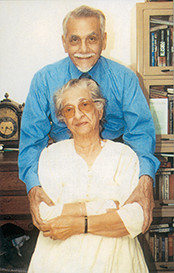
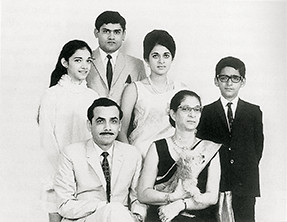
Burjor and Abad Karanjia (left) and with family (from left) Delshad, Zulfikar Bharmal, Rutton and Yuzud
"My father was a man of great faith but not a great believer in rituals or traditions,” revealed Karanjia’s daughter Delshad Kumana adding, "He firmly believed that ‘work is worship.’ He was extremely open-minded and liberal and was amazed at the petty squabbles between members of our small community.” In his novel, More of an Indian, Karanjia had dealt with the emotions of a Parsi girl who is torn between her non-Parsi lover and her father. As Karanjia had conveyed in an interview with Parsiana (see "The Greater End,” October 1973), intermarriage with non-Parsis would be bound to "destroy the pristine purity of the religion,” but that in the long run "a country is greater than a religion.” His collection of short stories was titled Masks and Faces.
With his last book review for Parsiana written barely a month before his demise, he shared a special rapport with our publication: he felt honored to write for us and we deemed it a privilege to carry his articles. In fact, in later years, he declined payment for his reviews and articles. He was known to be a man of extremely simple habits, humble and undemanding but if perchance an issue of Parsiana did not reach his abode in Poona, we would be promptly requested to dispatch a second copy. In fact when copies did not reach by ordinary post or courier, they were sent by Registered post knowing that he so looked forward to them in his old age.
As the evolved writer had graphically expressed in his memoir, "At my age the flesh weakens, the body sags and life tends to fall into a sterile groove. But the trained mind remains awake, alert and ready to accept change... Change is a stimulant. For me it is the breath of life. When life ceases, change ceases. We live in a time of change. To change is to grow, develop, explore and expand. You tackle change and it changes you, and then change becomes a celebration. Life is forever change, and when the End comes, it too is just a change of lodging.”
The respected writer is survived by his daughters Rutton Zulfikar Bharmal and Delshad Kumana, and son Yuzud.
◆ ◆ ◆
From the archive