
In Memoriam
Intrepid Irani
Died: Cushrow Russy Irani, 74, chairman and editor-in-chief of The Statesman, and a fearless crusader of a free Press, on July 23, 2005 in Calcutta following multiorgan failure.
Died: Cushrow Russy Irani, 74, chairman and editor-in-chief of The Statesman, and a fearless crusader of a free Press, on July 23, 2005 in Calcutta following multiorgan failure.
"Irani was among the tallest of our journalists. He was a distinguished editor, a learned commentator on political, judicial and social issues, an institution builder, a leader in his profession and above all a truly secular nationalist,” summed up the Prime Minister of India Manmohan Singh in his condolence message. He further commended Irani for being "passionately committed to the welfare of our people and the progress of our nation…As chairman of the Press Trust of India he helped invigorate this organization at a time when it was forced to face the challenge of competition at home and abroad. His expertise in constitutional matters helped the country when he was made member of the Constitution Review Commission.”
The President of India Dr A. P. J. Abdul Kalam admired Irani "for his innovative and purposeful writing…(of) a number of thought-provoking books.” The Vice President of India Bhairon Singh Shekhawat "looked forward to reading his popular column ‘Caveat’ which was a virtual crusade against corruption and all that is wrong in our system of governance… In his passing away we have lost a veteran journalist known for his courage and exemplary moral standard.”
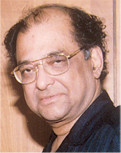
Irani: all for Press freedom
Impressed with Irani’s "unflinching spirit” former attorney general of India Soli Sorabjee recalled in The Indian Express of July 24, 2005 how Irani convinced him to join the board of The Statesman during the Emergency "to ensure that The Statesman did not succumb to any political pressure… We were firmly agreed on one point. The Statesman would not crawl, nor bend and follow the disgraceful example of some national dailies…” In the face of several onslaughts during the Emergency The Statesman had to seek legal redressal umpteen times when they worked conjointly. After Sorabjee resigned from the Board they remained good friends "but that did not prevent him from castigating me in one of his Caveats… He could be arrogant, have scraps with his editors and did not suffer fools gladly. But he had that rare and lovely virtue, courage, which he displayed at all times not counting the cost,” summed up Sorabjee.
In appreciation of the ordeals encountered during the Emergency Irani was rewarded with the Freedom Award by New York’s Freedom House and the Astor Award by the Commonwealth Press Union, London for "distinguished service in the cause of Press freedom.” He was the first Indian to be elected chairman of the International Press Institute (IPI) in 1980. He was reelected to this post in 1981, 1990 and 1991 and was made an honorary life member in 1982. As noted the condolence letter from IPI director Johann Fritz, "Cushrow was not only a preeminent figure in Indian journalism for more than 40 years but also a staunch defender of Press freedom worldwide.”
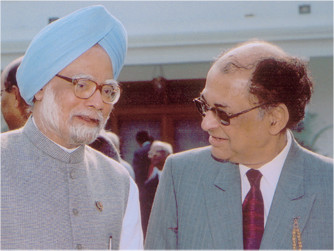
Manmohan Singh (left) with Irani
At the World Press Freedom Committee (the apex body of Press freedom organizations all over the world) "he served in various offices for 25 years. Every major publication that I recall had his input. Every meeting saw him in the lead. Cushrow was always there when needed, speaking out with authority, going beyond what any of us in the West could convey…he was not from any region but a leading citizen of the world,” reminisced Dana Bullen. Among the other international bodies with which Irani was associated were the International Center for Journalists where he served on the advisory board and ARTICLE XIX, the human rights organization headquartered in London where he was on the board of directors.
"His high moral values and professional integrity made him a very respected and recognized personality around the world,” attested Abdul Waheed Khan, assistant director-general for communication and information, United Nations Educational, Scientific and Cultural Organization (UNESCO), adding, "He supported UNESCO’s mandate ‘to promote the free flow of ideas by word and image’ by being a member of UNESCO’s advisory group on Press freedom at its inception. He was also actively involved in different UNESCO programs notably in countries in transition such as Indonesia, Columbia and the Philippines.”
The establishment of a C. R. Irani Institute of Good Journalism would be a worthy tribute to Irani who chose "the brave, the gutsy and the path of honest journalism,” wrote Mira Kakkar of Thoughtshop Foundation, "and as not to waste this human being gifted to us he should consciously be held up as an example to all young journalists. Let them learn what it takes to be C. R. Irani – the journalist who stood up to world governments and corporates.”
In the mid-1960s, Irani had rescued The Statesman (started in 1875) from "falling into the hands of unscrupulous politicians and their minions and a decade later from being captured by Indira Gandhi and her cohorts during the infamous Emergency,” recalled S. V. Raju, editor of Freedom First continuing, "In this battle he was to keep company with another indomitable figure, Ramnath Goenka, the founder of the Indian Express and with men of character and integrity like A. D. Gorwala, editor of the weekly Opinion, Minoo Masani, editor of Freedom First and Sorabjee.” The People’s Union for Civil Liberties (PUCL) appreciated in its Bulletin of September 2005 how Irani always gave one year’s full page advertisement of The Statesman in the PUCL Bulletin. He also donated newsprint from The Statesman, Delhi for the PUCL Bulletin.
The Indian Newspaper Society viewed him as "a valuable mentor,” and as noted their condolence resolution, "The Society remains indebted to him for his untiring efforts in promoting the interests of the publishing fraternity.” The Press Trust of India Limited, the leading news agency in the country, was the other national organization where Irani had served as chairman for three terms.
At the time of the Indo-Pakistan war in December 1971, Army chief Sam Manekshaw sought a special favor from Irani: to urgently print pamphlets to be dropped over what was then East Pakistan to get their soldiers to surrender, recalled Lt Gen Adi Sethna who was deputed on this mission. Over the years The Statesman increased in its versatility and besides Calcutta was also published from New Delhi, Siliguri and Bhubaneshwar. Irani’s Caveat columns have been compiled into four volumes. In Pursuit of Freedom is a collection of his speeches and articles. Additionally he has authored Bengal – the Communist Challenge, Pax Americana – the war that lost Iraq its freedom, and Ayodhya – Demolishing a Dream.
Before his appointment as managing director of The Statesman Irani had a brief foray into politics when he joined the Swatantra Party and a few years later was elected national joint secretary and a member of its national executive. After his studies at St Xavier’s School, St Xavier’s College and Government Law College in Bombay, Irani did not practice law but joined the Alliance Assurance Company Limited in Calcutta as a trainee executive and was sent to London for further training within six months. Thereafter he was with the Sun Alliance Insurance Group and later passed the Fellowship Examination of the Chartered Insurance Institute, Institute of Arbitrators, London and Federation of Insurance Institute. The Vintage and Classic Car Club of India gives Irani credit for being "the pioneer in organizing vintage car rallies in Delhi, Calcutta and the earlier years in Bombay too.”
Besides his popularity in the Indian circles, Irani was respected by several consulates and embassies as attested by their condolence letters. He was made Knight Commander of the Order of Isabella Catholica by the King of Spain for "highest loyalty to democracy.” "Over the years visiting American dignitaries including former US ambassadors to India made it a special point to call on him during their visits to Calcutta and discuss with him issues of bilateral and international interest,” noted the condolence letter from the consulate general of the United States of America.
But it wasn’t only the state dignitaries with whom Irani fraternized. "Mother Teresa…found a good friend in Irani,” wrote superior general Sr M. Nirmala on behalf of the Missionaries of Charity. An admirer of The Calcutta Samaritans, their condolence letter mentioned, "It was only because of the support and encouragement of good people like him that we were inspired to carry on in our work with the suffering and marginalized people of Calcutta – people in the slums, on the streets, rickshaw pullers, women and children, drug addicts, alcoholics and so on… With his passing, Calcutta’s civic life will never be the same again.”
Irani found time for community institutions too. He was the senior trustee of the R. D. Mehta Estate and fellow trustees would always consult him on legal and other matters, recalls his wife Threety. Additionally he evinced keen interest in the development of the community at the Calcutta Zoroastrian Community’s Religious and Charity Fund and would go out of his way to find a good lawyer to safeguard the community’s interests. Prominently pinned onto the collar of his coat was an asho farohar hung on a gold chain that constituted his regular attire and proclaimed his Zoroastrian allegiance.
The fearless journalist is survived by his wife Threety and daughters Ratti Sharma, Nilufer Babaycon and Nirvan Shroff. Parinaz M. Gandhi
◆ ◆ ◆
From the archive