
Media
Press-ing ahead
Never one to be bowed down by adversity, Hormusji Cama dons the leadership mantle of the Indian Newspaper Society
When one-time home minister Buta Singh’s driver honked at the car in front which had halted at a red light, the last thing he expected was for the vehicle’s occupant to step out, stride over, open Singh’s car door and tell him in no uncertain terms that if the politician wanted to break the signal he could, but he was not going to.
Singh apologized as security personnel scurried around the outspoken Hormusji Cama, a director of the Gujarati daily, The Bombay Samachar.
When Cama visited the information and broadcasting minister Priya Ranjan Dasmunshi, the official was intermittently watching a sports match on a television placed in the office. Cama prepared to walk out of the room when the minister asked him the reason for his unexpected departure. Upon being told about the television set distracting the minister, Dasmunshi paid attention to Cama but not before admonishing him that "I’m your minister.” To which Cama retorted "I’m your employer,” a reference to the taxes paid by Cama and others.
Never one to be daunted by an opponent, the six-foot, 46-year-old Cama, took the Indian Newspaper Society (INS) to court when the election results for the prestigious newspaper body’s presidency showed he had lost by 89 votes.
"If I had lost by three or four votes I would have accepted the result,” said Cama, then INS vice president. But a 89-vote margin meant something was amiss. Cama took the matter to court and the Bombay City Court judge P. S. Paranjpe noted in his judgment, "Twenty-three bogus ballot papers were cast and there is absolutely no explanation offered by the defendants (INS) as to how come 102 ballot papers were cast even though 79 persons attended the AGM.
"In this election not only the members but even their proxies attended the AGM and both of them cast the votes. This is absolutely unheard of… It has been established by the plaintiffs (The Bombay Samachar and Cama) beyond any doubt that various proxies which were declared invalid should not have been declared invalid and various proxies which were declared as valid could not have been declared as valid.”
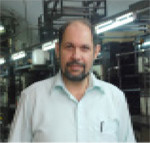
Hormusji Cama:"The industry (is) faced with tremendous hurdles”
The judge nullified the election of D. D. Purkayastha of the Calcutta based daily The Telegraph in September 2005. A year later Cama was voted president unanimously. The convention is for the vice president to assume the presidency for a period of one year. Cama had served as the vice president for the year 2003-2004 but was denied presidency on account of the irregularities in the election.
The Cama family along with the scions of The Hindu and the Malayala Manorama are the only ones to have three of their family member serve as INS presidents. Cama’s grandfather Muncherji (1950-51) and uncle Rusi (1986-87) also held the top post. The 68-year-old all India body formerly known as the Indian and Eastern Newspaper Society has over 700 members with a combined circulation of over 53 million, notes its website.
In his first letter to members as INS president Hormusji wrote, "The industry (is) faced with tremendous hurdles. The government seeks to curb our freedom and finds novel ways to achieve its aims.” Cama was particularly perturbed about the proposed setting up of a new wage board for journalists and other press workers. "All other wage boards have been scrapped,” says Cama as "they are no longer required.” The electronic media is not covered by the wage board, he adds. So there is no justification to single the print media for special treatment.
Another point of contention is the advertising rates set by the DAVP (Directorate of Advertising and Visual Publicity). The understanding was that only government bodies could avail of special discounted tariffs while advertising in the print media. But a zealous minister tried to extend the coverage to public sector units (PSUs) such as banks, airlines, insurance companies, etc.
Cama obtained a court judgment of 1981 in which The Statesman had opposed the Government of India’s inclusion of PSUs under the DAVP tariffs and won. All PSUs have to pay "the card rates,” that is the regular tariffs charged by the industry, noted the court.
When asked about the repeated prediction that the newspapers are a sunset industry and that according to one media authority, Philip Meyer, a University of North Carolina journalism professor, "the last daily reader will disappear in September 2043,” (Rind Survey, August 2004) Cama retorts, "If I had a crystal ball I would comment… looking to the present I don’t think print can ever disappear. I don’t think anything can replace print.”
He cites the increase in global consumption of newsprint to substantiate his point, adding that China was investing heavily in newsprint. "Why are they doing so if there was no future in print?” He noted however that new technologies were being developed especially in Japan and Sweden whereby a thin acrylic sheet would carry news that was being constantly updated. A touch screen would make maneuvering easy. "New technologies are for the cities,” he says, "but in the villages people will still want papers to read.”
Commenting on an Indian Readership Survey (IRS) finding that newspaper readership in India is on the decline, Cama notes that some of the findings are at variance with the circulation figures cited by the Audit Bureau of Circulation (ABC), a body that certifies the circulation figures of member newspapers and magazines.
Cama believes the methodology used may not have accurately reflected the true picture. "I’m not prepared to believe that each and every publisher is a cheat” claiming a higher circulation than the publication actually has, he states. Since many newspaper firms are now publicly owned, a dip in readership, real or imagined, would affect their share valuation.
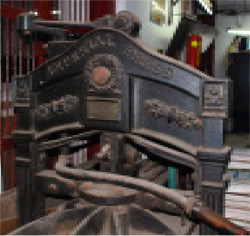
Decorative crown of an antique proofing press at the Samachar
The family paper The Bombay Samachar is "slightly growing,” says Cama with an ABC certified circulation of around 1,00,000. The paper is trying to target the younger reader. The Gujarati reading population in south and central Bombay is "stagnant.” The migrant population from south Gujarat that has moved into north Bombay prefers to stay with the Gujarat Samachar, he observes.
In order to expand the Samachar base, Cama says the company has plans "to go into Gujarat in a big way.” The company will "tie up with somebody.” What happens after the present generation of Camas? "Professional management,” he says. "Today we (Hormusji’s brother Muncherji, cousin Mehli and himself) manage. After us professional managers” will run the business. As regards diluting the family equity in the Samachar company, Cama says "we will resist it in our lifetime.” The Samachar, he proudly notes, is Asia’s oldest existing newspaper and the fourth oldest in the world. It’s been in the family since 1932 when the previous owner Navroji Belgamwalla defaulted in his payments to the Camas and other creditors. The Camas took over the business and paid off the other debts.
The red brick ground plus first floor heritage structure is owned by the family and not the paper, notes Cama. The building belonged to Lady Hirabai Jehangir who wanted to advance money to the Sidhva family to buy Regal Cinema. Muncherji paid the amount to Jehangir and acquired the building.
Cama’s son Jehangir, based in Delhi, is an outstanding student, but more inclined to the study of physics than the newspaper industry, says Cama, himself a science graduate. Jehangir is also, like his father, a gifted pianist and will be appearing for a diploma in piano having already passed his eighth grade Trinity exam.
Hormusji’s mother, Banoo, is a pianist and his late father Noshir, a concert violinist. Hormusji’s maternal grandmother, Dhunmai Cassinath, was a music conductor and his maternal grandfather Merwanjee wrote the music for several Parsi songs including Chhaiyé Hamé Zarthoshti, says Cama. Hormusji is "actively involved in promoting western classical music in Delhi.” He is on the executive committee of the Delhi Music Society that runs the Delhi School of Music. The institute has around 600 students.
What is the Cama family and the Samachar’s stand on community issues? "We are a little bit of both, orthodox and liberal. We don’t believe ké sadro kusti fèki deo” (throw away the sudreh kusti) nor are we die-hard conservatives, he observes. But when his father Noshir was cremated as per his wishes, the family "faced a volley of abuse,” says Hormusji.
"My father always wanted to be cremated. He said ‘All my life I have been with Gujaratis. I don’t want them to be treated like pariahs at my funeral.’” Cama was referring to the obnoxious Parsi custom of denying non-Parsis the right to view the deceased’s face after the geh sarna ceremony. The municipal crematorium "was spic-and-span. I felt at peace. Nobody came asking for money,” he notes.
Cama is perplexed how an otherwise enlightened community can be so fundamentalist "when it comes to religion.” He recalls an incident in the Iranshah Atash Behram in Udvada when due to the darkness he could not locate his shoes outside the kebla (hall). He shone a torch which resulted in a verbal diatribe being unleashed at him by a priest. No artificial source of light other than the fire is permitted in the precincts, he was informed. Cama told the priest to either help him find his shoes or give him a candle. "Is it going to matter to my religion if I shine a torch?” he queries.
He bemoans the loss of enterprise and willingness to work amongst Parsis. "Take our newspaper. Where are the Parsis? Our editor is a Hindu lady. Few Parsis are capable and willing to put in the work.” He says it is "shameful that Parsis are asking the government for reservation. This is the worst thing to happen to Parsis.” Especially if you’re the kind of person who takes the government head on.
◆ ◆ ◆
From the archive