
Books
Manuscript 1601
The Khorda Avesta and Yasht Codex E1 facsimile edition by Firoze M. Kotwal and Almut Hintz. Published in 2008 by Otto Harrassowitz, Wiesbaden. Pp: 607. Price
€ 98.
This facsimile edition has placed a manuscript of considerable importance containing the texts of some Pazand afrins, Avesta afringans, Ahuna Vairya prayer, Ashem Vohu prayer, various nirangs, the five gahs, various niyaeshies, various patets, Payman I Pahlavi (in Pazand), Payman I Sanskrit (in Sanskrit), various shnumans, various yashts, etc before the world of Iranists. This manuscript (E1) was written by the scribe Shapur Hoshang Asa in 1601, that is, just 10 years later than the manuscript F1 used by Karl Geldner for his Avesta: the Sacred books of the Parsis (Stuttgart 1895) — a work on which most of the prayer books in Gujarati are based. E1 was made available to Dastur (Dr) Firoze Kotwal by the trustees of the First Meherjirana Library, Navsari.
Kotwal and Hintz have expended seven laborious years over this publication. Firstly, the manuscript had to be restored before one could think of handling it over a period of time. Secondly, in 2001 Kotwal had to be on sabbatical in Cambridge where he was provided with a study in Sir Harold Bailey’s library. And lastly, the work of photographing the manuscript, digitizing the slides and preparing camera-ready copy had to be undertaken. Besides, without the generous contributions of certain individuals, trusts and institutions the work would not have seen the light of day — the names of contributors are mentioned in Acknowledgements.
As many as 50 pages have been set apart for an exceedingly informative Introduction, the most engaging characteristic of which is the number of references and cross-references in the body of the text as well as in the footnotes (84 in all). The content of E1 is described with remarkable exactitude and, wherever necessary, a comparison has been made between it and F1. An account of history and ownership of the manuscript is also given. Some of the interesting features packed in the Introduction are:
Functional difference between a niyaishn (litany) and a yasht (hymn).
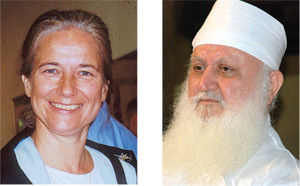
Almut Hintz (left) and Dastur (Dr) Firoze Kotwal
Late in the 19th century Christian Bartholomae translated "anahita” (in Aban Niyaish as well as Yasht) as "undefiled,” "unblemished.” Following him Kavasji Kanga in his Gujarati translation rendered it as "nirmal.” James Darmesteter treated it as a proper noun. However, in 1927 Johannes Hertel suggested "unrestrained” and his interpretation has been endorsed by researchers like T. Goto (2000), N. Ottinger (2001) and Jean Kellens (2002-2003) by rendering the epithet as "unbound”, "unrestrained” (torrential river, streaming down from the mountains). Since this is a case of lending difference of meaning on etymological grounds which, nevertheless, suits the context in every respect, the same has been supported in footnote 34.
A table specifying in which gah(s) each niyaesh and yasht should be recited.
Some information about Navsari Prakash, which was started by Dorab Meherjirana and published for 15 years for the sole purpose of protecting and preserving long-cherished beneficent customs and traditions.
It may come as a surprise to some Parsi advocates of vegetarianism "as a Zoroastrian teaching” that the text of the manuscript gives "formula for ceremonial slaughtering of cattle (nirang gospand halal kardan) and that this is corroborated by the text of another manuscript (T19) in the Meherjirana Library, Navsari.
An unlooked-for error in E1, namely, of mentioning the prayer of Ahmai raescha in the geh sarna ceremony has been pointed out.
Today, when we find a relentless stripping down operation directed against our rituals and dogmas, Kotwal and Hintz have sought thoughtfully to espouse the cause of rituals as well as dogmas.Wherever necessary, transliteration and translation of Avesta, Pahlavi, Pazand, Persian and Gujarati texts are given, while bearing in mind the latest researches in the field of Iranian studies.
The outrageous apathy of some of our trustees/trusts is brought to light by footnote 14: despite a number of efforts by Kotwal, one manuscript (E2, containing 559 pages according to Bamanji Dhabhar’s description) housed in the Modi Atash Behram, Surat remained inaccessible! Conceivably the only snag is to be found in footnote 18 which touches upon the subject of the mobeds pronouncing sha for sa, as is their wont. The footnote reads: "they have had license (reviewer’s italics) to pronounce it like that for centuries.” In this context, "license” takes on a rather provocative meaning.
After the Introduction one finds index of texts contained in E1 which, in turn, is followed by a list of over 70 works by way of references. The rest of the pages contain two folios of the manuscript on each page. Indication in margins on both sides of the page is given regarding the title of the text and, in case of missing portions in the manuscript.
Printed on permanent/durable paper, this work would provide further possibilities for Iranists. The work is dedicated to first Dastur Meherjirana (1510-1591) whose picture appears in it. A must for libraries all over the world. However, the reviewer finds it opportune to note that those not orientated towards ancient Iranian languages are bound to find it beyond their grasp.
FARIBOURZ NARIMAN
◆ ◆ ◆
From the archive