
Books
Rites and rituals researched
The Herbadastan and Nirangastan, volume IV: Nirangastan, Fargard 3, edited and translated by Firoze M. Kotwal and Philip G. Kreyenbroek. Published in 2009 by Association Pour L’Avancement Des Etudes Iraniennes, Paris. Pp: 125. Price: Euros 20.
"There is a prodigious scholarship on myth, ritual, religion, rite, mostly by experts who have never lived their way into these things for a moment,” states Theo-dore Roszak in Where the Wasteland Ends.
To unravel the message embodied in any ancient or medieval religious text is a daunting task. The problem increases manifold in case of a Pahlavi text because of diverse reasons. In Pahlavi we find a puzzling compound of Semitic (Aramaic) and Aryan vocables. Unlike in Avestan, the mode of writing is cursive and cryptic leading to ambiguity and, consequently, to misinterpretation. A single vertical stroke (like ‘aleph’ in modern Persian or Arabic) could indicate a variety of sounds: it may represent u, na, ra, la, va or o and a scholar who embarks upon a translation of a text has to determine the manner in which the said stroke should be read in a particular word. To add to the complexity is the use of logograms which are spoken Aryan but written Semitic like gosht (meat, flesh) which is written bisra; shahanshah (King of kings) which is written malakan malaka. Incidentally, this crafty system of writing is called Huzvaresh (disguise, camouflage) and it was devised by Parsi priests of yore to hoodwink the Arab conquerors. At times, the translator may be constrained to emend an error of the copyist or reconstitute a portion of the text while seeing to it that certain scholarly norms are not vitiated. Also, he has to sift out the crux of the matter with the help of sound philological groundwork.
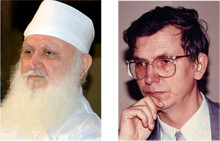
Dastur (Dr) Firoze Kotwal and Philip Kreyenbroek: transliteration and translation
Through such perplexities Kotwal and Kreyenbroek have succeeded in finding their way. The first volume of this work was published in 1992, the second in 1995, the third in 2003, and thus, in a manner of speaking, the volume now submitted to the world of scholars is a fulfillment of a promise made 17 years ago.
So to speak, the work is a technical exposition of ritual and it is divided into 25 chapters. Subjects like wearing the sacred girdle, size and quality of sacred garments, the barsom twigs, clothing and the girdle, the barsom and agricultural pursuits, sharing the performance of rituals, collecting firewood and twigs for the barsom, pestle and mortar, aspects of haoma offering, fetching water and reciting Avestan, etc are adequately dealt with. Every page of the transliterated text and translation contains a number of footnotes. In all there are 585 referential footnotes for the transliterated portion and 407 explanatory footnotes for the translated one. However, nearly 1,000 footnotes are in no way a mark of extravagance, rather these are incorporated because the amplitude and justice of their provisions warranted more meaningful use.
Since Sohrab Bulsara published his Aerpatastan and Nirangastan in 1915, many Iranists have exercised themselves over the sources and precise meanings of certain Pahlavi words and phrases. Pahlavi dictionaries have been brought out at intervals. In short, today Pahlavi is better known than heretofore. As mentioned in the introduction, the critical apparatus — a revolting expression as far as some Parsi pseudo-mystics are concerned — is "almost exclusively the work of Dastur Kotwal.” And the latter has made full use of the researches carried out by Iranists, past and present, while preparing this work. And what is more, as a practicing priest Kotwal has lived his way into traditional rites and rituals. The fruitful method adopted by Kotwal displays a scrupulousness of traditional principles seldom matched in modern scholarship.
Though the first volume of this work came out in 1992, Kotwal had started working on this project about three decades ago and, therefore, this brilliantly expounded study is marked by thorough research, excellent critical judgment and a remarkable vigor of style. Kotwal’s discriminating analysis has brought out many subtleties of meanings not to be found in Bulsara’s work. What shines through the work is not just the familiarity with the subject but a dedication that has produced an opus which has outdated Bulsara’s work mentioned above. Omission of diacritical marks here and there does not mar the overall value of the work. R. C. Zaehner in his The Dawn and Twilight of Zoroastrianism (pg 344) has expressed regret regarding the "neglect of Pahlavi and the bland assurance with which Avestan scholars make use of Pahlavi sources without bothering to compile their own word-index…” Had he been living Zaehner would have been happy to note that in the work under review 13 pages have been devoted to fairly exhaustive Avestan and Pahlavi glossaries.
It is gratifying to note that, as mentioned in the introduction, the chairman of Ness Wadia Foundation and F. E. Dinshaw Charities, Nusli Wadia and his co-trustees and the Athravan Educational Trust gave their unstinting support to Kotwal’s research activities. Unlike such supporters, an institute established in 1916 with the help of public money, namely, the K. R. Cama Oriental Institute espoused indifference and stayed behind as mere spectator!
Evidently the nature of the work presumes linguistic, theological and philological knowledge in the reader. Otherwise stated, it is of no use to the casual reader or to the cliquey ones who revel in propagating the Gathas alone cult, though it will prove to be of abiding interest to scholars and students of Zoroastrianism in general and of rituals in particular. If a second edition of this monumental work is published, it would be worthwhile to combine the four volumes into one containing around 700 pages.
◆ ◆ ◆
From the archive