
Books
Devoted to death
Days of Transition: The Parsi Death Rituals by Dorothea Lüddeckens and Ramiyar Karanjia. Published in 2011 by Wallstein Verlag, GeiststraBe II, 37073, Göttingen. Pp: 176. Price: Euros 24.90.
Preoccupied with death and disposal methods for the deceased is an alarmingly large aging proportion of Indian Zoroastrians. From an overseas perspective the problems associated with dying, death, and the hereafter are compounded by the approved and reproved modes of disposal alternatives — a contention limited to Bombay.


Dorothea Luddeckens (l) and Ervad (Dr) Ramiyar Karanjia;
The anxieties caused by the invalidity or denial of full priestly rites over alternative methods of disposal — cremation and inhumation (burial) — have given rise to fears among the many for whom dakhmenashini is unavailable.
This newly published volume goes some way to arouse fears of inappropriate or incomplete alternative treatment for their departed. Co-authored by Zurich-based Dorothea Lüddeckens at Lichtenberg-Kolleg, Georg-August-Universität, Göttingen, and Ervad (Dr) Ramiyar Karanjia, principal of the Dadar Athornan Institute, Bombay, their quite adequate coverage of Parsi beliefs and practices in India is commendable. It is an ethnological study, largely done in German, and, as here, very competently translated into good, literal English.
Sandwiched between an Introduction, Epilogue and Appendices, the thrust of this joint dissertation is spread through five chapters whose contents reflect the overall concepts suited to the justification of current Parsi perspectives to which it seems confined.
In their wordy Preface, both authors have striven to impress their standpoints on their readers’ minds. Their design is to attempt a fusion of two disparate cultural attitudes within an Indian ambit, through claims "to preserve the traditional as well as textual viewpoints.” The result inevitably remains cosily ambiguous, and the two modes have become self-cancelling.
The nub of the problem, while maintaining its ritual base, is to avoid as best possible the dilemma of the dysfunctional dakhma system with a heavily calqued ritual in an urbanized present-day setting in Bombay’s Doongerwadi: the failure of the infamous solar concentrators during the sunless June to September; and the lack of raptors — specifically vultures — to say nothing of the preposterous "aviary project” and the underhanded secondary burials.
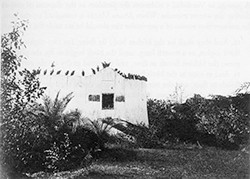
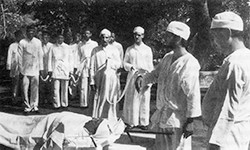
(left): dakhma in Bombay, mid-20th century and (right) nassassalars, priests and participants in paivand with their partners
Added to these are the hushed-up differences among officiating priests, and irreligious bans imposed on outmarried females, their progeny and the exclusion of priests who lighten the distress of bereavement through their dutifully recited prayers.
The authors are extra-careful with usage of allusions to fuel their arguments against the withholding of prayers that give much-needed solace at such burdensome times to the bereaved and the distressed. It is these prayers with their explanations and their accompanying ritual actions that constitute the chief interest of this book. And yet, where one would most expect thoroughness, there is instead a growing sense of unease at its naivety. Glancing through the names bracketed in their Acknowledgements, the diligent reader loses confidence in the veracity and accuracy of the "insider” projections — they reflect an ad hoc Parsiism, not Zoroastrianism.
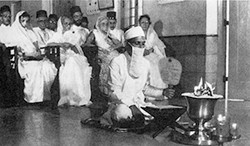
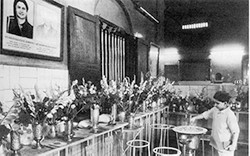
Above (left): prayer vigil before geh-sarna ceremony and (right): muktad table with vases in an agiary;
The text is frequently interspersed with curiously devised "Comments” (advertised as "theological commentary”) which often manage to be bizarre and simplistic. For what purposes were these intended? In a technical work as this, the remarks contained could have been better focused and incorporated into the text! The Glossary, extensive enough for this kind of work, is quite unfocused. Since glossaries should serve their primary purpose of accuracy within brevity of information, it is disheartening to note the frequent carelessness of revision. The brief notices associated with the terms listed are inadequate — could the authors, rightly concerned with the mise en scène (the entire ritual set-up) have let slip their concentration? See, from random examples, the naive notes attached to Ashem vohu, "Ahuvar” (!) etc., Nirang (1), Den /Din, and even Baj. The four Ahu- items are dislocated.
The volume is a technical work — a deadly (pun unintended) serious one — fully demanding of accuracy at every level. The frequent footnotes and the inclusion of a very impressive Bibliography (no Aogmadaecha? no Menant?) attest to the hard graft of the authors for this merit-worthy production. Having said which, the views contained therein are not always in consonance with those of text-related Zoroastrian scholarship. The shifting sands of "tradition” have undoubtedly swallowed them up!
Justice is done to daena as crucial part of every thinking, sentient human — it becomes the post mortem (de)personified substance that, in the shape of the deceased’s thoughts, words, and works during life, accompanies the urvan over the Chinwad Pul of popular imaginings, and, teaming up with the fravashi, grandly accesses the Endless Lights of Paradise (anaghra raocha) in Vahishta ahu, a.k.a. Garo.demana, also Behesht.
In popular beliefs, practices and traditions, it has long been held that priestly interventions are prerequisites for the well-being and ease of the souls of the departed. It is a good, benign psychology which continues to advance these views. However, as the authors themselves agree, the set prayers do not reflect the funerary requirements, and that those prayers are in fact recited for the solace of the bereaved.
The volume is a technical work — a deadly (pun unintended) serious one — fully demanding of accuracy at every level. The frequent footnotes and the inclusion of a very impressive Bibliography (no Aogmadaecha? no Menant?) attest to the hard graft of the authors for this merit-worthy production. Having said which, the views contained therein are not always in consonance with those of text-related Zoroastrian scholarship. The shifting sands of "tradition” have undoubtedly swallowed them up!
Justice is done to daena as crucial part of every thinking, sentient human — it becomes the post mortem (de)personified substance that, in the shape of the deceased’s thoughts, words, and works during life, accompanies the urvan over the Chinwad Pul of popular imaginings, and, teaming up with the fravashi, grandly accesses the Endless Lights of Paradise (anaghra raocha) in Vahishta ahu, a.k.a. Garo.demana, also Behesht.
In popular beliefs, practices and traditions, it has long been held that priestly interventions are prerequisites for the well-being and ease of the souls of the departed. It is a good, benign psychology which continues to advance these views. However, as the authors themselves agree, the set prayers do not reflect the funerary requirements, and that those prayers are in fact recited for the solace of the bereaved.
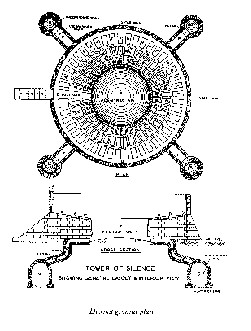
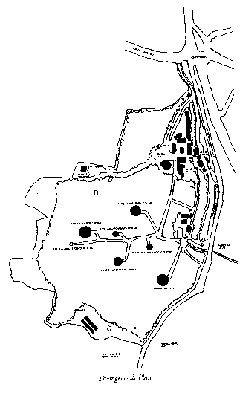
left: ground plan of dakhma; Doongerwadi plan
The complacent comments on the misuse of the Gatha Ahunavaiti, if indeed these hymns for life and the living are so perverted during the geh sarna, are nothing less than shocking. The reality ever was that they were recited for the well-being and alleviation of distress of the bereaved and the mourners (see the Ushtavaiti, Ys. 46.10), the deceased’s soul being beyond redemption.
Well-chosen illustrations adorn the text: e.g., the Sogdian lamentation tableau and Arda Wiraz’s depiction with its old Gujarati commentary focuses superstitious minds on the imperative of good thinking, right-speaking and well-working.
Randomly chosen here are the gahs: The liturgical times are given, very curiously, with 40 minutes past each terminating hour. One would much like to be enlightened on these generous allowances: 40 minutes being a very substantial overspill. Whilst the dutifully devout Zoroastrian’s day indeed commences with the sunrise to noon Havan watch, the priestly liturgical round begins with the midnight to dawn/sunrise Ushahina — to wit, the darkness-houred ceremonial Vandidad period. Elsewhere it is casually noted that the watches extend by a few minutes! Why this discrepancy?
In discussing the Farziyat all mention of the determinant role of the Rapithwin is avoided. Prayers exactly dedicated and at their right times are provenly efficacious. The argument would, could and should lead into the gahanbar area where their very nomenclatures demand a precise reckoning from the seasonal based solar calendar. It is mind-boggling that prayers are mistimed, and rendered ineffective through priestly negligence, ignorance and wilfulness over this crucial matter. The authors seem unaware that the excised passages listed were in fact retained — the priests turned towards their congregations when pronouncing the blessings intended for the living — another lost tradition?
The statement that the 10th month — Dai — has not a day dedicated to its particular deity is an avoidable nonsense, for pious Parsis preface both the first day — Hormazd — and the 10th month with Dadar, "Creator,” which can and does refer only to Ahura Mazda himself! What higher deity could one wish to venerate?
Nasasalars, with their lowly, soul-destroying (no pun) occupation are blithely dealt as an underclass, subjected to tedious cleansings and humiliating ostracism. The nasu-kashas of the Vandidad referred to the marking out of the furrows surrounding the body, betokening the separation of the dead from the living. Now used pejoratively, the term khandia is in keeping with the shameful tendency to not only demean their humble occupation but to heap upon it the indignity of abuse.
Sag-did: "Dog’s gaze” needs fuller explanation in view of the Vandidadic three-day mortuary stay, and certain grudgingly admitted cataleptic "resurrections.” The idea of an ownerless dog, brought in to sniff out residual signs of life, and not repel the druj.nasu, goes back a very long way to Indo-European (and Ancient Egyptian) beliefs on hell-hounds and the hounds of death.
Regarding the comment on legs drawn up for "using as little space as possible,” a little research would have yielded the most ancient of explanations: the body was fetally positioned in anticipation of rebirth in the after-world.
About the noticeable partiality by the authors in their selection of textual evidence: was it for reasons of convenience, prudence, unwillingness to expand on statements of belief and practice, or just plain agenda-driven "non-controversiality?” Our Vandidad, the primary manual dealing with the treatment of the dead, funerary structures, contagion, purity and pollution, ritual cleansings, the set prayers and procedures — these could have benefited greater precision in their presentation of current religious observances.
When all’s done and dusted, this serious book — a useful addition to the traditionalist’s library — emerges as a high level labor of sincerity and sound purpose; this review level is tailored accordingly. As a study in Parsiism, however, it has limited appeal since such traditions form and disperse according to need and circumstance — as has clearly happened over the past hundred years in India itself. Ironically, the title of the book must therefore serve also as its epitaph: it is a study in "of Transition.”
◆ ◆ ◆
From the archive