
Books
'Matchless expertise'
The Herbadastan and Nerangastan, Volume III: Nerangastan, Fragard 2 edited and translated by Firoze M. Kotwal and Philip G. Kreyenbroek. Published in 2003 by the Association Pour L’Advancement Des Etudes Iraniennes, Paris. Pp: 320. Price: 40 Euros.
About 15 years ago Dastur (Dr) Firoze Kotwal and Philip Kreyenbroek decided to embark upon the stupendous task of bringing out the transcription and translation of the enigmatic Middle Persian text, The Herbadastan and Nerangastan — a text corrupt at several places. An Iranist, however well equip-ped he may be with philology, or even linguistic phenomenology, would find such a task baffling and it is here that Kotwal’s matchless expertise in the field of rituals proved to be a precious asset. Of course, Sohrab Bulsara had published in one volume the English translation of this work with notes in 1915, but his work is totally outdated by the great strides made by Pahlavi studies during the last nine decades.
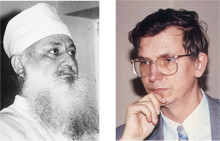
Kotwal (left)and Kreyenbroek: trans-lational labors bear fruit
Kotwal and Kreyenbroek had published the first volume of the present series in 1992 and the second in 1995, the first contained the Herbadastan and the second, the Nerangastan Fragard 1, both reviewed by the present reviewer. The third volume can be said to contain the most daunting part of the work, not just in terms of the length of Fragard 2 of the Nerangastan but also the intricacy of the ritual material it embodies coupled with the textual corruption. Viewed in its broadest aspects, this volume, dedicated to the memory of Neville N. Wadia, is a most significant contribution to the literature and methodology of rituals and all allied topics. Undoubtedly the work will receive the respectful attention of Iranists in general and those among the orientalists who are specially interested in different aspects of Zoroastrian rituals in particular. Also this can be said to be the copestone of the duo’s translational labors plus Kotwal’s unwearied industry and a swift intuitive judgment as to the value of the ritual material incorporated in Fragard 2 of the text. A fact needs to be underscored that this is a highly scholarly work meant, to the greatest extent, for scholars and only fractionally for some laymen.
The Fragard in question "by far the longest part of the work” consists of 44 chapters (23 to 66) of varying lengths and touching upon diverse topics related to Zoroastrian rituals. The fact that this copiously annotated work — 1,148 footnotes for the translated portion and 1,953 for the transliterated one — with Avestan and Pahlavi glossaries running into 26 pages is sufficient to indicate its scholarly proclivity; however, certain material incorporated in some of the chapters might prove to be enlightening to some laymen who have allowed themselves to be ensconced in the pipe-dream of some vegetarianists. As is well-known, since the last few decades two or three scholars and five or six laymen have been perpetuating canards like:
Zoroastrianism enjoins vegetarianism upon its followers.
No reference to animal sacrifice is to be found in the sacred books of the Parsis.
Slaughter of animals for food or sacrifice or cooking meat on fire is considered as sin in Zoroastrianism.
Though plenty of material from Avestan and Pahlavi texts are available to debunk such claims, a perusal of the below mentioned headings of some of the chapters of this volume would serve the purpose:
Chapter 36: On those whose animals may be sacrificed
Chapter 37: On animals that may be sacrificed
Chapter 38: On animals that may not be used for sacrificial purposes
Chapter 40: On the kinds of animals to be sacrificed
Chapter 41: On offerings from female animals
Chapter 47: On meat offerings
Chapter 48: On the quantity of offerings
It need hardly be added that the contents of these as well as a few other chapters would be found to be stunning by the Parsi indoctrinators of vegetarianism in a Zoroastrian garb. Otherwise stated, ritualistic sanctification of animal slaughter in Zoroastrianism is uncontrovertible.
Today, when authentic new publications on Avesta-Pahlavi texts and commentaries, Iranian history, art and architecture, numismatics, etc have become rare in our dwindling community, when Parsi medical doctors, lawyers, engineers, journalists, social workers and, oddly enough, columnists, bring out one book after another under the excuse of ‘guiding’ the community, it is heartening that Kotwal, in collaboration with an Iranist like Kreyenbroek has pursued his chosen task of publishing the third volume of this intricate text with explanatory notes. With their exact and rigorous scholarship together with strict adherence to traditional perspective, the authors have been responsible for the correct placing and valuation of intricacies of rituals covered by the text. At places where, even with all their expertise, they could not translate accurately a portion of the text, they have been candid enough to express their inability. For instance, footnote 882 of the translated portion informs the reader that the rendering of a part of 49.6 is "guess based... and on the context.” Indeed the translators merit commendation for their highly skilful rendering in general from a difficult Pahlavi text codifying certain Zoroastrian rituals through proficiently whetted idioms that do not readily lend themselves to the English tongue.
Like the earlier volumes the present one commands serious recognition of Iranists in general and students of Zoroastrian rituals in particular. In a small way recognition of this significant work has just come from an unexpected quarter. The Research Institute of Art, Culture and Communications, Ministry of Culture and Islamic Guidance, Iran invited Kotwal and Kreyenbroek to participate in the awards ceremony. For personal reasons the former could not make it to Iran, but the latter did. However, the fact that their work was awarded the first prize (consisting of citations signed by the President of Iran and six gold coins) may stimulate the members of our community.
Scholars would be looking forward to the fourth and last volume of this monumental work which is expected to be out by January 2006.
◆ ◆ ◆
From the archive