
Business
A steely century
In a vindication of Jamsetji Tata’s vision and with fortune favoring the brave, in its 101st year, in July/August 2008, Tata Steel made its debut in Fortune 500 — a coveted list of the world’s top 500 companies, ranking at No. 231.
It’s been a long and hard 100-year journey — from setting up the country’s first steel plant in remote Bihar in colonial India to becoming a global giant, the sixth largest steel company in the world, employing over 80,000 people across four continents. On April 22, 2008, Prime Minister Dr Manmohan Singh visited Jamshedpur in the company of several Union Cabinet ministers to release a special commemorative stamp brought out by the Government of India’s Ministry of Communications to mark Tata Steel’s 100 years of service to the country. "Today Tata Steel is a symbol of a new phase in the growth of Indian industry,” stated the Prime Minister. "I compliment Ratan Tata, his colleagues J. J. Irani and B. Muthuraman for their leadership and vision. The country owes a great deal to such dynamic leaders of business. They create wealth, they create employment, they create new capabilities and they create new possibilities… I take great pride in the fact that our government, in 1992, chose J. R. D. Tata as the first Indian business leader to be awarded the Bharat Ratna (the nation’s highest civilian honor)…I compliment Tata Steel for showing faith in the people of this region and for re-investing in the state… Tata Steel has a proud record of corporate social responsibility (CSR).”
As part of CSR, the company has embarked on the Tata Steel Centenary Project — a Rs 100 crore initiative to implement social and environmental sustainability. Through focus on land and water management in the backward tribal areas of the states of Jharkhand, Chhatisgarh and Orissa, the company aims to improve the livelihood of 40,000 poor tribal households in 400 villages and create models of excellence that the government and other corporates can emulate. Tata Steel will also open schools for the children of tribal communities to train them to be self-reliant. Two major projects for Jamshedpur include developing and maintaining one of the city’s key areas into a promenade and park and a "Centenary City Center” with malls and entertainment facilities.
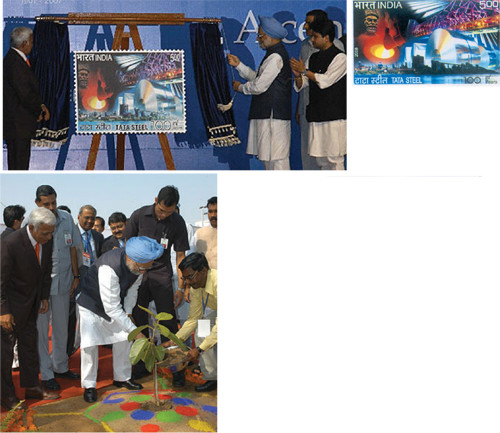
Prime Minister Dr Manmohan Singh unveiling Tata Steel’s centenary postage stamp and (below left) planting a banyan sapling in Jamshedpur to mark 100 years
Centenary celebrations were spread over the year and included the launch of R. M. Lala’s book The Romance of Tata Steel and a film Spirit of Steel by Zafar Hai. After a long, long wait, air connectivity between Calcutta and Jamshedpur, the steel and garden city which is the company’s joy and pride, arrived with the landing of the first commercial flight (Air Deccan) on the day the company completed 100 years. A four-day festival called Shatrang was for the people of Jamshedpur — with live shows and talent hunts, folk festivals and competitions involving all strata of society.
With a long history of promoting sport, tournaments and meets were part of the centenary celebrations. (As early as 1919, even before the country had an Olympic committee, Jamsetji’s son Dorab had provided the facilities for four Indian athletes and two wrestlers to participate in the Antwerp Games of 1920. He also secured for India a place in the 1924 Paris Olympics and as president of the Indian Olympic Council financed the Indian contingent, states www.dorabjitata trust.org. The Tata Football Academy, the Tata Steel Adventure Foundation and the Tata Archery Academy in Jamshedpur have produced many champions, including the archers of the Indian contingent at the Beijing Olympics in August 2008.)
Tata Steel turned 100 on August 26, 2007. Four months ere that, it had completed the Corus acquisition process, till date the largest international transaction by an Indian corporate. British directors now sit on Tata Steel’s board, with Ratan Tata as the chairman. Jamsetji Tata’s dream (of setting up India’s first steel plant) had been mocked in the early 1900s. In its 101st annual report 2007-2008 Tata Steel quotes its director Philippe Varin, chief executive officer, Corus: "Our aim for the future is to be ranked among the top ‘preferred employers’ across all industries and we will continue to invest in both our people and human resources processes as we strive to achieve this goal.” "There is great emphasis on teamwork; on transparency and communication; on trust, honesty, debate and respect,” states Jean-Sebastien Jacques, group director, strategy. Others on the board include Nusli Wadia, S. M. Palia and Irani, with Muthuraman as managing director.
With gross revenues totaling Rs 22,526.80 crore in 2007-08, Tata Steel’s profit after tax stood at Rs 4,687.03 crore for the year ended March 31, 2008, as per the financial highlights in the annual report. "Consolidated net sales revenues stand at Rs 131,536 crore (USD 33 billion)…consolidated profit after tax (after minority interest and share of profit of associates) stands at Rs 12,350 crore… The company has truly taken its place in the global steel industry,” states Ratan Tata, noting also that this has been a turbulent year, with the sub-prime crisis in the US and western Europe impacting the global financial system, "resulting in a significant cutback in investment flows and the availability of funds.” The company nevertheless raised, as per group chief financial officer Koushik Chatterjee, a phenomenal USD 10 billion during the year and completed the long-term financing for the Corus acquisition. For the first quarter ended June 30, 2008, net profit surged over 22 percent, reports The Economic Times, August 1, 2008. "While the company may grow and spread its geographical footprint, embracing different cultures, it will not lose sight of its great heritage of social and community responsibility,” emphasizes the chairman.
◆ ◆ ◆
From the archive