
Books
Temples of progress
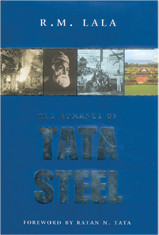
The Romance of Tata Steel by R.M. Lala. Published in Viking in 2007 by Penguin Books India Private Limited, 11 Community Centre, Panchsheel Park, New Delhi 110017. Pp: 169. Price: Rs 495.
In The Romance of Tata Steel Russi M. Lala, the Tata chronicler, traces a hundred years of Tata Steel and brings to life an account of the courage, vision and commitment of the men who created India’s first modern industrial venture, one which provided a substantial springboard for India’s industrial growth. The journey spans a period from the strongly colonial India of the 1880s to the liberalized and independent India of today. The saga of Tata Steel is an eventful one. Lala recounts the initial struggles: the rigors of exploration, the struggle to raise the necessary finance, and survival under stifling government controls. He also relates the evolution of humane labor practices (an eight-hour day long before it gained acceptance in the West), the unique and participative labor relations which ensured a strike-free industrial culture for 65 years, and the fact that Tata Steel has promoted a culture of philanthropy perhaps unequalled in the corporate world.
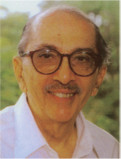
Russi Lala: chronicles 100 years of Tata Steel
It is a fascinating story and Lala tells it with professional diligence. The founder Jamsetji Tata had been greatly impressed with Thomas Carlyle’s remark that "The nation that has the steel will have the gold.” That comment stayed with him. Even when he was working on other projects the idea of building a steel plant in India remained in his subconscious mind. Lala’s book is all about how this idea reached fruition and ultimately became the bustling city of Jamshedpur. Lala relates all the early milestones: Jamsetji’s perusal of a report by Ritter von Schwartz on the prospects of iron-making in the Chanda district; Major R. H. Mahon’s report on setting up an iron and steel industry; Lord Curzon liberalizing the licensing policy on mining; Jamsetji’s interview with Lord Hamilton, the secretary of state for India; Jamsetji’s trip to America and his contact with the metallurgist Julian Kennedy and Charles Page Perin and the latter’s dispatch of C. M. Weld to prospect in India, all find mention.
The early history of Tata Steel reads like an exciting adventure and Lala tells us, sometimes at a breathless pace, how thick jungle was transformed into a modern day temple of progress. He narrates the exploration by Weld in the company of Dorab Tata and Shapurji Saklatvala and the role played by P. N. Bose (the geologist whose report Dorab had chanced upon in Nagpur) in telling the Tatas about the iron ore deposits in Mayurbhanj state, and the subsequent find in Gurumahisini. He also relates the serendipitous find of Sakchi, the place where the steel plant finally came up, and the raising of finance for the project from entirely indigenous sources of which Dorab Tata said proudly: "Above all, it was a purely svadeshi enterprise, financed by svadeshi money and managed by svadeshi brains.”
By the time the first ingot had rolled on February 16, 1912 Jamsetji had been dead for nearly eight years and it was left to the trusty trio of Dorab, R. D. Tata (J. R. D. Tata’s father) and Burjorji Padshah, Jamsetji’s brilliant but eccentric lieutenant, to not only carry forward his plans till they reached fruition, but also steer the fledgling company through its early trials and tribulations. War clouds were gathering over Europe at the time and 30 months later World War I started in August 1914. Lala narrates how suddenly the Tata plant became a place of international importance for it offered the only potential supply of iron and steel east of the Suez. The Tatas supplied three lakh tons of steel over four years and the British acknowledged that the allied victories in Mesopotamia would not have been possible but for the 1,500 miles of railway lines supplied by the company. This was despite the fact that Jamsetji had to suffer the scorn of people such as Sir Frederick Upcott, the chief commissioner of the Great Indian Peninsular Railway, who had promised to "eat every pound of steel rail (the Tatas) succeed in making.” Dorab’s dry rejoinder that Sir Frederick would have had "some slight indigestion” had he carried out his undertaking is now one of the most famous (and amusing) quotations associated with Tata Steel.
At the end of the War, Lord Chelmsford renamed Sakchi as Jamshedpur in honor of its founder who had not just wanted to build a new factory but also to create a new city. In a letter to Dorab in 1902 Jamsetji had written: "Be sure to lay wide streets planted with shady trees, every other of a quick-growing variety. Be sure that there is plenty of space for lawns and gardens. Ensure large areas for football, hockey and parks. Earmark areas for Hindu temples, Mohammedan mosques and Christian churches.”
Lala also narrates some amusing anecdotes. There is the story of how Padshah would exasperate Perin by suddenly reading poetry in the middle of a serious technical discussion. Lala says that after the initial strain the "effortlessness with which the two worked together is a fine example of how a common purpose and vision can bring the most different of men together.” Many national leaders were also closely associated with TISCO (Tata Iron and Steel Company, as it was called then) and Subhas Chandra Bose and Mahatma Gandhi helped resolve some of the key labor crises that arose during those times.
It is well known that labor benefits such as an eight-hour working day, free medical aid, provident fund, establishment of a welfare department and the worker’s accident compensation scheme were introduced by TISCO well before they were enforced by law. A separate Personnel Department was set up in 1947 by J. R. D. Tata. In a note circulated in 1943 he wrote: "…but when employing 30,000 human beings, each with a mind and soul of his own, we seem to have assumed that they would look after themselves and that there was no need for a separate organization to deal with human problems involved.” At JRD’s instance, a process of joint consultation was started and these Joint Dialogue Councils were perhaps the finest innovation in labor relations in India.
Lala also tells the reader about some of the ‘men of steel’ who made TISCO what it is today: Tutwiler, John Keenan, John Peterson (who was a mentor to JRD), Sir Ardeshir Dalal, Sir Jehangir Ghandy, Sumant Moolgaokar, Russi Mody and J. J. Irani. The last named was responsible for modernizing the plant and saving the company. As TISCO entered the 1980s, the plant and machinery were old, profits poor and what was worse, there were no reserves for replacing the old plant. Irani told JRD: "If we do not renovate the plant totally, 10 years from now you and I will be standing outside the gates selling tickets to people to come and see the steel museum.” JRD laughed but got the board to sanction a complete modernization plant in four phases, the first of which was completed in 1991. By 2000, TISCO had a completely new plant. From 1991 to 2000 it was Irani who got the company back on track. By the time B. Muthuraman, his successor, the current managing director, was firmly in the saddle, TISCO had moved from the danger of being an obsolete plant to a world class, cost-effective steel-maker.
Acknowledgement of this came from Peter F. Marcus, the editor of World Steel Dynamics, who ranked Tata Steel as No. 2 in the year 2002; from 2004 to 2006 it was ranked as the best steel company in the world. In 2007, it also became one of the largest when it took over Anglo-Dutch steel giant Corus. NatSteel of Singapore and Millenium Steel of Thailand had already been taken over by the company. The focus now is on the decentralized production of steel using resources most economically. Semi-finished products are made in countries rich in raw material and then taken to countries with first-rate finishing facilities and high demand.
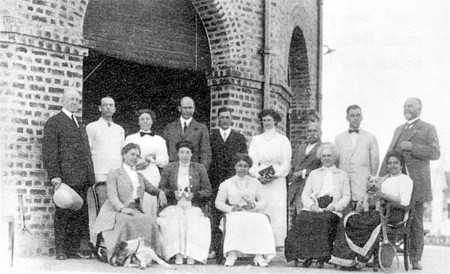
Sir Dorab Tata with his wife, Meherbai (extreme right), Charles Perin (extreme left) and other members of the TISCO management and their spouses
In keeping with the founder’s spirit of giving, TISCO has always contributed generously to philanthropic efforts. Today, Tata Steel’s social welfare program includes initiatives on the urban, rural and tribal fronts. Its willingness to help during natural calamities starting with the earthquake which hit northern Bihar in 1934 was also evident when the Gujarat earthquake took place in 2001. The Tata Relief Committee at Jamshedpur was already on the scene long before the agencies in Bombay could get their act together. It was the same story with the tsunami disaster a few years later. In fact just five years after the steel plant had started, Jamsetji’s sons Dorab and Ratan selected Sidney and Beatrice Webb and L. T. Hobhouse to chalk out a social welfare program for TISCO. The Tatas requested The Servants of India Society to spare one of their ablest social workers Amritlal Thakkar (who later became famous as Thakkar Bapa), for that purpose. In 1958 TISCO established its first community development center of which there are nine today. Tatas also assist hundreds of villagers in the neighborhood of Jamshedpur and in their far flung coal and iron ore mines. TISCO was also the first company to have a social audit of its activities.
Tatas have always represented the spirit of adventure and it is no surprise that TISCO has also given a tremendous fillip to sports. The Tata Steel Adventure Foundation, of which Bachendri Pal, the first Indian woman to conquer Mt. Everest, is the leading light, enrolls more than 3,000 persons every year. The Tata Archery Academy, the Tata Football Academy, and more recently the Tata Athletic Academy provide the necessary training and facilities required to win laurels at national and international events. Jamshedpur also boasts of some of the best sports infrastructure and apart from Keenan Stadium there is the magnificent J. R. D. Tata sports complex.
Though Lala’s book is a must read for any person who wants to know the history of this great company, one problem with his account is that it is uncomfortably saccharin. The editing out of Russi Mody’s role, the man who once exemplified brand TISCO reduces the value of Lala’s book as a chronicle of modern Indian corporate history. Mody gets only a few token mentions, some of them not exactly complimentary. Brief concessions to his human resource skills apart, the sole laudatory comment is allowed for Mody’s contribution as head of the mining section, for he "ensured facilities which propelled Tata mines to the very top in production and morale.”
While Lala recognizes Mody’s man-management skills they are attributed to the TISCO culture rather than his management practices or personal ability. This is faint praise indeed. Mody had been one of the ‘gang of four’ (the others were Darbari Seth of Tata Chemicals, Ajit Kerkar of Taj and Sumant Moolgaokar of TELCO, now called Tata Motors). These were satraps created by JRD himself, all of whom were cut down to size to ensure the seamless transfer of power to his heir Ratan Tata in 1993. Even Muthuraman had been hand picked by Russi Mody and his protégé Aditya Kashyap. Lala also chooses to completely ignore the sacking of Russi Mody and his less than graceful exit from the Tatas. After all, in every romance there is the occasional tiff. And so it is with an organization which is also bound to have its share of quarrels and disagreements. By completely ignoring l’affaire Mody, Lala makes his account somewhat less authentic.
Bakhtiar K. Dadabhoy
◆ ◆ ◆
From the archive