
Cover Story
Man of mettle
Tata’s Dr Jamshed J. Irani is awarded the Padma Bhushan for his distinguished services to trade and industry
As director of Tata Sons, Dr Jamshed J. Irani’s office at Bombay House is spacious, sober and serene amidst the cacophony of honking traffic, hurrying officegoers and hawkers vociferously peddling their wares at the busy Flora Fountain precinct below. Irani loves the company he has — a family of yellow-breasted, thumbelina sized feathered friends darting in and out of the plants that adorn the terrace, chirruping care and concern for their little loved ones! "I have instructed the mali (gardener) not to disturb their nests,” says the steel man who spent 33 years in green and gardeny Jamshedpur, nine of them as managing director (MD) of giant Tata Steel, India’s largest integrated private sector steel company. "No one in the building has as verdant an ambience in the office as I have,” smiles Irani.
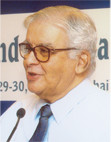
On one wall hangs a framed citation in Hindi — the award of Padma Bhushan Irani received from the President of India in March this year for his services to trade and industry. "I had no inkling that my name was under consideration. On 26th morning (Republic Day, January 26, when the honors were announced) my secretary rang up to congratulate me. Since he is not given to playing practical jokes, I took it as true. Of course I greatly value the Padma Bhushan. It is a national honor. There are people who strive their utmost to have it conferred (on themselves) — that’s something I abhor,” asserts the man of steely resolve who took over the reins at The Tata Iron and Steel Company Limited (TISCO, as it was then known) in 1992 at a troubled time and scripted a remarkable turnaround story.
On another wall in his office is the scroll of the honorary knighthood (KBE) Irani received on October 14, 1997 in New Delhi at the hands of Queen Elizabeth II for his contributions to Indo-British trade and cooperation (see "Knight in shining armor,” Parsiana, December 1997).
In July 2001 Irani retired as MD on reaching the age of 65, in keeping with Tata group policy and moved to Bombay on the Tata Sons board. With 96 operating companies in seven business sectors (information systems and communications, engineering, materials, services, energy, consumer products and chemicals), the Tata group is among India’s largest and most respected business houses with revenues (in 2005-06) of $ 21.9 billion (Rs 967,229 million), equivalent to about 2.8 percent of India’s GDP (gross domestic product)! Tata Sons is the group’s holding company and was established as a trading enterprise in 1868 by group founder Jamsetji Tata. The chairman of Tata Sons, Ratan Tata, is the chairman of the group which has its headquarters at Bombay House.
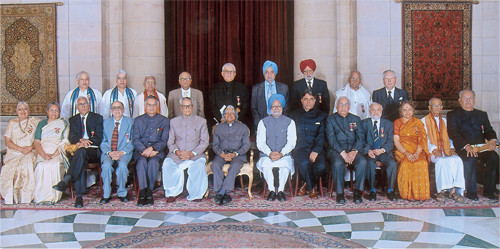
President A. P. J. Abdul Kalam and Prime Minister Manmohan Singh (seated 7th and 8th from left) with Jamshed Irani (behind the President) and other awardees. Also seen is Padma Vibhushan recipient Fali Nariman (seated 4th from left)
On April 2, 2007, Tata Steel proved it is cast in strong mold by completing its audacious, tough-fought acquisition of Anglo-Dutch steelmaker Corus (erstwhile British Steel, and a company several times its size) for a mindboggling $ 12.9 billion (Rs 55,000 crore), the largest ever acquisition by an Indian company worldwide. "The present global environment is such that you have to take risks. Nothing is going to fall into your lap. There is no such thing as space available. You have to go in where others already are, be superior or die,” says the metal man known to speak his mind. Irani narrates to Parsiana the analogy of a crowded table: "Suppose there are already 10-12 people on a table and another 25 waiting to get on. You must plonk yourself early on right into the center, so that you are best placed. In the pushing and shoving that is bound to ensue at the edges, others will fall off. But you don’t move.”
Funding the Corus deal is a challenge, admits 71-year-old Irani who is also on the board of Tata Steel, Tata Motors, Tata Teleservices and several other companies.
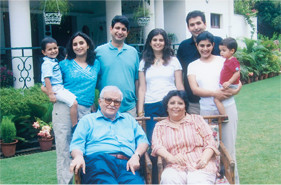
The Irani family: Jamshed and Daisy with (from left) Rehaan, Niloufer and Yezdi Nagporewalla, Tanaaz, Zubin, Priya with Aayush
Seeing the big and buoyant picture (and cracking the whip if need be!) is the job of Tata Sons, the real power center of the group. Alongside Ratan Tata are Noshir Soonawala, vice chairman, Ishaat Hussain, finance director, R. Gopalakrishnan, Arun Gandhi and Alan Ros-ling, executive directors, Farrokh Kava-rana, Syamal Gupta, Irani and R. K. Krishna ![]() Kumar. Brought on to the board recently is Cyrus Pallon Mistry. With a market capitalization of $ 59.19 billion, 246,000 employees and a shareholder base of over two million, in the past decade and a half, the Tata group has shed its old image of a lumbering giant to become hip and happening, exiting unprofitable or troublesome businesses like cement, aviation, plantations, etc and venturing aggressively into areas like Information Technology, telecom, retail, etc. "Present focus is on the making of a one lakh rupee car. We want to be big in telecom, but that might take a while,” assesses Irani.
Kumar. Brought on to the board recently is Cyrus Pallon Mistry. With a market capitalization of $ 59.19 billion, 246,000 employees and a shareholder base of over two million, in the past decade and a half, the Tata group has shed its old image of a lumbering giant to become hip and happening, exiting unprofitable or troublesome businesses like cement, aviation, plantations, etc and venturing aggressively into areas like Information Technology, telecom, retail, etc. "Present focus is on the making of a one lakh rupee car. We want to be big in telecom, but that might take a while,” assesses Irani.
Back from a trip to China, Irani asserts that the infrastructure there is very good. "But the people have very little say. When told to march (by the government) they all march — fast and with discipline. We march all over the place!” The government just takes over the lands it requires, resettling 50,000 people in one shot. "In India, because you have said move, they won’t move, even if it is for the better!”
For the Chinese, industrial development comes first, environmental protection is second, he observes. "Wherever we (Tatas) are, we are totally committed to protecting the environment. We believe strongly in corporate social responsibility. Jamshedpur is probably the only city where you can drink water from the tap. Hundred percent of the sewage is treated (in a town of 700,000, where a small proportion are Tata employees). During Irani’s tenure as MD, TISCO had pledged to usher in the new millennium by planting a million trees (between June 5, 1997 and the end of 1999). Having completed the task well ahead of schedule, the company upped the number to 1.5 million trees, winning for itself the Outstanding Corporate Citizen Award at the ET (Economic Times) Awards for Corporate Excellence in 1998. "We also make steel,” noted the company’s creative ad campaigns! In 2001, the year Irani retired, TISCO was ET’s Company of the Year for its overall good performance. The steel major has ISO 14000 certification for environment management for most of its works, plants, mines and collieries.
Irani is a member of the Scientific Advisory Committee to the Cabinet, Government of India, and on the Central Advisory Board of Education, among numerous other commitments. On the question of reservations for Scheduled Castes and Scheduled Tribes, Irani believes in affirmative action by Indian business. "Unfortunately, education has become an industry,” he laments. "While we have some of the best educational institutions in the world, the quality is so terrible in others that their products are quite unemployable!” As part of the Tata Steel centenary project, the Sir Ratan Tata Trust signed a Memorandum of Understanding with Tata Steel on April 17, 2007 for a Rs 100 crore mega initiative that focusses on enhancing the livelihoods of 40,000 poor tribal households in the tribal districts of Orissa, Jharkhand and Chhattisgarh covering a total of 400 villages. The company has sterling achievements in the field of AIDS awareness, conservation of natural resources, etc.
With the planned industrial township of Jamshedpur functioning as an island of orderliness surrounded by the disorder that often prevails in the rest of the state, the changeover from Bihar to Jharkhand, Irani says succinctly, has made no difference! Never one to kowtow to politicians or troublesome bureaucrats, the well-known Tata code of conduct takes the steam out of unreasonable requests!
Jamshed grew up in Nagpur where his father Jiji worked for Empress Mills. "My father gave me the best education he could afford. He was a great influence in my life,” says Irani. With a first class first in MSc (Geology) from Nagpur University, Jamshed proceeded in 1958 to what was at that time the mecca of steel — Sheffield in the UK. Winning a gold medal for his PhD in metallurgy in 1963, Irani began his career in the research arm of British Steel. As a Tata scholar, however, his progress was being monitored in India by the J. N. Tata Endowment and through them came a message from then chairman J. R. D. Tata that he should knock on the doors of TISCO first when he returns. "JRD saw me briefly when I came back. My first year at TISCO in Jamshedpur however was not a good experience and I did think of going back. When JRD came to know of this, he shifted me to another job where I was happier and I forgot all about going back!”
There were 700-800 Parsis in Jam-shedpur when Irani first went there in 1968. The number has come down to half and "the rate at which we are going now, Jamshedpur Parsis would be wiped out in two generations,” he believes. "I have personally tried very hard to bring Parsis to the steel city. It’s a good life. We have fine clubs. There is horse riding, para gliding, river rafting through our Adventure Club, with two to three-week camps in the Himalayas. We have chess, archery and football academies... My wife Daisy is a trustee of the agiary (in Jamshedpur) and we can’t find a priest to live there, despite offering free accommodation, education and medical facilities for him and his family.”
Forthright in his view that "the community will die out unless you take in the children of both males and females married out,” Irani however is not in favor of conversion per se. He adds laughingly that he has heard that someone wants to start a blood bank, only of Parsi blood: "It will be insipid blood because of inbreeding!” You can bring 1,000 vultures to the Doongerwadi in Bombay, but are they going to stay when their natural habitat has been destroyed? he queries. "Parsis just love controversy! But why is it always ‘are you against this or that?’ ‘What are you for,’ we should ask.” Commenting on the disruptive behavior at meetings of the Federation of Parsi Zoroastrian Anjumans of India, Irani says: "If they behaved like that at company meetings, they would be thrown out!”
With son Zubin married to Priya, a Kashmiri, and living in Delhi, Jamshed and Daisy are proud grandparents of Rehaan and Aayush. "All three of my children, Zubin, Niloufer and Tanaaz, have been absolutely independent. They abhor achieving anything on my name,” he asserts. Zubin was 33 when he became MD of Carrier India, I was over 53 when I became MD!” Older daughter Niloufer and her husband Yezdi Nag-porewalla are with KPMG in Bombay, Tanaaz is with Tata Teleservices.
An ardent cricket enthusiast, Irani sponsors the Jiji Irani cricket trophy in memory of his late father, which is played by rotation in different centers in India. "Around 100-120 Zoroastrians (players and supporters) come together each year. It’s more than just cricket — it’s a good way of mixing and building friendships,” he avers. On Irani’s watchlist of hobbies is stamp collecting. "Bombay is a good place for that,” he chuckles.
Would he like to retire in Bombay or Jamshedpur? we query. "Oh, definitely Jamshedpur! We have a lovely house there. It’s a far more personal life — everybody knows everybody else! In the six years I have been in Bombay, I barely know a quarter of the people who live in my building. I’m proud to be a Tata man. And now with Corus (former British Steel where he started) having come into the Tata fold, I can say I have worked for the Tatas all my life!”
The Statistics of steel
Famed as the flagship company of the Tatas and a bluechip scrip for investors, TISCO (whose name was changed to Tata Steel on August 12, 2005) has seen the best and worst of times. Now in its 100th year, a combination of internal and external factors had taken their toll on the company. Jamshed Irani explains the background: "Jamsetji Tata (the founder, who incorporated the company in 1907 in what was then back-of-beyond Bihar because of the availability of coal and iron ore, despite the mockings of British colonial officials) was a terrific entrepreneur, yet 15-20 years into its life, the company faced bankruptcy. In 1927, Dorab Tata (Jamsetji’s son) pledged his wife’s jewellery and his own personal fortune to avail of a loan of one crore rupees from the Imperial Bank to pay wages!
"TISCO has survived several critical phases. In the 1960s, it was the government who was throttling the steel sector. The ’70s saw the specter of nationalization.” In the ’80s, Irani recalls, he had once told J. R. D. Tata (then chairman of the group whom he greatly admired) that if TISCO was not modernized, "we’ll soon be standing at the factory gates selling entry tickets to a museum.”
When liberalization arrived in the early 1990s and Indian businesses were faced with competition, TISCO was ill-equipped to meet the challenge. "We had an old and decrepit plant. It was a difficult decade for TISCO and the steel industry. In fact there was a time we were even advised to exit the steel business!”
But far from being bogged down by the baggage of history or the stutterings of socialism, TISCO forged the keys of opportunity with a massive restructuring exercise. The loss-making cement units were sold, the plant was modernized, a brand new cold rolling mill was set up in record time, consumer interest was fired with a range of value-added, branded steel products. Its massive 78,000 workforce was pruned to 45,000 (present strength 38,000, as per the annual report 2005-06) without industrial unrest. TISCO became one of the world’s lowest-cost producers of steel.
Then came the acquisition of Corus. Paying an enhanced price of 608 pence per ordinary share in cash to outbid its Brazilian rival CSN, "the enlarged company (Tata Steel and Corus) will have a pro forma crude steel production of 27 million tonnes in 2007 and will be the world’s fifth largest steel producer with 84,000 employees across four continents,” states the group’s website www.tata.com
"The time for India has come,” says the much decorated metallurgist who takes pride in the India story. "Tata Steel is already an MNC (multinational corporation). There are many geographies where we already are (Singapore, Thailand, Vietnam, China, South Africa, equity participation in coalmines in Australia, proposed ventures in Iran and Bangladesh) and it is important to develop what we’ve got.” Tata Steel’s consolidated turnover (excluding Corus) for the financial year 2006-07 stands at Rs 27,437 crore and profit after tax at Rs 4,177 crore in its landmark year. The company declared in May 2007 its highest ever dividend of 155 percent. "I see a very good future for Tata Steel,” predicts the ex MD.
◆ ◆ ◆
From the archive