
Business
A career to remember
Dr Jamshed J. Irani retires from the Tatas and looks forward to opening new avenues
His is one of the most well recognized and respected faces in Indian industry. On June 2, 2011, Dr Jamshed Jiji Irani turned 75 and stepped down from the board of Tata Sons and all other Tata companies, including blue chip Tata Steel and Tata Motors. Despite the stresses and strains of a 43-year corporate career at the highest level, Irani’s countenance is still cherubic! The snowy hair, eyebrows and mustache reinforce the air of a distinguished retiree, but for the former managing director of Tata Steel, age does not mean ambivalence or the comfort of a couch!
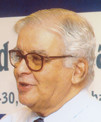
Dr Jamshed J. Irani
"There are many things I’ve wanted to do and I will now probably have more time to do them,” he says. "I have retired from everything connected with the Tatas (as per the rules of retirement) but I will continue with the non Tata things. Many people want me on their board, but I have to be selective. I am not hungry for directorship.” Having headed expert public committees in the past, the government also wants him to chair bodies. "They look upon me as a person who has no axe to grind. They want non-controversial people who will contribute without fear and without taking sides,” he remarks.
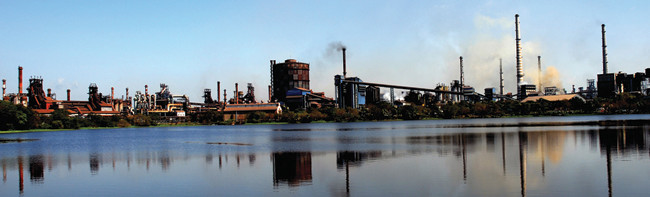
Tata Steel plant at Jamshedpur
Irani also looks to script a significant story in distance education. He is the non-executive chairman of Everonn Education Limited, a leading, listed, Madras-based educational company. Everonn offers Internet and VSAT-enabled virtual and interactive classrooms. It has a "firm foothold in schools, colleges, web products, entrance examination guidance, retail, skill development, teachers’ training, education resources, e-governance, animation and gaming and formal education segments,” as per its website www.everonn.com Distance education provides those with feeble social and economic opportunities a higher caliber of learning. "The government is spending a lot of money, with good budgetary allocation, but good teachers are hard to find,” Irani elaborates. The fact that teachers are poorly paid means that the best do not get attracted to the profession and in villages children are sent to school mainly for the mid-day meal. "You have to make quality teachers available to a larger audience of students. In distance learning, the teacher sits in the studio and the lessons are broadcast directly on TV to school rooms. This way one good teacher is available to say 35,000 students instead of 35 at a time. It is also interactive; there is two-way communication.” The government is supporting this initiative. HDFC (Housing Development Finance Corporation) and financial institutions see this as a promising sector, he adds.
Irani says he will soon shift base from Bombay back to Jamshedpur which had been home to him and his family during his decades with Tata Steel (see "Man of mettle,” Parsiana, June 7, 2007). " Rusi Lala has been after me for a long time, urging me to write my memoirs, but I’ve not been enthused up to now as I’ve been too busy. I have been a regular chronicler, though, noting down in my red diaries what I do, what I don’t do,” he asserts. "I will open a small office in Jamshedpur.”
After decades of boardroom brainstorming and asset management, the time is also ripe now for a few flights of fancy! Having been to the North Pole, the land of the midnight sun, two years ago on the perfect midsummer day of June 21, the Antarctic now beckons! "I’m not talking of the South Pole! There are cruises to Antarctica from South America. I’d really love to go there. For 20 years I’ve thought about taking a trip on the Trans-Siberian railway. It’s a two-three week journey, all the way from Vladivostok to Moscow,” he smiles. Iran is also on top of the agenda. "I’ve been on business, but only to Tehran. Next year hopefully we’ll go on a tour, visiting Persepolis and other places.”
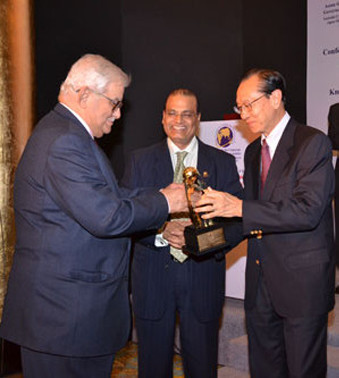
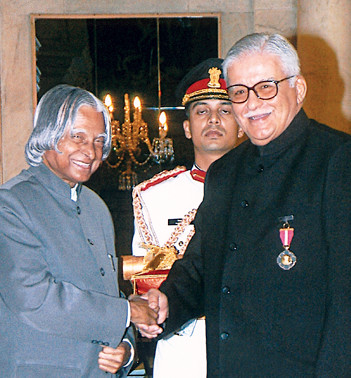
Above (left): Dr Jamshed Irani at Asian Centre’s Corporate Governance and Sustainability Awards 2011 (photo courtesy: asiancentre.org) and Irani (ext right) receiving Padma Bhushan from then President Dr A. P. J. Abdul Kalam
For Irani, working towards putting Earth first and making earthlings aware of the disastrous consequences of climate change has also been mission critical. As chairman of Tata Quality Management Services (TQMS), Irani had said at a conference of chief executive officers on climate change in July 2010, as quoted in the TQMS house magazine Quest in its issue of November 2010: "A few years ago, when the Tata Group of companies embarked on the climate change program, I was apprehensive of how much we would be able to achieve and how effectively we would be able to deal with the growing malaise of global warming… We have been able to convince a growing number of companies that climate change must be dealt with at a strategic level. I take pride in the fact that we are over the first hurdle — our (Tata) companies are convinced climate change is sure to affect all our lives, if not in our lifetime, then definitely during that of our children and our grandchildren. The task ahead, as I see it, is to convince more and more people in the Group that we have to work together to deal with the problem of climate change.” The veteran industrialist has interacted with government and has been on climate change committees.
India, he believes, is still shining compared to other countries. Around eight percent growth is a given; with good governance 10 percent is possible. With the standoff between the government and civil society continuing (at the time of the Parsiana interview) on the drafting of the long awaited Lokpal Bill, we ask him for his views. "You cannot substitute the government. You can only improve government. There can be no parallel power center. You have to take inputs from many stakeholders and civil society is just one of them.” In 2004, the government had constituted an expert committee under Irani’s chairmanship to make recommendations on the revision of the Companies Act, 1956. "We took the views of all sections — owners, labor, lawyers… and gave our recommendations within six months, but over five years have passed and no action has been taken,” he says.
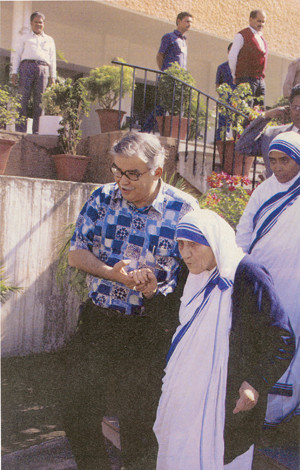
Irani with late Mother Teresa at inauguration of leprosy hospital Nirmal Hriday
With the Tatas apparently in the constant line of fire in the print and electronic media with reference to the 2G spectrum scam, we ask Irani if he found this distressing. "The media is hyperactive. It’s a dog eat dog attitude. Everything is sensationalized. Unfortunately, people remember only the bad news. The good is not publicized and not remembered. Instead of discussing business prospects at lunch, we discuss how to answer things in the media!” he comments. "A few days ago the CBI (Central Bureau of Investigation) probing the 2G spectrum scam gave a clean chit to Tata Teleservices, saying (in a Delhi court to the special CBI judge O. P. Saini) that there was no illegality in the granting of the licenses to the Tatas. I was quite sure of us (being absolved) anyway. But the media did not write much about it as they would have had to eat their own words.” Some are biased, some in the pocket of vested interests seeking to keep news one-sided, he adds.
In the din of democracy in India, the corrupt remain unpunished. "The deterrent effect is important. For every one person who is detained, hundreds get deterred. Anyone not paying taxes should be severely punished. Economic offenders should be put behind bars quickly. Most cases end up in courts for years till the man dies. We are very fortunate to have an honest Prime Minister, respected in India and outside. The system has not made him effective. He is being pulled in different directions. What we have seen in the last few months (with politicians and ministers in jail) is an encouraging sign. Anyone who is not beyond suspicion should be asked to go.”
The Tatas have gone much beyond the shores of India, asserts Irani. Almost two-thirds of the Group revenue of Rs 3.2 trillion ($ 67.4 billion in 2009-10) now comes from overseas, as per Tata sources. "Ratan Tata has led the charge very well in our international business, be it for markets, raw materials or manufacturing units outside India. The future lies in hi tech areas — software, telecom, advanced automobiles, defense supplies, power, steel… As far as the environment is concerned, there is a two-pronged approach. Companies must cut down their own emissions and also generate wealth by being in the business of environment, for example, in producing solar, wind or geo thermal energy,” Irani explains. The Group has a global workforce of nearly 400,000 people, 28 publicly listed companies and a shareholder base of 3.5 million in India, as per the Tata Review, May 2011.
Irani is proud that he has worked for the Tatas all his life. After completing his BSc in 1956 and MSc (Geology) two years later from Nagpur University, Irani proceeded to Sheffield (at that time the mecca of metallurgy) in the UK from where he obtained his PhD with a gold medal for his thesis. He started his career in 1963 as a senior scientific officer at the BISRA (British Iron and Steel Research Association), Sheffield where he rose to head the physical metallurgy division. Returning to India in 1968, he joined the Tata Iron and Steel Company (as it was then known) as assistant to director, research and development. He became general manager in 1979 and managing director (MD) in 1992. "That was the active and focused phase of my life — turning around and modernizing an old and outdated plant, expanding and making it profitable. JRD (J. R. D. Tata, then Group chairman) was a father figure to me. I dare to say he was my professional father. He intervened at three crucial times in my life — first when he made sure I came back from England, and then stayed back and later when I was made the MD. I regret that JRD never saw the modern plant. He died before it was ready.”
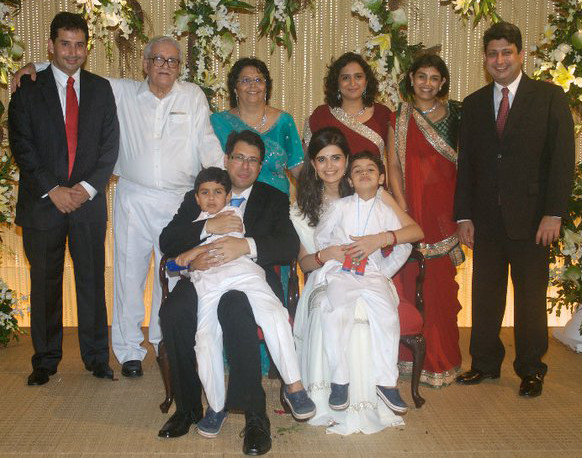
Jamshed and Daisy Irani (back row, 2nd and 3rd from left) and family at the wedding of daughter Tanaaz with Cyrus Rastomjee
Irani retired as Tata Steel MD in July 2001 and was inducted into the apex Tata Sons board at the headquarters in Bombay. Among the slew of honors conferred on him in India and abroad is an honorary knighthood (KBE) conferred by Queen Elizabeth II in 1997. The Government of India awarded him the Padma Bhushan in 2007.
Irani and his wife Daisy leave Bombay after a 10-year stint. Their son Zubin is senior managing director in charge of India operations with United Technologies (UTC) in Delhi. (Otis, Carrier, UTC Fire and Security are part of the six-company UTC). Daughter Niloufer and her husband Yezdi Nagporewalla are with KPMG in Bombay. Younger daughter Tanaaz is with Tata Teleservices, while her husband Cyrus Rastomjee is a senior executive with Swiss bank UBS.
The Parsi kom (community) is in a way killing itself, Irani asserts. "We are great at creating a problem where there is none. No, I do not believe in bringing Russians, Japanese… into the community. But where one parent is Parsi, full facility should be given. If both the parents agree to bring up the child as a Zoroastrian, what is wrong with that?” he queries. "Unless the community changes its ways, we will be extinct in 100 years.” All the public infighting is also very unfortunate, he says. "The BPP (Bombay Parsi Punchayet) is a commercial body. It should focus on housing, education, etc and not dabble in religion. Jamsheed Kanga and Homi Khusrokhan should be congratulated for taking them on in the renegade priests case. I was one of the (office bearers) on the Federation of the Parsi Zoroastrian Anjumans of India. I used to be disgusted at the shouting at meetings. I believe that the method for the disposal of the dead should be as per individual wishes.”
There were around 800 Parsis in Jamshedpur at one time, he states. Now there are only 300 or so, mostly old and retired. Despite a good salary, housing and educational facilities for the family, it is difficult to get a mobed for the agiary there, he adds.
As Irani goes home to the town Jamsetji built, the extended Tata family remains all around. With fewer irons in the fire and profit not a priority, the steel man can, perchance, care about his coin collection and have the time to stand and stare at the green of his garden.
◆ ◆ ◆
One reader wrote
Queen of Great Britan awarded Dr Jamshedji Irani with knighthood.Zoriastrians have always made the country and the community proud.
From the archive