
Cover Story
Value Added Tata
The one lakh rupee Nano heralds India’s arrival on the world auto engineering stage and promises pride of ownership to the common man
It was a four-year journey from concept to creation, from pipedream to promise fulfilled. Along the way it had confounded critics and competitors. Nowhere in the world had a car been made at a price of $2,500 (one lakh rupees). International car makers outwardly scoffed, perchance inwardly fluttered. Politicians joined Press and public in throwing many a spanner in the works. Yet when the unveiling finally arrived on January 10, 2008 at the Ninth Auto Expo in New Delhi, Ratan Naval Tata, the driving force and chief architect of India’s much awaited one lakh rupee car, basked in the warmth of a rapturous reception. A fortnight later, in the Republic Day honors list, the Government of India bestowed on Tata the Padma Vibhushan, the second highest civilian award in the country.
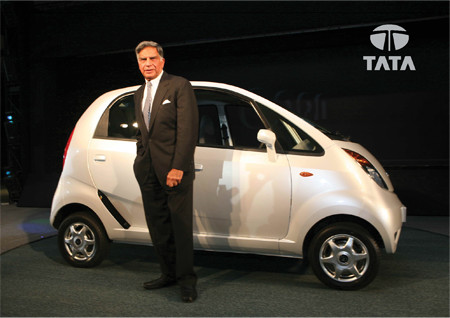
Tata Group chairman Ratan Tata
"There are no celebrities at this function nor any dance routines…I invite you to join me in this journey of innovation and evolution…I give you the new car from Tata Motors, the people’s car that everyone has been waiting for,” Ratan Tata stated at the launch as he stood on stage amidst a burst of son et lumière as frenzied photographers, international television crew and crowds of common men jostled for vantage space at stall No. 11 at the famed exhibition center of Pragati Maidan. "We decided we’d call it the Nano (which means ‘small’ in Gujarati and ‘one billionth part’ in the English dictionary) because it connotes high technology and small size,” stated the Tata Motors chairman and head of the Tata Group, one of India’s oldest, largest, well-respected business conglomerates. With revenues of $28.8 billion (Rs 129,994 crore) in 2006-07 and a market capitalization of $70.3 billion (as on January 17, 2008), the Group founded in 1868 by Jamsetji Nusserwanji Tata now has 98 companies and exports products and services to 80 countries worldwide!
The irony of Ratan Tata in the spotlight at the launch could not have been lost on the discerning observer. Here was a man known to be low profile, private, reticent — a tall man, turned 70, hair and bushy eyebrows flecked with grey, standing beside a contemporary, cute car, a bachelor wanting to revolutionize personal transportation for families! An architect by education, a licensed pilot often at the controls of his executive jet or chopper, bold enough to fly a fighter plane. A man who believes that a word once given must be honored — which made him and the company he heads retain the dealer price of the Nano at one lakh rupees (excluding Value Added Tax and transportation costs) "because a promise is a promise” and never mind if it related to an off-the-cuff calculation and remark he made at the Geneva Motor Show some years ago when a foreign correspondent asked him what the price of his new small car was likely to be!
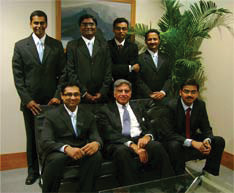
Ratan Tata (seated center) with Nano's core design team
The 624cc, 33bhp, 20kpl (km per liter), four-door, four-seater Nano is perhaps symptomatic of the Tata Group philosophy. Tata Motors, India’s largest truck and car manufacturer (which exactly 10 years ago launched Indica, India’s first indigenously designed and manufactured car) makes what is currently the world’s cheapest car and simultaneously bids two billion dollars to acquire the ultra luxurious Jaguar and Land Rover brands, with the British auto unions reportedly backing the bid! "It is possible that you can have high brands…it would be a great mistake to try and integrate everything…I think it should be nurtured as a brand… it gives us an entry into the high-end market. There are not that many stand-alone opportunities available. There weren’t that many stand-alone opportunities available in the steel industry either (referring to Tata Steel’s buyover of Anglo-Dutch steelmaker Corus last year at over $12 billion). So when you see something, you decide… there is a risk of course,” Ratan Tata told The Times of India, January 11, 2008.
Tata himself took "a leap of faith” when he decided to accept West Bengal’s Marxist chief minister Buddhadeb Bhattacharjee’s invitation to set up the plant to manufacture Nano at Singur in Hoogly district, not far from Calcutta. "We were breaking new ground not only on the product front, but also in helping industrialize a previously ignored part of India,” Tata is quoted on www.tata.com The West Bengal government acquired 997 acres of land from farmers for the plant (to come up on 645 acres) and ancillary industries, amidst a storm of political controversy, discontent and violence fomented by Left Front detractors. The government’s and Tatas’ stand was vindicated on January 18, 2008 when the Calcutta High Court ruled that the Singur land acquisition was perfectly legal and that there had been "no colorable exercise of power” by the West Bengal government in acquiring the land. With a project cost of around Rs 1,500-1,700 crore, the plant has a planned capacity of 250,000 units a year in the initial phase, to be upgraded to 350,000 annually. When asked how it felt to be on the front pages (because of the agitation in Singur) Tata replied: "Embarrassing and unpleasant. Whenever you are on the front page, you are also — each time and more so in India than anywhere else in the world — creating detractors and critics. For every action there is some kind of reaction, somebody who is hunting for something to criticize. And most often it is the reaction that people remember. This is all the more embarrassing because we are not a Group that seeks publicity.”
The revolutionary idea of a one lakh rupee car, essentially Ratan’s brainchild (as was the Indica) germinated from the chairman’s concern at an all-too-familiar sight on Indian roads – a family of father, mother, toddler and baby perched precariously on a two-wheeler, driving in the rain. "I asked myself whether one could conceive of a safe, affordable, all weather form of transport for such a family… Some scoffed at what we would produce, perhaps a vehicle comprising two scooters attached together or perhaps an unsafe, rudimentary vehicle — a poor excuse for a car…Let me assure you that the car we have designed will indeed meet all the current safety requirements of a modern day car,” Tata asserted at the unveiling. Personally involved in the execution of his dream project from the initial design doodles to the final exhausting hours in New Delhi before the launch, Tata readily acknowledged the dedication and sacrifice of his 500-strong design team of young engineers, as well as company executives who toiled determinedly to meet both the price and time targets, despite the carping of critics.
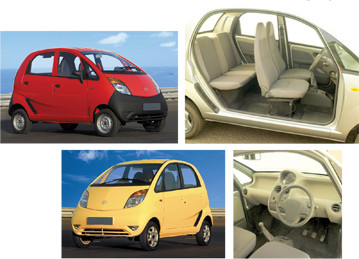
(Right) with Tata Motors managing director Ravi Kant The Nano: standard version (top left) and luxury model
"The Nano’s looks are terrific by any standard, you won’t be embarrassed to sit in it. What has really stunned the world is Nano’s shock price. Company executives (of rival companies) are scratching their heads wondering how Tata did it,” writes automobile expert and Autocar India editor Hormazd Sorabjee in his editorial in the February 2008 issue of Autocar. With a rear-mounted engine, the Nano is stated to be smaller in size but roomier than the Maruti 800, India’s most popular small car so far.
Despite the steep increase in the cost of steel and other inputs, Tata Motors has maintained the price of the standard version of the Nano at one lakh rupees, the chairman emphasized. The car will also be available at a higher price in two deluxe models with air-conditioning. A diesel variant is also to be launched. Nano is slated to hit the roads in the latter half of 2008.
With bigger and bigger fuel-guzzling, road-cluttering luxury sedans, SUVs (sports utility vehicles) and MUVs (multi utility vehicles) seen on Indian roads, Tata is pained at the Nano being singled out for criticism as being likely to cause congestion. "I think people are attacking us because they are apprehensive… Today we have almost 60-70 million two-to-three-wheelers in the country. We produced about 1.4 million cars and at some point we will exceed two million. Nobody said anything about that. It only happens to be this car that is being targeted. We conform to Euro IV (emission norms) in terms of our engine. Today Bharat Stage III is required. We conform to Bharat III. All scooters and two-wheelers are Bharat II today – not that they are not conforming, but that’s what their standard is… Two or three wheelers have become more of a menace on the road than a car because of their ability to weave in and out,” Tata told The Economic Times (ET), January 11. "In fact this is a car the greens (environmentalists) should embrace rather than oppose,” wrote auto expert Adil Jal Darukhanawala in a front page report in The Times of India, January 11.
Time magazine lists the Tata Nano along with all-time greats like Ford’s Model T and the Volkswagen Beetle in its list of the dozen most important cars starting with 1908. "At $2,500 it’s hard to see how it won’t sell, but even if it doesn’t it will become the poster car for a new stripped-back style of engineering — glue (aerospace adhesives) instead of welds! — that could change the world.”
Changing established assembly-line manufacturing too is Tata’s plan for leveraging the intellectual capital of small entrepreneurs. "We would create entrepreneurs across the country over time that would produce the same car,” Tata was quoted in ET, January 11. "We would produce all the mass items and ship it to them as kits so it is similar to an SKD ( semi knocked down) or CKD (completely knocked down) operation.” Tata Motors would retain the responsibility for quality assurance of these satellite assembling and dealership activities. "It will be very satisfying if the small car created 10 or 15 satellite groups of young engineers who thought they could get together and do a business they would never be able to get, normally, in the assembly of cars,” Tata told the paper.
"India may soon get its own ‘green’ car with Tata Motors and the Indian Space Research Organisation (ISRO) teaming up to launch a vehicle that will run on hydrogen, leaving behind only water vapor as exhaust. The car, which has been on Ratan Tata’s mind since 2005, is expected to hit the roads by 2008,” wrote the Hindustan Times, November 23, 2007 in a front page report. "Tata Motors is working on or supporting the development of alternate fuels, including bio-fuels and hydrogen, as well as electric vehicles and hybrid vehicles such as cars and public transport vehicles,” the paper added. Advance thinking from a man whose appointment 16 years ago as Group chairman and successor to the legendary J. R. D. Tata (JRD) had raised much apprehension!
Ratan had joined the Tata Group in 1962, returning to India after a Bachelor of Science degree in architecture from Cornell University in the US. After serving in various companies he was appointed director-in-charge of NELCO (National Radio Electronics Company Limited) in 1971, which was then a company in dire straits. In 1981, he was made chairman of Tata Industries, responsible for transforming it into a strategic think-tank and promoter of new ventures in high-tech areas.
Though handpicked as successor by JRD, who had been chairman of the Group for 53 years, Ratan’s accession as chairman pitchforked him into many a boardroom battle with powerful, independent-minded and often mercurial company heads such as Russi Mody (Tata Iron and Steel Company, renamed Tata Steel in 2005), Ajit Kerkar (The Indian Hotels Company) and Darbari Seth (Tata Chemicals) who allegedly resisted attempts to bring the companies under greater control from the nerve center of Tata Sons (the Group’s holding company) at Bombay House. What Tata Sons was looking for was a change in drive and direction. The Group had been functioning as a loose, lumbering confederation. Flagship companies were showing losses, it was imperative that businesses in sluggish sectors like textiles be exited and sunrise industries such as information technology, telecommunications, retail, etc be pursued more aggressively.
Going global was high on the agenda but not, in Ratan’s own words, "over everyone’s dead bodies.” The acquisition by Tata Tea of the Tetley brand in the year 2000 for over $400 million was a defining moment – the first major acquisition of a well-known international brand by an Indian business house. Heady milestones followed, accompanied by headaches caused by corruption, competition and vested interests – buying a controlling stake in government-owned Videsh Sanchar Nigam Limited (India’s leading international telecommunications service provider), Tata Motors’ buyout of the heavy vehicles unit of Daewoo Motors, South Korea, infotech powerhouse Tata Consultancy Services going public in 2004 with the largest Initial Public Offer in the Indian market raising $1.2 billion, Tata Steel accessing overseas markets via acquisitions in Asia, Australia, Africa, and of course the largest of them all — the passage to England with the Corus deal.
"The Tatas do not walk into a company on a Monday morning and inform employees their resignations are expected on the table by evening,” Ratan Tata had patiently explained to a TV interviewer repeatedly quizzing him over what is known in common parlance as ‘hostile takeovers.’ There should be synergy, a common business philosophy between the acquirer and the acquired for the business to grow. "History will decide whether we have been foolish or courageous,” he asserts.
With the retirement age of board members once again raised from 70 to 75 years, Tata is due to step down in 2012. For now, much remains to be done. A successor has to be identified and nurtured before he takes charge of a Group which is into a plethora of goods and services from salt to steel to software and which has almost 290,000 employees and over 2.9 million shareholders! Propelled by philanthropy too, a portion of the profits from Tata Sons is channeled each year into the Sir Dorabji Tata Trust and the Sir Ratan Tata Trust, which are among India’s oldest, non-sectarian trusts. Among its several projects, the Group is currently believed to be working on a low cost drinking water purification system for India’s masses.
"Right now I’m in a very lonely phase of my life,” Tata had told a leading newspaper on the eve of the Nano launch. "When the Indica was under production my friends here said ‘you will produce a lemon.’ They begged me to distance myself from it, they started to leave me alone. If things get okay then of course everybody is your friend again. But it gets, just as you said, fairly lonely.” There’s much merit in retiring, as Michael Schumacher did, at the peak of one’s career, he believes. "You don’t want to fade away by hanging in there for too long.”
"Indian in ownership, at home in the world,” is his vision for the Group. History will judge whether Ratan Tata has been Tatas’ renaissance man.
◆ ◆ ◆
From the archive