
Cover Story
The taj of the Tatas
In its 100th year, the Taj is renamed The Taj Mahal Palace and Tower
When Jamsetji Nusserwanji Tata’s grand creation, The Taj Mahal Palace Hotel, opened in Bombay on December 16, 1903, it stood in solitary splendor — on the all-quiet eastern waterfront. Each dawn, starbursts of the golden orb of day touched its magnificent onion-shaped cupolas, cusped arches and carved cornices; the moon over the midnight blue waters of the Arabian Sea sent in its silver through the 125.5 ft central cupola which stood vastly taller than the surrounding structures.
Its famous next door neighbor — the honey colored basalt arch of the Gateway of India — did not exist. It was built, on land reclaimed from the sea, and inaugurated 21 years later! The Indian Electricity Act was still being framed by the British colonial masters, there was no telephone. The plebians traveled by ox-drawn carts or in trams drawn by horses clip-clopping through the streets; the gentry used the horse-drawn victorias (carriages) or elegant gigs and landaus.
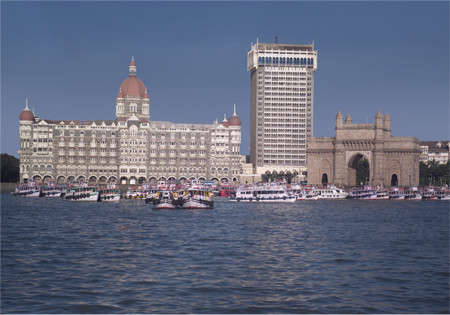
On the waterfront (from left) Taj heritage structure, Tower Wing and the Gateway of India
"Ahead of its time since 1903,” states the Taj’s motto. When the first 17 guests checked in, the Hotel was well ahead of its time! Scouring the cities of the world — London, Paris, Berlin, Dusseldorf — Tata imported for his luxurious hotel "the latest arrangements and contrivances.” While the Hotel was being constructed, he had visited an exhibition in Dusseldorf and contracted with a German firm to electrify the Hotel at a cost of two annas per unit! The Taj was the first commercial establishment in Bombay to be electrified ("... and then the lights came on,” by Goolam E. Vahanvati, advocate general of Maharashtra, published in The Taj, Volume 32, No 1, Centenary Issue 2003). It had electric lights, fans, bells and clocks and four electric passenger lifts! Its laundry had electrically heated irons, the kitchens, cellars and services were of the latest type. The sanitation was modern; exotic Turkish baths enveloped guests in a cocoon of relaxed luxury. "A 15-ton carbon dioxide ice-making plant provided refrigeration and cooled suites of rooms, and the mechanical marvels of the Hotel were nicely rounded off by a soda water factory, an electroplating plant, machines for washing plates and burnishing silver...”
(The article adds that three years later, it was Jamsetji’s sons Dorab and Ratan who formed a company with a totally Indian capital of Rs 175 lakhs to develop electric energy by harnessing the abundant rainfall in the Western Ghats. Two huge reservoirs at Lonavla would create a waterfall of nearly 1,800 ft and turbines and generators at Khopoli at the foot of the Ghats would generate electric power which would be transmitted along 43 miles of transmission lines to the outskirts of Bombay, from where "the current would be stepped down” and brought to consumers in the city. The scheme aroused a storm of agitation and active opposition from vested interests rather than acclaim! Ultimately the British government took the stand that it was impossible for them not to sanction the introduction of cheap electricity into Bombay, but the Tata Hydro Electric Supply Company was granted a license initially only to supply power to bulk users like factories and the railways!)
Jamsetji’s vision was large — and nationalistic. He had already made a personal fortune out of Lord Napier’s Abyssinian War in 1867 through contracts for the 16,000 British troops sent from Bombay. His first industrial venture, the Alexandra Mills, commenced the manufacture of cotton goods in 1869, taking on the British at their own trade. Six months of study and observation in Lancashire led to the launch of the Empress Mills in 1877 in Nagpur. Jamsetji believed in making profits, and was not diffident about the acquisition of technology and knowledge from the West. His entrepreneurial spirit saw steel when he learnt that rich deposits of iron had been found around the small village of Sakchi in remote Bihar and that the Jharia coalfields nearby could supply the necessary coal. Among Jamsetji’s last journeys was a visit to Alabama and Pittsburgh in the United States to study the coking process. Steel meant self-reliance for India, he believed. Jamsetji’s concept was consolidated by his sons, when India’s first private steel mill was set up in the steel city that bears his name (Jamshedpur).
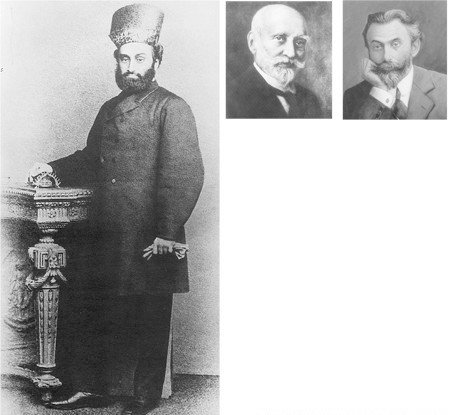
Towering personalities (from left): Jamsetji, Dorab and Ratan Tata
Jamsetji died on May 19, 1904. Ninety nine years later, the Tata empire presently under (non-executive) chairman Ratan Tata has blossomed, as per their fact file, to become India’s largest employer in the private sector, with 2,30,000 employees across 95 companies! Its turnover is more than US $ 11 billion, equivalent to 2.6 percent of India’s GDP (gross domestic product). The firsts have continued — India’s first international airline (Tata Airlines later Air India), the first car maker in India (Tata Engineering, now Tata Motors) to design and build an indigenous car aptly christened Indica, the first Indian software company (Tata Consultancy Services) to cross the $ 1 billion (Rs 5,012 crore) mark in total revenue; India’s largest ILD-services provider (Videsh Sanchar Nigam Limited); the first Indian multinational corporation in the global tea market (Tata Tea) following its acquisition of the Tetley brand... The Tata footprint covers the sunrise industries of the new millennium as well as old war-horses like Tata Steel and Tata Chemicals, nimble footing their way through the first decade of the 21st century.
And the hotels have grown too. The matriarch at Apollo Bunder is the taj (crown) of the Taj Group of Hotels, now encompassing 65 hospitality entities with 8,155 rooms in India and abroad, as per their 102nd annual report 2002-03. Categorized into luxury, leisure and business segments, they cover beach resorts, garden retreats, wildlife sanctuaries, historic and business centers...
For the centurion, however, age has not withered nor custom staled her infinite variety. "If the walls of the Taj could speak, what tales would they tell?” queries Ravi Dubey, senior vice president, corporate affairs/projects. Tales of mustachioed maharajas in full regalia with their retinue of retainers; of royal reveries of the heads of state gracing grand banquets — King Emperor George V and Queen Mary on their state visit in 1911, Queen Elizabeth II and Prince Philip, the Shah of Iran and Queen Farah; modern day king makers and politicians of all persuasions — Pandit Jawaharlal Nehru, Mahatma Gandhi, Mohammed Ali Jinnah, Lord and Lady Mountbatten, President Nasser...
From celebrated men of letters George Bernard Shaw and Somerset Maugham to romantic novelist Barbara Cartland; Hollywood heartthrobs Douglas Fairbanks and Gregory Peck to modern day actress Susan Sarandon; from Yehudi Menuhin to Paul Harrison, John Lennon and Mick Jagger... the Hotel has seen it all — the fame, the frailties and the foibles of the bold and the beautiful; the diffident gawking of out-of-towners viewing five-star opulence for the first time!
The stories and the pictures linger — of the deceased maharaja given a stately farewell carried out seated upright in a chair as befits royal dignity; of Rutty, daughter of Sir Dinshaw Petit and wife of Mohammed Ali Jinnah, seeking refuge in the Hotel when she quarreled with her famous husband; of Sarojini Naidu holding court in what was almost her permanent suite in the Taj; of JRD (Tata group chairman prior to Ratan) and wife Rodabeh receiving important guests...
Encapsulating the decades — from the time bits and bites pertained to culinary delicacies, when grass meant lawn and a big mac referred to an oversized raincoat — to the megabytes of 21st century cyberspace is Zafar Hai’s film entitled The Taj of Apollo Bunder. Well-known actor Roshan Seth — tailcoat, red rose in buttonhole, stiff upper lip and tongue-in-check — takes us through the trials, tribulations and triumphs of 100 years.
Built at the then phenomenal cost of £ 500,000, World War I saw the Hotel being partly converted into a 600-bed hospital; it felt the reverberations of World War II and its economic aftermath. When India "awoke to life and freedom,” the Taj took a while to find a fresh avatar in independent India. The elegant soirées, the live orchestras, the beat of the British regimental bands had made their passage out of India from the Gateway. In place of royal privy purses came the deep plastic of corporate clients; the lilt of the waltz and the swirling skirts were replaced by the dulcet notes of shehnai, the red and gold of brocade and zardozi as wedding guests swished their way up the staircase to the Crystal Room shimmering in the crystalline clarity of the enormous Belgian chandeliers.
An invitation to navjotes and Parsi weddings in the Crystal Room, now alas reduced to a trickle, saw maroon and magenta garas amidst the carved pillars (which once adorned Petit Hall, the palatial residence of the Petit family, before it was demolished), lustrous diamonds and rubies of Parsi matrons glinting in the sparkle of the chandeliers lighting up the Taj when their days at Petit Hall were done. And the young ones shaking a leg to Goody Seervai and his accordion, Nelly and her band.
Noted filmmaker Ismail Merchant recollects earlier years: "... elegantly dressed Parsi ladies... took afternoon tea (at the Taj)... On one such occasion — just after the film Rock Around the Clock had taken Bombay by storm — there was a dance in the Ballroom, and everyone was rocking and rolling so furiously that dancers collapsed and had to be dragged outside to cool off. The haughty Taj suddenly resembled a madhouse and the genteel Parsi ladies were appalled at having their tea and their tranquility disturbed in this way (The Taj, Volume 32, No 3, 3rd Quarter 2003).”
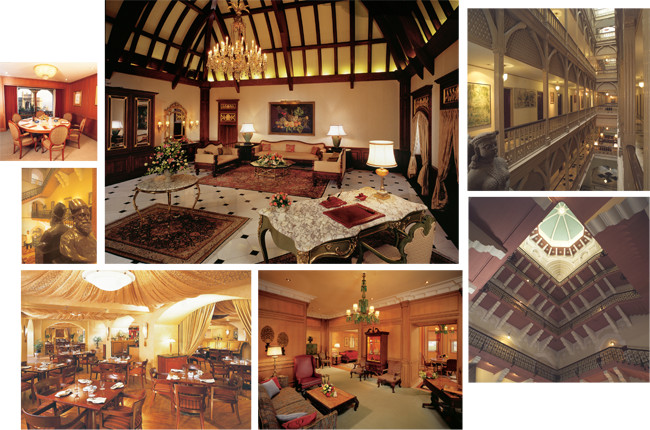
Clockwise from top left: Room with a view; the opulence of the Presidential suite; the old and the beautiful — the Heritage Wing; the magnificent stairwell and dome; antiques in the Tata suite; the Shamiana — contemporary coffee shop; Jamsetji — regal reflection :All photos courtesy Taj Magazine/Tata Central Archives
Undisturbed however are the treasure trove of paintings, furniture and artefacts that adorn the suites, public areas and corridors. Maqbool Fida Husain’s enormous canvas entitled Three Stanzas of the New Millennium adorns the lobby of the Tower Wing (constructed in 1973 where the Greens Hotel once stood), paintings by Shiavax Chavda, K. K. Hebbar, K. H. Ara, Anjolie Ela Menon, Naina Kanodia and other leading Indian painters are among the Taj’s impressive art collection. Jehangir Sabavala’s oil on canvas dating from the early 1970s entitled Outward to the Unknown hangs, appropriately enough, in the Bell Tower suite!
A Pandora’s box of exquisite lacquer, Oriental and European porcelain and pottery, Victorian colored glass, teak, rosewood and mahogany furniture, metal work and tribal art set the Hotel with its 500 plus rooms including 50 lavish suites apart from the johnny-come-lately, steel, glass and chrome competitors mushrooming rapidly all over the city.
The old faithfuls are still around. "In 1933, Gazdar’s (Gazdar Private Limited) — elite jewelers to the finest families in the country — became the first commercial outlet to open at the Taj,” writes Meher Marfatia in The Sunday Times of India of June 22, 2003. To Noshir Dotivala, a spry 80 today, goes the distinction of being the oldest employee still at work in the building (with the possible exception of Meherwanji Chinoy, a Gazdar’s director two years his senior), continues Marfatia. The Smithsonian in Washington possesses a jade vase from Gazdar’s, notes Dotivala with pride. Philanthropist Bapsy Sabavala once rode a horse up the staircase en route to a Crystal Room fund raiser; maharajas who had regular meetings (prior to Independence) in the Princes Room were among Gazdar’s best customers, recalls Dotivala.
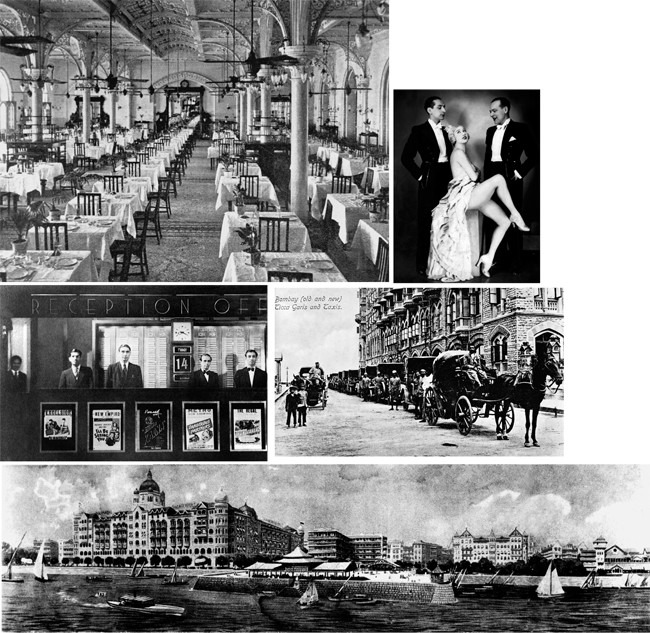
Grace and grandeur of old Ballroom (top); sugar and spice of the ’30s cabaret (alongside); all attention at the Reception (center); Stately and sedate transport(alongside); keeping watch over old Bombay harbor (bottom);
The tête-à-têtes and the rendezvous remain, albeit in different avatars. The centenary refurbishment has seen a new check-in lobby for the Heritage Wing. The heavy interiors of the Indian restaurant Tanjore have been replaced by the minimalist decor, the contemporary look and nomenclature of Masala Kraft. The Rooftop Rendezvous, popular with the Parsis in the 70s is no more — in its place comes Souk with its Middle Eastern decor and cuisine. The smoked salmon, schnapps and soufflés remain at the restaurants but the tandooris, tikkas and thalis give stiff competition! In 1903, a suite of rooms including full board involved the princely sum of Rs 30 (roughly 40 pence); in 2003 the price of a bottle of bubbly at the aristocratic Zodiac Grill may run into four figures! The Harbour Bar was Bombay’s first licensed bar, holding Bar License No 1; the new Starboard is "Bombay’s trendiest bar,” says the Taj’s website www/tajhotels.com The flounces and fishnet tights of the risqué cabaret in the Ballroom have metamorphosed into the cool chicks and dudes dancing at Insomnia, "Bombay’s most happening nightclub!” Aromatherapy and yoga at Jiva, the Taj Spa alongside the pool, are in the fitness of things. Modems and telephone lines for internet connectivity are passé in this e-age — WiFi (a new broadband solution using Wireless Fidelity) allows guests the convenience of high speed internet from their laptops in any part of the Hotel.
Over the decades, myths about the Hotel’s conception and construction have grown. "How and when he (Jamsetji) toyed with the idea of a hotel is far from clear. Rumor has it that he thought of it when either the Watson’s or the Pyrke’s — two of the finest hotels in Bombay at that time — refused him entry on racial grounds. Another story has it that his experience of the great plague, which began in 1896, convinced him that he needed to put up a great hotel to restore the image of his beloved Bombay, a hotel which would be Indian owned, managed by European staff and open to visitors and guests of all races. The fact remains that the idea took his family by complete surprise even as his friends feared that Jamsetji would end up with a white elephant,” writes noted journalist and former editor of The Times of India Dileep Padgaonkar in the Centenary Issue.
The aristocracy of its architecture ensured that the Taj instantly joined the "chain of caravanserais which sumptuously punctuated the travels of later day British imperialists — Shepherds in Cairo, Raffles in Singapore and the Peninsula in Hong Kong,” continues Padgaonkar. The Taj was located at Apollo Bunder, popularly known as ‘Palva’ (a corruption of the word palla or palwah, the sable fish found abundantly in the surrounding waters where the Koli fishing boats landed at the bunder or pier). ‘Palva’ was a popular hava-khana [literally ‘eating the air,’ (source): Bombay, The Cities Within by Sharada Dwivedi and Rahul Mehrotra] for the burra sahibs and memsahibs of the British Raj, as well as the locals including the prosperous Parsis who viewed Palva and the Taj with proprietory pride! (chaalo, Taj farava jayeé). The western promenade — the grand curve of Marine Drive — was not completed till the 1930s.
Adding to the stories surrounding the Taj is the popular perception that it was built back to front and that the architect committed suicide when he realized what had happened! "Not true at all,” emphatically asserts Dubey. "What Jamsetji really wanted was the maximum number of rooms facing the sea. The Hotel was built exactly according to plan. We have the visuals of elevation with us.” The architectural plans were originally initiated by Sitaram Khanderao Vaidya and D. N. Mirza, but Vaidya’s untimely demise brought on the scene a radical Englishman by the name of W. A. Chambers who completed the project, states public relations executive Rubana Pestonji. The style was eclectic, described variously as Moorish, Eastern and Indo-Saracenic. The U-shaped wings around a central courtyard, the high ceilings and long verandahs were designed to tap the breezes blowing not directly from the harbor with its picturesque prows, but from across Back Bay to the west where the original entrance was and where the swimming pool now stands.
At the heart of the structure was the magnificent cantilevered central stairway which stands today, a century later, in a cascade of carpet sweeping down from the central dome, Jamsetji’s patrician figure in dagla and pugree seated benignly at the top of the first flight.
Among the most farsighted of Bombay’s citizens at that time, Jamsetji’s schemes for the improvement of the city were many, but most of them did not see fruition, primarily due to the shortsightedness of the authorities. A "splendid project he envisaged was the development of a suburban Venice on 1,200 acres of low-lying areas, criss-crossed by creeks and bounded on the west by the village of Juhu Tara, where he proposed to reclaim 500 plots, each comprising an acre, to be surrounded by canals with sluice gates. In addition, the village of Juhu Tara was to be developed as a fashionable seaside resort. Jamsetji unfortunately died... and although his sons and successors were keen to implement his ideas, priority was given to constructing the Tata steel works at Sakchi and the reclamation projects were indefinitely postponed (Bombay, The Cities Within).”
According to his biographer Frank Harris, Jamsetji purchased land on the island of Madh, in Juhu and Bandra and built bungalows on each plot in the 1890s. On the island of Salsette (which mainly comprised the Bandra and Thana regions), he purchased a house and the whole village of Anik. Large numbers of people had fled to Salsette during the plague epidemic and had built small, ramshackle houses amidst the swamps and scrub. On the large properties he owned north of Bandra, Jamsetji made plans to build houses for the middle class at moderate rents, but his schemes were frustrated by a series of building fines imposed by the Bombay Government on undeveloped lands. Jamsetji carried on a protracted correspondence with the collector of Thana regarding the Rs 1,500 fine per acre that would have to be paid on the houses as well as on the gardens and compounds that surrounded them.
The levies were in fact much higher than those at Bombay itself. In 1899, as spokesman for the residents of Salsette, he petitioned the Bombay governor: "Apart from a mere handful of Bombay residents desirous of having houses in the suburbs, those desirous of building residences there are mostly men of moderate means... By far the greater portion of these are the permanent residents of the suburbs themselves...” The Government however maintained that the properties were, in fact, owned by capitalists. In sheer frustration, Jamsetji finally wrote to the then Viceroy, Lord Curzon. Whilst pointing out that he was the only ‘capitalist’ among the signatories to the appeal, Jamsetji asked for protection to the 10,000 landholders of Salsette. Although the press and the public supported Jamsetji’s stance, the Government continued with its intractable attitude.
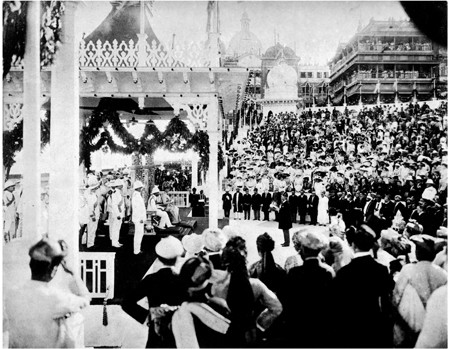
Witnessing the royal welcome to King George V and Queen Mary in 1911 at Apollo Bunder
Meanwhile, Jamsetji persisted in his efforts to implement other plans such as a reclamation scheme around Mahim creek, stretching from the causeway to Bandra and Santa Cruz. To improve the health of these localities, he proposed the reclamation of low-lying swamps and their conversion into pasture ground for milch cattle, also eliminating thereby the nuisance of malarial areas. He hoped to create a fishery too at Mahim creek to provide a sizable supply of salmon, mullet and prawn to feed the city’s rapidly growing population. Although Jamsetji’s plans did not fructify, his efforts symbolized the potential that private entrepreneurs were recognizing for the Greater Bombay region and by the 1900s the Government began to commence investment in infrastructure for this region (Bombay, The Cities Within).
Almost a century after Jamsetji’s efforts to develop the suburbs, the Taj obtained a sibling in the north — the erstwhile Regent Hotel, now known as the Taj Lands End, near Jeejeebhoy Point in Bandra. States the annual report 2002-03 of The Indian Hotels Company Limited which owns the Taj Group: "This was probably the largest acquisition in the hotel industry in India to date, (making the Taj) the only one in Bombay to have a large presence in north and south Bombay.” (The Taj President was acquired earlier.) Breaking new ground in South Bombay are the Wellington Mews Serviced Apartments (also a first for this part of town) to be launched in the last quarter of the financial year 2003-2004, which will provide five-star, exclusive, serviced apartments to long-staying guests.
India’s experiment with socialism in the middle years of the 20th century, with stifling controls and heavy taxation, almost checked out the five-star hospitality industry. Through the decades the Taj came to be known as the Taj Mahal Hotel, the word ‘palace’ lost in the mists of time. In its centenary year, the hotel is renamed The Taj Mahal Palace and Tower, in keeping with the vision of its founder. The Taj Palace and The Taj Mahal Hotel in Delhi, The Taj Bengal in Calcutta, The Taj West End in Bangalore, The Taj Coromandel Hotel in Madras and The Taj Mahal Palace and Tower, Bombay are members of the "Leading Hotels of the World.” More recently the Taj Exotica Resort and Spa, Maldives, Taj Lake Palace, Udaipur and Rambagh Palace, Jaipur joined the exclusive list of "Leading Small Hotels of the World,” according to Hotel sources.
Keeping up royal connections is the recently inaugurated Usha Kiran Palace Hotel in the erstwhile princely state of Gwalior; the Falaknuma Palace is slated to open in late 2004 in the one time residence of the Nizams in Hyderabad. With luxury suites and apartments in London and hotels in Dubai, Oman, Yemen, Zambia, Colombo, Kathmandu and Maldives, their new Taj Exotica adds to the list when it opens in the azure surroundings of Mauritius in November 2004, according to the Taj News of August 2003. The Taj Group is the largest hotel chain in South Asia, as per their annual report.
Piloting the progress are the people. Heading the board of directors is the reticent Ratan Naval Tata, who moved from executive to non-executive chairmanship in December last year on his reaching the age of 65, in keeping with Tata Group policy. R. K. Krishna Kumar is vice chairman. Others on the board are octogenarian Jamshed Bhabha, Noshir Soonawalla, Keki Dadiseth, Shapoor Mistry, Zubin Dubash, Deepak Parekh, S. K. Kandhari, Jagdish Capoor, Tejendra Khanna and Burjor Nariman who is also the company secretary. Raymond Bickson of the US is managing director. Maneck Patel, vice president and general manager of the Taj in Bombay, Jamshed Daboo, chief operating officer of the Leisure Division, Shirin Batliwala, vice president, coordination, Luxury Division, Rohinton Commisse-riat, general manager, marketing, Luxury Hotels are among the several in the top echelons of management.
While the government has somewhat loosened the strangles on the five-star hospitality industry with the relaxation of the luxury tax and expenditure tax, the board is still battling the shocks and awe of international occurrences like September 11, 2001, the Iraq War and SARS (severe acute respiratory syndrome) this year. In sync with Ratan Tata’s vision of a people’s car (costing around one lakh rupees), the Taj Group has also "witnessed considerable progress in the development of a model ‘value for money’ hotel to be launched by the Group,” states their annual report. The Group also aims to establish a significant presence in international gateway cities such as New York, Los Angeles/San Francisco and Singapore, as well as in fast growing markets like China. The profit after tax for the year ended March 31, 2003 at Rs 40.48 crore declined by 50 percent over the previous financial year, as per their statement of accounts.
"What adds a unique dimension to the Taj is the fact that a significant part of the profits of the enterprise go back to the Tata Trusts which, for some eight decades, have been working to build our nation, to bring relief to those in distress, to educate the most talented minds... at the heart (of the house of Tata) lies the unique concept of trusteeship,” states Krishna Kumar. The Taj community development philosophy involves distribution of surplus food to charitable homes, providing training in kitchen management and housekeeping to deserving persons and institutions like remand homes, prisons and hospitals, interaction with street children and youth in slums and charitable homes, etc.
The year-long centenary celebrations are not all partying, elucidates Dubey. The Hotel continues to espouse environmental, social and cultural causes. It sponsored a conference on the Game Theory by Nobel laureates John Nash and Amartya Sen in early 2003.Maestro Zubin Mehta, whose father Mehli Mehta had played the violin at the Taj when Zubin was a child, wove magical melodies with the Vienna Philharmonic Orchestra at the Jamshed Bhabha Opera House in March, with the Taj hosting the Orchestra’s stay.
Concerned about the deterioration to its famed namesake in Agra, the Taj Group has funded a panel of international experts from institutions like the Getty Foundation, the Smithsonian and the Metropolitan Museum of Art in the US, says Dubey. Contributions to the National Culture Fund have seen progress on the visitor facilitation center being improved, repairs to sidewalls, etc. The expert panel will "look at the marble itself soon,” notes Dubey.
History and the hotel are intertwined. The rites of passage will go on with cosy conferences, international conventions, wedding nights spent in suites, golden anniversaries celebrated. The small picture changes, the large palette stands. One hundred years on, the Taj remains one of the most precious jewels in the Tata crown.
◆ ◆ ◆
From the archive