
In Memoriam
Mirza’s musical medley
Died: Ervad Adi Jamshed Driver (Mirza), 78, well-known playwright, poet and ghazalkar, in Bombay on March 1, 2007 following cardiac complications.
"A poet of great ability…” summed up educationist and author Bejon Desai when referring to Driver’s talents, adding, "In the last 15-20 years of his life as a ghazal-poet Adi knew very little of the murky side of life but knew more than what was required of fine imageries, sentiments, piety of living in a loving and lovely manner… To become a poet, rather a successful poet, one must keep himself abreast with the works of great poets, also study hard the meters and prosody and the ecstasy with which these bards have presented their emotions and innermost feelings so beautifully,” observed Desai who had known Adi since their days together at the Youths Own Union (YOU), a cultural organization where they had often shared a platform.
All his yesteryear friends continue to remember him as Adi Mirza for it is only in the early 1990s that concern for the family’s security made him change his surname from Mirza to Driver (his family profession) when animosity against the Muslims resulted in his receiving anonymous calls.
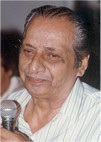
On April 7, 2007, there was a condolence meeting arranged for Driver at the Juhu Jagruti Centre, Vile Parle when renowned poets and singers rendered Gujarati ghazals penned by Driver from his book Sadgi. "It was then that I realized what a great man Adi was,” wrote Marzban Giara who had interacted with him when compiling his book of songs Gaavo Mari Sathe. He further remembered Adi as "a multifaceted personality. Some persons can play an instrument, some can write poems and some can compose songs. But Adi was a versatile genius who had all these qualities…
"I first met him at a music program he conducted in the library hall of the K. R. Cama Oriental Institute (KRCOI) some seven years ago. For over two hours he had the audience spellbound…He played the harmonium and also sang songs composed by him like Satya no sacho rah batavé, énu naam té Bawaji; Insaan nazar né samji lé; Jagat ma sauthi nyaaro chhé, Asho Jarthost Paigambar…Between the songs he would recite a few couplets or shayaris (verses) composed by him…”
In the last decade of his life the Indian National Theatre would invite him each year to their Independence Day program where he would recite ghazals which were very well received by his fans. So impressed was the renowned singer Manhar Udhas by this Parsi ghazalkar who had a "distinctive style of writing Gujarati ghazals in the traditional format,” that he ensured that every cassette released by him included at least one of Driver’s compositions. Appreciating the "guidance and blessings” he received from Driver, Udhas remembered well his album Abhushan in the early 1990s that had first included a track penned by Driver. "I induced him to attend mushairas because the audience was very keen to see the face of the Parsi poet who had penned the lyrics of the ghazals I was singing,” he added.
Singer Soli Kapadia who has rendered Driver’s compositions on stage, on television and on All India Radio referred to "the simplicity of this great musician,” and noted, "I consider him a landmark. He was another Mareez (king of Gujarati ghazals) renowned for his Gujarati poetry.” Lamenting that the community so far has not recognized his genius Kapadia hopes that some business house will come forward to promote his project wherein he is recording for posterity Driver’s lyrics and tunes. Although he will lend his voice for this project in an honorary capacity, he still expects the cost per CD to work out to Rs 10-15 lakhs, allowing for the fees of other musicians and studio recording.
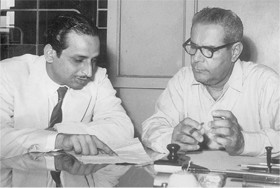
Mirza (left) with legendary filmmaker Sohrab Modi
Commonly referred to as the "Mirza Ghalib of the Parsi community,” Driver gave his last public performance at the KRCOI on September 4, 2006, when he along with two other Parsi musicians was felicitated by the Rahnumae Mazdayas-nan Sabha on Dadabhai Naoroji’s birthday. Chief guest and Surat’s comedy king Yazdi Karanjia had then referred to these eminent musicians as "Sangeet na raja ané ghazal na badshah (king of music and emperor of ghazals).”
His play Lovji na Lagan was performed last year on the founder’s day of Girton High School when his eldest granddaughter Dinaz played the lead role, a matter of great pride to him. By public demand, this drama was once again reenacted on Zochild Day later in the year.
Earlier his plays (he wrote over 15 of them during his lifetime) would be telecast on television too, recalls Mani Mulla who had performed the role of the heroine in many of his productions. His scripts invariably had a social message and dealt with the practical problems of society. Having known him since she was a child of 10, she still remembers how the "tall and handsome Adi Uncle met his talented and beautiful wife Roda” at the YOU meets. The fact that both he and her (Mulla’s) father were practicing mobeds was another common ground for them. "Sensitive, warm-hearted, smiling, I have never seen him frown,” states Mulla who would visit him at his residence in his latter days too when invariably "he would take out his harmonium and together they would spend some hours together singing or talking of the good old days.”
"Every time I came to Bombay, (his) house was the first place I would visit. Just to see him and have nostalgic thoughts was worth everything. He was always full of life and I enjoyed just being with him,” wrote Noshir Umrigar of London of his friend of 60 years who "took me under his wing and was always protective and supportive of me.”
Driver’s education was at the M. F. Cama Athornan Institute from where he qualified as a sampoorna mobed and later graduated in Arts from St Xavier’s College. He had worked for Greaves Cotton, Godrej and Boyce and Remington and the experience gained helped him to start his own business in the buying, selling and repairing of typewriters and electronic calculators. During muktads he would pray at the Kappawalla and Eedawalla agiaries.
"He was a very simple man. Material things never mattered to him,” recalls his son Aspi. "Papa lived by the maxim of khao and khavrao (eat and make others eat heartily),” mentions his daughter-in-law Roxana who appreciates how the doting grandfather, who was also a good cook, would invariably ask his three grandchildren, Dinaz, Dilnaz and Farzad, before they left for school what their food preferences for the day were and he made sure he complied with their wishes.
One of the anecdotes the well-built Driver loved narrating to his grandchildren and others was of the time he went to enroll for piano lessons from a Prof Saldanha who observing his big palms and podgy fingers advised him to take up boxing instead! But just before leaving Adi played a few notes on the piano which so impressed the professor that he instructed him to come for lessons from the next day. His harmonium training was under Pandit P. Madhukar.
Very health conscious, he would insist on going down for a stroll each day. However, in the last few years when his legs started failing him and he became housebound, he passed his time minutely reading the newspapers and sketching in pencil, his creativity rising to the fore yet again.
The talented artiste is survived by his wife Roda and son Aspi.
Remembering ‘Rohi’
Died: Rohinton Kooverji Sethna, 68, civil servant in various United Nations (UN) bodies, of cancer in Sarasota, Florida, on June 21, 2007.
"A person’s true legacy is the memories other people have of them. We remember Rohi (as Rohinton was commonly and fondly known) as a man of great personal integrity and enormous courage. He stood up for principles of honesty and good management against the powers that be and paid a price for it. Many others we know have such memories of Rohi,” attested a former UN colleague at Sethna’s memorial service, of the man who retired from the United Nations Development Programme (UNDP) in 1999, having served the organization over 20 years, guiding programs for sustainable human development in Italy, Kenya, Burma and Barbados, and at the UN headquarters in New York.
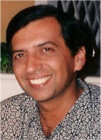
Rohinton Sethna: mega courage
A chartered accountant who began his career in London, Sethna’s first assignment with the United Nations came in 1978, when he was posted to Rome, Italy as finance officer for the Food and Agriculture Organization, notes a write-up from the family. During his years with UNDP, Sethna oversaw a wide range of programs such as geothermal energy and disaster relief in the Eastern Caribbean, opium crop burning and farmer sensitization in Burma, training police dogs in South Africa as part of a drug control program, issuing award-winning anti-drug public service videos in Nairobi and election monitoring in Indonesia, adds the bio data. In Kenya he served with what was then UNDCP — United Nations Drug Control Program. He oversaw the program in East and Southern Africa and the Indian Ocean Islands. At the end of the four-year contract he returned to UNDP, his wife Pheroza informs us.
Son of the late Goolu and Kooverji Sethna of Karachi, Rohinton was an alumnus of the Karachi Grammar School. His brother Pervez, the fourth member of the family, eventually settled in Winnipeg. After a few years in England, Rohinton and Pheroza migrated to the New World with their young family in his quest for new challenge. They chose to establish their first base in Montreal, Canada and Sethna initially worked in Canada as well as the US for the accountancy firm then known as Touche Ross.
Aside from his professional work, Sethna and his wife were said to have made an impact on every community in which they lived. In Barbados, they became advisers and surrogate parents to a family with 11 daughters. In Burma, upon meeting a young amputee in an orphanage, they made arrangements for the boy to be fitted for a new prosthetic leg and ensured that he continued his education. They also supported underprivileged children in Kenya, collecting donations to contribute towards the children’s school fees, supplies and housing costs, states a family source.
After retirement he continued to work with the UN as a consultant. An avid golfer who loved cricket, Sethna was said to be enamored by the wildlife he encountered while living in Kenya.
He is survived by his wife Pheroza, sons Zaab and Shan, daughter Zahra and brother Pervez.
Arnavaz S. Mama
◆ ◆ ◆
From the archive