
In Memoriam
A worthy wordsmith
Died: Dina Keki Mehta, 80, author, playwright and editorial team member of different publications including Parsiana, on February 4, 2009 in Bombay following acute rheumatoid arthritis coupled with osteoporosis.
During the six decades that Mehta made her mark on the literary scene through her short stories, plays, novels, she had crafted characters and fabricated fiction with her sorcery of words. Her titillating tales have been published in New York, London, Hong Kong besides India in periodicals like The London Magazine, Good Housekeeping, Cosmopolitan, Homes and Gardens, Asia Magazine, Imprint, The Illustrated Weekly of India, Gentleman and The Deccan Herald, as notes her life profile. A collection of some narratives was brought out by Vikas Publications under the title The Other Woman and Other Stories. Yet another collection was published under the Rupa banner: Miss Menon Did Not Believe in Magic and other stories. A selection from it was read on BBC Radio 4 from 1995 to 1997 and even presented as a theatrical experiment by Alyque Padamsee in Bombay.
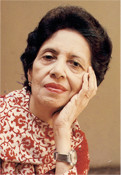
Dina Mehta: portrayed a social conscience
Mehta’s first novel, And Some Take A Lover, focused on the divided loyalties of two generations of a Parsi family during Mahatma Gandhi’s Quit India movement in the 1940s. Her second novel, Mila in Love was published by Penguin India in 2003.
Before she joined Parsiana Publications Mehta had worked as fiction editor of The Illustrated Weekly of India, the English drama critic for Mid Day, and was on the editorial board of the Sunday Standard where she handled the children’s supplement and also wrote a weekly column for adults entitled "Brown Studies.” Sabras, the house magazine of Tata Chemicals Limited, had during her editorship earned the general excellence award in the internal magazines category from the Association of Business Communicators.
As senior editor of Parsiana and Voyage her editing skills came to the fore when she had to prune and fine tune articles sent in for publication. But she seemed happiest working as managing editor of Kaiser-E-Hind in its second avatar as a monthly featuring articles of socio-politico-economic interest. Her articles, always handwritten for she never managed to befriend the computer, would be meticulously proofed, and finally published only if she was satisfied that the prose and punctuation were perfectly in place.
One of her early three-act plays The Myth Makers won the second prize in the First All-India Sultan Padamsee Playwriting Competition in 1968. Ten years later yet another three-act play entitled Tiger, Tiger won an award in the Second Sultan Padamsee Playwriting Competition. The following year, 1979, was particularly memorable for her radio play, Brides Are Not For Burning was selected out of 500 entries from all over the world in a competition sponsored by the BBC. The prize was a two-week holiday in London during which the play was twice broadcast on their world service. A decade later yet another two-act play Getting Away With Murder was shortlisted by the BBC for their World Playwriting Competition and was subsequently selected for a book by three playwrights entitled Body Blows: Women, Violence and Survival. Her play on domestic violence, A Sister Like You was shortlisted by the British Council New International Playwriting Awards in London. But the author did not perceive her role to end with the written word. Even in the stage presentations of her dramas Mehta would feel the need to sit in at rehearsals.
Among Mehta’s other award winning works were Friday Father, a one-act play; When One Plus One Makes Nine, a television script produced by Bombay Doordarshan; Survivors.
Her cousin Minoo Golwalla who was a singer with the Glynborne Opera acknowledged in his condolence letter to the family, "It was Dinsu who inspired my adolescence and made me dream dreams and sent me on a journey of discovery…If I may be allowed license to reminisce I believe she was the Svengali in my life…a truly admirable soul…” His son Zubin Varla, a well-known stage actor and jazz musician, added, "She will remain that remarkable woman in our memories…”
Mehta’s elder daughter Huzan Sethna reveals the hidden persona of this litterateur:
"At Heathrow mum and I gave in our passports at different counters, and I was asked by an officious looking immigration officer what the purpose of my visit was. When I told him quite truthfully that my mother and I were guests of the BBC and British Air, he looked at me in disbelief, and asked what on earth the BBC could want from a mere girl like me. When I told him that my mother, whom I pointed to at the counter, had won the 1979 worldwide playwriting competition sponsored by the BBC I was waved through in respectful silence.
"Mum had come a long way. After Dad’s death in ’76, juggling three part-time jobs, at The Illustrated Weekly, Sabras and Kaiser-E-Hind, to bring up two teenage daughters, she had found the time to write Brides Are Not For Burning, an indictment on the evil of dowry related deaths, where bride burning by the husband’s family for failing to satisfy their material expectations is commonplace.
"Brides Are Not For Burning was one of her many triumphs. Her Tiger Tiger on Tipu Sultan won the second prize in the Sultan Padamsee Playwriting Competition staged in Delhi. Her short stories were published in the New York Time magazine, in London and Hong Kong, some translated into Italian and even recently into Japanese. Her work always portrayed a social conscience, a meticulous attention to the use of the English language, sometimes working for weeks on one paragraph to get it just right — a perfectionist when it came to her chosen field.
"As a mother, I learnt to admire her more as I grew up. As a child I often wished she were more ‘ordinary’ more like my friend’s mums who cooked and kept immaculate homes. My mother’s housekeeping skills could at best be called haphazard — the kitchen looked like a tornado had hit it on the occasions she cooked for a party and our cook’s face wore a martyred and smug look for weeks to come at the memsahib’s inefficiency.
"Growing up rather unconventionally, with a pell-mell of visitors, theater personalities, play readings, Christian scientists, yogis, poets, writers, cricketers and actresses, the house was always brimming full of interesting ‘avatars,’ particularly when dad, who could draw people to him like a magnet, was alive. The chaos was bewildering as a child, but once my sister and I could partake in the sometimes bizarre conversations we grew to accept and even enjoy the confusion.
"But there were always constants. Every morning mum would read out aloud certain ‘affirmations’ or something from Buddhist, Zoroastrian, Hindu or Christian philosophy. I remember her reading from Rajneesh’s The Mustard Seed most vividly — the Bible taking on a new vibrancy and clarity, a novel interpretation which would probably affront the more conventional. Mum had a strong belief in man’s ability to move mountains, to soar, to be the master of his own destiny, to triumph over disaster.
"So time went by, my sister and I married and had children of our own and the relentless march of time continued. Mum was as unconventional a grandmother as she was a mother. No cakes and pastries but books and ideas and the kids loved it and her. Till the age of 75 mum still went to work as one of the editors of Parsiana and it was only after that when she was plagued with rheumatoid arthritis and a particularly virulent form of osteoporosis that she really began to slow down, being confined to the house during the last couple of years.
"During the last month, with a week in the B. D. Petit Parsee General Hospital, mum and I spent a lot of time with each other, reminiscing, talking about a host of things, even death, though I often had to shout because she had gone a little deaf. Despite being in pain she still remained positive, asking me to help publish the last short story she had just completed, a triumph of mind over matter, for her fingers, severely misshapen with arthritis could hardly hold a pen. As she sat up in bed I told her that she still managed to look elegant, a compliment she took quite in her stride.
"This is how we, her family will remember her, an elegant lady — for hers was a life full of grace and gentleness and elegance and dignity — a life truly well lived.”
A character in one of Mehta’s short stories describes a voyage which could almost be speaking for the author: "It was as if I had set off at a tremendous spurt in an unknown direction, which filled me with apprehension, so that I wanted to grab a familiar guard rail, a handbrake, anything to decelerate the impetuous motion. But at the same time I didn’t really want to stop. I knew of nothing that I had accumulated in all my years that I wanted to stay with…”
The engaging author is survived by her daughters Huzan Rustom Sethna and Rashna Ali Mamaji, and sister Shirin Darasha.
◆ ◆ ◆
From the archive