
In Memoriam
Jehan’s jihads
He would sit behind a large wooden desk, peering at you through his thick glasses, speaking in a soft voice with an impish smile on his face. A listener had to strain to hear his words above the muted din of traffic outside the red brick building near Horniman Circle. But Jehanbakhsh Dhunjishaw Daruwala’s editorials in The Bombay Samachar Parsi Tari Arsi (PTA) column and elsewhere in the Gujarati daily rang out loud and clear. The editor of Asia’s oldest newspaper and the fourth oldest paper in the world who died on December 26, 2011 in Bombay at the age of 97 attacked the Parsi and Bohra establishments, the priesthood or whoever he felt was denigrating the communities’ public life. He was liked, respected and feared.
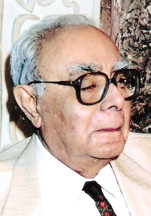
Jehan Daruwala: iconoclast editor
"He was an iconoclast who loved to demolish every orthodox citadel,” wrote the current PTA columnist and noted lawyer Berjis Desai. Several trustees of the Bombay Parsi Punchayet (BPP) "died a thousand deaths every Saturday night, thinking what new scandal was going to hit them first thing on Sunday morning.”
Daruwala started his full-time journalistic career at 60 after retiring from the insurance industry and in the 25 years (1975 to 1999) he was editor "nailed many a lie and exposed many a charlatan,” stated Desai.
The Bombay Samachar chairman and managing director Muncherji Cama termed Daruwala’s editorship "fair balanced, and straightforward. He had the courage of his conviction.” Despite the controversial stances Daruwala took, "the management never interfered with the editorial department of the daily,” added Cama.
In a tribute, author and writer Marzban Giara who also penned the PTA column for some time following Daruwala’s retirement noted, "He wielded the power of the pen for helping the poor and for social reform.” An Iranophile, he encouraged Giara in assisting Dr Bahman Surti in translating Ferdowsi’s epic, the Shahnameh into English. Daruwala would "quote from memory apt couplets from this epic on various occasions. He also translated at the request of (the late Iranian philanthropist) Faridoon Zartoshty the Din-i-Hakhamanishian from Persian into English The Religion of the Achaemenians written and compiled by Ardeshir Jehanian and published in 1971 at the time of the 2,500th anniversary celebrations of Cyrus the Great,” recalled Giara. "He was the one and only Gujarati editor to receive the Ramnath Goenka Award, the highest award for excellence in journalism, as also the Kala Gurjari Award and Lifetime Achievement Award from the World Zoroastrian Organisation (WZO).”
"I was a novice to the Parsi politics of India and so on my very first visit, I got a good grounding in the thinking of BPP trustees and others elsewhere and their ways of dealing with people,” stated Shahpur Captain, one of the main founders of the World Zoroastrian Organisation who headed the body for many years, in an e-mail to Daruwala’s daughter Dinaz Delvadiwalla. "In those early days, I used to visit India every year and always my first port of call was Jehan’s office. A cold drink would inevitably be brought in by his smiling Gujarati secretary.”
Concerned about the dwindling Parsi population, Daruwala wrote, "The solution to this life-and-death problem of the community cannot be left to obscurantists and fanatics,” noted Frontline correspondent Lyla Bavaadam in the issue of July 8-21, 2000 following Daruwala’s retirement from the paper in 1999.
An article penned by S. Insaf dated May 10, 2008 on the web stated, "The owners, editors and the management of Bombay Samachar daily are progressive Parsis and they have always remained sympathetic to the Bohra reform movement. The Samachar had started a column ‘Vohra Vertaman’ some 75 years ago and in spite of strong opposition from the Bohra establishment, till today they have continued this weekly column.” Insaf quotes from an article penned by Daruwala titled "The Trials and Travails of Dawoodi Vohra Community Must Come to an End” in which Daruwala noted, "The tragedy of the Dawoodi-Vohras is that they are deprived of human rights by their own religious head that they respect. All that they want is, their religious head should not keep them as bonded slaves from the time they are conceived until they give up the ghost… Their grievance is that the priestly class exploits them from the cradle to the grave.”
Born on April 10, 1914 at Ahmedabad, Daruwala obtained his BA and MA from St Xavier’s College in Bombay in Persian and English Literature, stated Giara. He served in the insurance industry from 1937 to 1974, with the exception of a three-year stint as a lecturer in Persian at Shiraz University in Iran. When Samachar editor Minoo Desai took ill, the company’s directors searched for a Parsi editor to succeed him. "Every editor of this venerable newspaper was a Parsi,” write Berjis, Minoo’s son. After retiring fromthe Life Insurance Corporation of India, Daruwala worked part time for the Jam-e-Jamshed daily (it became a weekly years later).
"A simple man Daruwala led a frugal, almost Gandhian existence in a very small flat on the outskirts of the Dadar Parsi Colony (DPC),” noted Desai. "He was rather lonely after losing his wife Hilla (née Dhabhar) whom he adored… His voracious reading, despite a bad eyesight, saved him from boredom.”
"Hilla and Jehan were a made for each other couple, both very tall and graceful,” Giara recalls. "Both would regularly take walks at Five Gardens in DPC where they lived. Even after his wife passed away in 1994 Jehan would daily take a walk with his daughter even at the age of 90. He kept himself fit by regular exercise right till the very end despite failing eyesight and hearing.” He was cremated.
He is survived by his son Rusi, also a journalist and daughter Dinaz Delvadi-walla.
◆ ◆ ◆
From the archive