
History
Brain over brawn
When Mahatma Gandhi first suggested the salt march, the authorities and others dismissed it as an exercise in futility
Edited excerpts from a talk delivered by nonagenarian, political scientist Dr Aloo Dastur at the annual Leslie Sawhny Endowment (LSE) meet on May 18, 2007 at the Walchand Hirachand Hall Indian Merchants’ Chamber building. Dastur, a former freedom fighter, and head of the political science department at Bombay University is chairperson of the Gandhi Smarak Nidhi. LSE chairman Minoo Shroff noted that Dastur imbibed Gandhi’s philosophy of "simple living and high thinking.”
This topic, "Is Gandhi relevant in this century, the 21st century?” is for me a somewhat quizzical question. Generally Gandhi is associated with truth and non-violence. If truth and non-violence continue to be relevant, then the answer to the query on Gandhi also is positive.
And perhaps, it was Mahatma Gandhi who brought both truth and non-violence into the very quirky field of practical politics. Politics and non-violence were taken all over the world, generally, as being inconsistent with each other.
He knew we were helpless, he knew we had no weapons to fight with, he knew we didn’t have the willingness to fight, and that is why he brought in non-violence which anybody could practice. When Gandhi returned from London to practise in Bombay, he had to shiver before the judge. And people wondered who this man from Gujarat was, who couldn’t face a Bombay judge with equanimity. Remember, those days, barristers-at-law were a little superior to the rest of us. It was an English qualification. So when he was asked to go to South Africa, by a Muslim merchant to plead his case, he went.
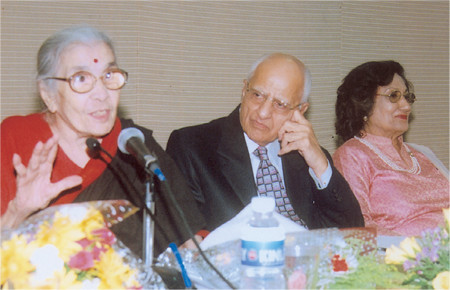
From left: Aloo Dastur, Minoo Shroff and Sheela Masani: Gandhi "had nothing but his brains”
Before he took up his job he was given, by his host, a first class train ticket. He entered the first class compartment. And his bag, and he, were literally thrown on to the platform from a moving train. He had to take a taxi. There were two white women in the taxi. How could he sit with them? So he had to be put next to the driver on an open seat in mid-winter. So all the time he was there, he began to think of what the future would be. "Shall I continue here to be thrown out of trains, or put to trembling winter drives or shall I go back to India?” And the second proposition he discarded. He continued, suffered personal humiliations, only to defy them. And how could he defy? He had no arms, he had nothing but his brains to decide what he should do and how he should do it, and how he should negotiate with the authorities.
Gopal Krishna Gokhale was one of his very great and ardent admirers. Called by Gandhi there, he went. And began to have a higher opinion of Gandhi learning from the South African Indians how Gandhi fought for them. So when Gandhi finally returned in 1917 to settle in India, Gokhale offered him leadership of the Congress.
And Gandhi’s reply was: "For 20 years I was away from India, and what do I know about India? I have to study first.” And then he went to learn about India and Indian conditions. And how did he go? In a third class railway compartment.
When Gandhi went around he was fully clothed. In Orissa, he went out for a walk along a river bank. And he found a woman covering herself up to the neck in sand. And he wondered why. He asked her, "Why are you doing this?” And she said, "My only clothes are there, drying in the sun. I have just washed them.” And then he asked himself, "Why do I wear so many clothes, one upon another, why? I can do away with my suit, I can do with my dhoti and my kurta.” Later on, the kurta also was superfluous for him. And he discarded it. He threw it away.
When Pandit Jawaharlal Nehru became the president of the Congress, on Gandhi’s initiative, in 1929 he changed the final goal of India. India’s struggle was no longer an Indian dominion under British Rule, like Canada or South Africa. It had to be total, complete independence. And Nehru declared that they would give to Mahatma Gandhi the leadership of the fight for Indian independence from British Rule.
When Gandhi declared that he would defy the Salt Law, Nehru was surprised. "Salt? What has salt got to do with freedom?” he queried.
The fight, Gandhi said, would start in the Sabarmati Ashram which he had established. He would lead a batch of 78 men from the Ashram all the way on foot, from Ahmedabad to Dandi, about 300 miles away.
Gandhi’s order was "No one shall pick any salt from any government salt pan until I have first picked it.” So everybody followed the 20-25 days’ march from one place to the other. And Indian officials, British officials relaxed. They believed people would laugh at the protest. On the contrary, when Gandhi came out from the Ashram, with the 78 men, what did he find? Hundreds of people, men and women who had come to see him start on the Dandi march, and several of them joined the protestors. As they neared the villages, the locals welcomed them, "Come and have your bath, come and have some breakfast, come and eat something.” And that walk came to attract the attention of entire India.
I think I can go a little forward and say, the foot satyagraha put India on the map of the world as a country that knew how to defy a strong, political empire.
Pregnant women went to jail in cities like Bombay and Calcutta, and had children in the jail. They called their sons "Swaraj.”
At the Round Table Conference, in London Gandhi spoke for 53 minutes. He mentioned that if an effort was made, as was then being made by Dr Bhimrao Ramji Ambedkar, to separate the scheduled castes from the Hindus, he would oppose that move with his life. A report came out two years later that scheduled castes were given separate electorates. When Gandhi read the report he was in Poona. He immediately said, "From today, I will not take any food. I will live only on water till I die.” And there was an upsurge here. How could people allow Gandhi to die? Except for Ambedkar. Ambedkar said, "That is not my concern.” He said, "I am here for the scheduled castes. What Gandhi does is not my concern.” And it took six days for the British government in India to pressurize Ambedkar to withdraw his suggestion for separate electorates. He did it and Gandhi broke his fast. Ambedkar showed his grace, years later. He married a Brahmin woman when his first wife died. Gandhi had died some eight to 10 years before. At his wedding Ambedkar said that had Bapu been alive, he would have been very happy.
When Gandhi went to England for that Round Table Conference, he realized that he had become a very unpopular man in Lancashire, the cotton center of England. He had talked of khadi, he had talked of hand-spun, hand-woven cloth. The mills had suffered. Cotton was grown on Indian soil, exported to England, woven into cloth in England, and sent back to India to be sold as cloth. To a certain extent, on account of Gandhi’s advocacy of khadi, the Lancashire mill industry declined and they were very angry by the 1930s. After the Conference, Gandhi visited Lancashire to meet the cloth workers. They asked him, "why have you taken away our livelihood?” He said, "I have done nothing of that sort. My people were hungry, my people were thirsty, my people were naked, and we have sent you all the raw cotton, to be made into clothes for us. I have just said that part of it should be reserved for us.” When he left them, some of the people thanked him for his journey.
If today we, in our wisdom, want to ask, "Is Gandhi relevant today?” I think the answer has already been given. His relevance lies not merely in what he said, it lies much more in what he did. There are people who say, "Gandhi changes his views.” Of course, he changes his views. He said, "If you want to know my views at a particular time, you must place me in that particular time and environment.”
But all through, he clung to being a Hindu. Whatever he admired in Buddhism, in Christianity, in Islam, he said, this is good, that’s better, this is excellent, but he said he was born a Hindu and would die a Hindu.
◆ ◆ ◆
From the archive