
Books
“He taught me to say ‘no’”
Author S. V. Raju narrates his years with Minoo Masani at the launch of his book on the statesman
Had Minoo Masani not been dead, "I’d have been roasted alive,” jested his longtime associate and biographer, S. V. Raju, apologizing for the delay in commencing the book launch program on November 20, 2007 at the recently restored University of Mumbai Convocation Hall. Masani was a member of the Indian Constituent Assembly that drew up India’s constitution and was the leader of the opposition in parliament from 1967 to 1971.
The function held under the auspices of the National Book Trust (NBT), India got off to a late start as the Delhi based organization’s director Nuzhat Hassan was delayed in the chaotic Bombay traffic. She apologized explaining she was in town for a day and tried to "pack in too many activities” without leaving leeway for the traffic snarls. The day being Masani’s 102nd birthday it was "an ideal day to remember him,” she observed, noting the NBT had published 160 such biographies including one on the late atomic scientist Dr Homi Bhabha. "We have many more (biographies) in the pipeline,” she added.
Expressing his gratitude to the Book Trust for giving him the opportunity to write on Masani, Raju said he debated writing a more detailed biography but opted for the NBT offer as the organization distributes their publications widely especially in the smaller cities and towns and sells them at a subsidized rate. He felt it would "be more useful to write” for the Trust.
Raju noted that the NBT had also published a biography of the freedom fighter Yusuf Meherally by Madhu Dandavate. "Yusuf and Masani were classmates at Bharda High School,” and Meherally "had a great influence on Masani,” said Raju adding that he knew from experience that few people could influence Masani!
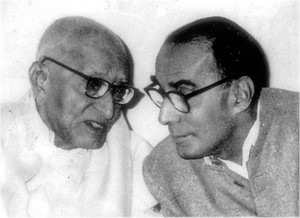
Minoo Masani (right) with C. Rajagopalachari
Meherally convinced Masani to take up law while Masani’s father Sir Rustom was keen he take up medicine. And it was Meherally who "dragged him into politics… They were both agnostics,” conveyed Raju.
The book is dedicated to Masani’s wife, Sheela, who looked after him when his illness rendered him "helpless.” Terming him a difficult boss, Raju recalled he would often correct his grammar and syntax hectoring Raju to speak correct English "and not babu English… He taught me to say ‘no.’ I practiced this on him much to his annoyance,” added the author.
Member of the Rajya Sabha, longtime Masani associate, and according to Raju "the most articulate member of parliament in the farmers’ movement” Sharad Joshi said he "expected a far greater exposition of what Minoo Masani was.” He felt the NBT book on Masani was fine for children but a more "detailed” biography was required to do justice to Masani’s legacy.
Masani was "not only honest but highly intellectual and highly disciplined,” said Joshi adding, "he had a certain charm. You couldn’t say ‘no’ to him.”
Joshi recalled how Masani, impressed with his efforts to improve the lot of farmers, once wrote several letters to him. When he received no response he phoned Joshi’s household to be told by his wife that the agriculturist was in prison and permitted to write only occasionally. Masani asked the wife if a special arrangement could not be made for important letters to be received and replied to which she timidly responded, "Maybe it is possible!” This became a standing joke between Joshi and Masani.
Joshi wondered why with stalwarts like Rajaji (C. Rajgopalachari) and Masani who founded the Swatantra Party, once the largest opposition party in the country "the political organization came to such a sad end.” He had named his own "one-man party,” the Swatantra Bharat Paksha (Free India Party).
Noted heritage conservationist, activist and businessman Cyrus Guzder recalled how Masani bemoaned that there was "too much politics and too little citizenship.” Looking at the plethora of ills that plagued the country during the Congress’ socialistic rule, Masani was "disappointed that the freedom he had fought for turned out to be a mirage.”
The vice chancellor of Mumbai University Dr Vijay Khole noting that Masani was an alumnus of the University commended his "contribution to the building up of the city.” He was at 38 the youngest mayor of Bombay. He said Masani’s call for experimenting with a "mixed economy… fell on deaf ears.”
Although the publication of the biography was, according to Khole, "a late exercise,” he complimented the NBT for undertaking the venture.
Against the tide
"I never had any illusion about the fact that I personally lacked the political appeal of the kind that a country like India needed for the purpose. I had always conceived my role in Indian politics as an effective Number 2 man who could run the machine efficiently provided there was a leader who had the necessary charisma.”
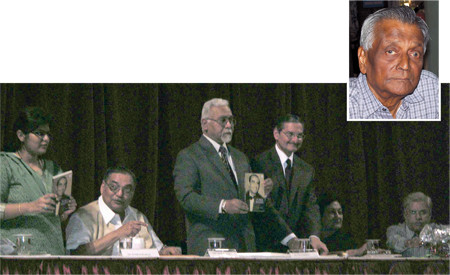
From left: Nuzhat Hassan, Sharad Joshi, Dr Vijay Khole, Cyrus Guzder, Sheela Masani and NBT regional manager A N Bhorkar. Inset: S. V. Raju
If there was one characteristic that Minoo Masani openly manifested it was his brutal honesty. He did not mince his words and was quick to point out the failings of others as much as of his own. The above quotation is cited by S. V. Raju, Masani’s longtime associate and friend in his biography titled Minoo Masani, released in November 2007. The 100-page book published by the National Book Trust, India (NBT, A-5, Green Park, New Delhi 110016. Price: Rs 40) deals with the early years and political lifespan of the 90-year-old statesman and politician who died on May 27, 1998.
"This book is the story of a principled politician — an oxymoron in current political dialog,” writes Raju in the foreword. "For Masani, means were important and if in the process the organization collapsed, so be it.” Thus the man who had so painstakingly built up the Swatantra Party (SP), once the country’s largest opposition group in parliament, had to watch it fall apart when the Party lost sight of its goals: "good governance and the strengthening of parliamentary democracy.”
The end chapters dealing with the rise and fall of the SP are the most riveting as Raju was actively involved with the Party from its infancy. A disillusioned socialist and former Congress party member, Masani’s initial efforts to form the party in 1957 met with little success. On June 7, 1959 the SP was born (Masani missing the first organization meeting on account of a delayed Indian Airlines flight). He was elected general secretary in December the same year. Raju joined the Party secretariat around that time. "Rajaji (C. Rajagopa-lachari) was the architect of the Swatantra Party and Masani its builder,” states Raju.
"Slovenliness, sloppiness and almost always saying ‘yes’ without meaning it are traits that are only too common amongst our politicians,” Masani observed. While his attempt to remedy these defects made him disliked, Masani retorted, "I was elected to be ‘effective,’ not ‘popular.’”
In the 1962 general elections SP won 25 seats in the Lok Sabha and 207 in the states of Bihar, Gujarat, Andhra Pradesh and Uttar Pradesh. Masani did not contest at the time preferring to "concentrate on organizing and directing the Party’s election campaign.” A year later he stood and won a Lok Sabha seat from Rajkot in Gujarat.
Four years later, in the 1967 general elections, the Party increased its seat count to 44 in parliament and 256 in the state assemblies. "With 44 members in the Lok Sabha it emerged as the single largest party in the opposition. In the state assemblies it was able to form a principled coalition government in Orissa, was the official opposition in the Rajasthan and Gujarat legislative assemblies and had significant representation in the Andhra Pradesh and Tamil Nadu legislative assemblies,” writes Raju.
Masani became the leader of the opposition in parliament. He saw the SP as a "party with a difference.” But when Prime Minister Indira Gandhi called for general elections in 1971 following her military victory in splitting Pakistan and creating Bangladesh, the opposition decided to form "a grand alliance” to counter her Congress (I) party.
Masani insisted on a common minimum program between the alliance partners consisting of the Congress (O), the Jan Sangh (now called the Bharatiya Janata Party) and the SP. But the SP’s national executive met in January that year and turned down the minimum program idea opting instead for seat adjustments.
"The SP which had in the previous two general elections put up over 170 candidates was allotted a measly 59 constituencies. Of these only eight were elected. Though Masani had warned of disaster if the alliance was to contest on a negative slogan and not on the basis of an agreed program, he took responsibility for the Party’s poor performance and resigned from its presidentship. Also he announced his retirement from party politics,” states Raju.
In 1974 the SP was dissolved despite Masani’s pleas to keep it going. Proposals were made to form a new party with Charan Singh and Raj Narain whose own party had, like the SP, fared badly in the 1971 elections. Masani’s argument that "zero plus zero was equal to zero” did not find takers among the party leaders, Piloo Mody included.
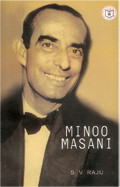
Origins
The Masanis hailed from Navsari. Minoo’s father Rustom was a writer, a journalist, secretary of the Bombay Municipal Corporation and vice chancellor of Bombay University.
"He was knighted by the British colonial rulers but renounced his title some years later in protest against British repression of the Quit India movement, and the arrest and imprisonment of Mahatma Gandhi in 1942,” says Raju.
Rustom and his wife Manijeh had four children: Minoo who became a barrister, Keki, a psychiatrist, Mehroo, who retired as deputy director, All India Radio and Pesi, a mathematician.
A student of Cathedral High School and the New High School now known as Bharda High School, Minoo graduated from Elphinstone College and proceeded to London to study law at the London School of Economics.
Active in student politics "he became an ardent” socialist, writes Raju. He admired the Soviet Union and was "delighted” to know that Jawaharlal Nehru, who he met for the first time in 1927 in London, shared that admiration.
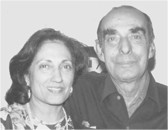
Sheela and Minoo Masani
Masani returned to India in 1928 but was not very successful as a lawyer as much of his energies were directed to the fight for Indian independence. In 1933 he was appointed president of the Bombay Provincial Congress Committee and when defying a ban on public meetings was jailed. "Nasik Jail proved to be an enjoyable and educative experience. All the intellectual pursuits that Masani enjoyed he found in prison,” says Raju. After being released he returned to Bombay to restart his legal practice. To his "amazement” he found that the then advocate general Sir Jamshedji Kanga attempted to debar him from practice for having convened an unlawful meeting. Two others, Phiroze and Keki Bharucha, were similarly kept out. Having lost in the Bombay High Court, Kanga appealed to the Privy Council being "a Parsi of the old mold and an old-time loyalist,” as Masani observed.
"M. C. Chagla, then secretary of the Bar Association (he was to become free India’s Chief Justice of the Supreme Court and later Union law minister), wrote to M. A. Jinnah who was in England, requesting him to appear for his fellow professionals, Masani and the Bharucha cousins. Jinnah declined saying that as a matter of principle he never appeared in court without charging a fee! Fortunately Gandhiji’s friend H. S. L. Polak agreed to act as a solicitor while D. N. Pritt and Wallach appeared for Masani and the Bharuchas free of charge. The judgment of the Privy Council delivered by Lord Blanesborgh disallowed the appeal saying ‘the circumstances were not such as to justify them in advising His Majesty to grant the advocate general of Bombay special leave to appeal.’ Exulted Masani, ‘Three cheers for British justice!’”
In 1943 when Dr D. D. Gilder, a Congress mayor of Bombay was arrested, Masani contested the by-election and became "the youngest mayor (of Bombay) at the age of 38,” writes Raju.
In March 1944 as Masani grew more skeptical of the Communists and the brutality of Stalin, he moved closer to Gandhi. He authored an essay "‘Socialism reconsidered.’ Masani now advocated a mixed economy… ‘You cannot replace something with nothing. You have to replace something with something better,’” he always used to say. He further defined his thinking on economics and the limits to state authority.
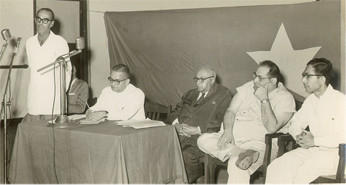
Minoo Masani addressing a meeting in Bombay. Seated from left: N.Dandekar, A. D. Shroff, Piloo Mody and B. K. Mistry
When Masani resigned from the Congress Socialist Party he had helped found in 1934, he joined Tatas in 1939. "I was tired of eking out a miserable existence on the meager bounty of one or two who thought my being in public life worthwhile. I wanted the dignity and economic independence that come of earning one’s own living,” he wrote.
Earlier when he had been staying at his parents’ house in Versova he found his father disapproving of his political activities. "My father was a liberal of the classical school, and with some justification, he felt that our activities disrupted social harmony and peace. On one occasion my father told me that he did not like propaganda for class war being conducted from his home.”
Rustom introduced Minoo to A. D. Shroff, then a director of Tatas. In 1941 he was appointed secretary of Tata Chemicals and then became the group’s head of public relations. In 1954 he was named J. R. D. Tata’s executive assistant. He resigned from Tatas in 1956 before filing his nomination as an independent candidate for the Lok Sabha. Two years later he set up his own management consultancy firm, Personnel and Productivity Services.
Perhaps J. R. D. Tata’s tribute in a volume of essays honoring Masani on his 80th birthday is one of the best testimonies to this exceptional man:
"In those 16 years that Minoo spent with us, my regard and affection for him grew. As I came into closer contact with him and listened to him and read his writings, I became increasingly surprised that a man of his intelligence, character and uncompromising integrity had been denied inclusion in the top leadership of the country…
"Although our minds often operated on similar, if not common, wavelengths, we both were somewhat impatient by nature, and I sometimes baulked at the speed at which he wished me to take decisions which I usually did in the end, but only after pondering, perhaps beyond need, over possible implications or ramifications…
"We found no difficulty, however, in agreeing with each other on two matters. One, the need for industrialists to adhere strictly to their social responsibilities as trustees of shareholders, consumers, workers and society, all of which Jamsetji Tata himself had made a part of the firm’s philosophy from the start. The other, in regard to the need to develop a real partnership, based on mutual trust, between management and labor…
"One of the most striking traits of Minoo’s character is his deep understanding of human relations, somewhat unexpected in an ‘ex’ fiery political activist. All in all, Minoo Masani was, and still is, a remarkable human being whose talents and character, sadly for India, failed to be recognized and used as they could have been to the country’s great benefit.”
Within the ambits of NBT’s format, Raju has done a commendable job of condensing 90 years of Masani’s life into 100 pages. He has touched more on the public nature of Masani’s persona rather than the personal. The book serves as a worthy introduction to the man and his times. A more detailed biography would be helpful to future students of the country’s political development. But where are the writers who undertake such ventures? A complete biography of Dr Homi Bhabha, the man who launched India’s atomic energy program, aside from the one published by the NBT, is still to be written. So also with many other eminent Zoroastrians.
The community owes a debt to Raju for skillfully undertaking what one hopes will be the first of many others biographies of Masani and his substantial contribution to India’s maturing democracy.
◆ ◆ ◆
From the archive