
History
Gandhi and the pa-rishis - II
Many prominent Parsis contributed generously to the satyagraha movement, while others staunchly opposed both his politics and political methods
Poring over Mahatma Gandhi’s collected works in 98 volumes numbering nearly 50,000 pages, Dinyar Patel, a PhD student at the Department of History, Harvard University came across umpteen references to the Parsi community. The outcome of his study resulted in two academic papers on the relationship between Gandhi and the Parsis.
His first paper titled "Like the Countless Leaves of One Tree” refers to Gandhi’s efforts to engage the community in the independence movement despite the Bombay riot of 1921 when Parsis supporting the future British monarch were targeted by the nationalists. His second paper "Gandhi and the Parsis” refers to Mahatma’s efforts to involve the community, especially the ladies from well-known industrialist families, in khadi production. The salient features of his study were presented by Patel in a talk at the K. R. Cama Oriental Institute on May 28, 2009. Beginning with the July 21 issue Parsiana is carrying edited excerpts from his papers.

Historian Dinyar Patel
"A strange relationship binds me to the Parsis,” Gandhi told a crowd in Colombo in November 1927. "The affection they have showered on me, a Hindu, wherever I have come in contact with them is something inexplicable and impregnable.” Growing up in Kathiawar, Gandhi came into contact with members of the Parsi community from an early age. One of his father’s friends, a man named Edulji, particularly impressed the young Mohandas with his ethos of simplicity. "His courage was as great as his simplicity and both were as great as his noble bearing,” Gandhi recalled in a column in Navajivan. "Ever since (meeting Edulji) I have felt that the Parsi community can do much, give much, if it wills.”
Aside from Dadabhai Naoroji, Gandhi became acquainted with other Parsis in the British capital and attended at least one Parsi community gathering in London which he quickly left once alcohol was served: "I felt ashamed to remain there and ran away,” he told an audience of Parsis in 1921. In his Autobiography, Gandhi mentioned Pestonji Padshah, a Parsi student "famous for his erudition even in London.” Years later, when Gandhi made a visit to Bombay from South Africa, Padshah urged that Gandhi not return to Durban and, instead, fight for Indian rights in India. "Our people in South Africa are no doubt in difficulty, but I do not want a man like you to be sacrificed for that work,” Padshah told Gandhi. "Let us win self-government here, and we shall automatically help our countrymen there.”
In spite of the profound impression Padshah’s words left on him, Gandhi did indeed return to South Africa. In South Africa, Gandhi had relied on Naoroji as an advocate within Parliament and various British associations championing the Indian community’s cause. Rarely a week passed without Gandhi either sending dispatches or copies of his journal, Indian Opinion, to the recently-elected MP’s office in London.”
After Naoroji lost his seat in the House of Commons, Gandhi forged a close relationship with another Parsi, Mancher-jee Bhownagree, elected to Parliament as a Conservative from Bethnal Green in 1895. In spite of his political leanings, Bhownagree proved to be a staunch ally of Indian South Africans and Gandhi even described him as one who "has felt as no other man has the national importance of the issues involved.” When Calcutta crowds burned Bhownagree’s effigy for his support of the 1905 Bengal partition, Gandhi penned a spirited defense of the MP: "The more moderate opinions of a man like Sir Mancherji have far greater weight than the extravagances of hot-headed Radicals,” the Indian Opinion stated in September 1905. "It is the conviction of calm reasoning alone that will get the full measure of justice for India; and for this reason Sir Mancherji is, of all men, the least deserving of the ingratitude of his fellow-countrymen.”
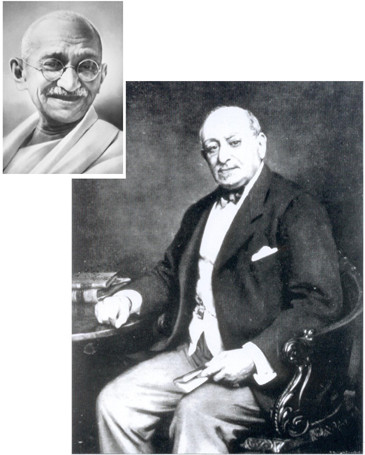
The Mahatma and Parliamentarian Mancherjee Bhownagree
However, some of the Parsis who most influenced Gandhi’s perceptions of the community were in South Africa itself. Rustom Gorkhodu, a Natal merchant commonly referred to as "Parsi Rustomjee,” was perhaps best known as the man who sheltered Gandhi and his family during an attempted lynching by a European mob in 1897. Gorkhodu was also one of Gandhi’s most trusted confidants, following him to jail countless times and donating generously to causes both in South Africa and India. When Rustomji passed away in 1924, Gandhi honored him at a condolence meeting at Chowpatty Beach presided by Sarojini Naidu — who had been a guest of Gorkhodu’s during her own visit to South Africa. Another Parsi, Sorabji Shapurji Adajania, was Gandhi’s designated successor as the leader of the satyagraha (non-violence) campaign in South Africa. Consequently, Gandhi arranged a scholarship for Adajania to study law in England, where he came in contact with Gopal Krishna Gokhale and was invited to join his Servants of India Society. Sorabji died shortly after returning to practice law in Johannesburg, robbing Gandhi of a volunteer he had praised as "the greatest of the satyagrahis.” Considering that the number of Parsis in South Africa was most likely no greater than a hundred, it is easy to understand Gandhi’s glowing praise of the community in 1910 as "a brilliant race.”
Gandhi greatly benefited from the support and mentorship provided by individuals such as Naoroji, Sir Pheroze-shah Mehta, Sir Dinshaw Wacha and the Petits. Yet, these individuals, symbols of the liberal nationalism of the late 19th and early 20th centuries, ultimately represented a narrow segment of the Parsi population. Once he returned to India, Gandhi encountered staunch opposition from the many Parsis who took issue with both his politics and political methods. Furthermore, as he developed a political program for India radically different from the constitutional gradualism espoused by Mehta and Naoroji, the Mahatma found new critics amongst the liberal Parsis who had earlier supported him in South Africa.
If Parsiana readers have any personal reminisces or family stories involving Mahatma Gandhi or any of his associates, acquaintances, or volunteers, about various important Parsi Gandhians and nationalists such as Dr M. D. D. Gilder, Burjorji Bharucha, Sorabji Adajania, the Captain sisters, Jamshed Mehta or Mithubehn Petit they can contact the author at dinyar.patel@gmail .com or +001 (650) 796-2486. His mailing address is: Department of History, Robinson Hall 2nd Floor, Harvard University, Cambridge, MA 02138, USA.
To be continued
◆ ◆ ◆
From the archive