
In Memoriam
Homji’s humanity
Died: Homi B. Minocher Homji, 94, international civil servant, after a brief illness in Toronto, Canada, on May 31, 2007.
"All work is empty save when there is love. And when you work with love you bind yourself to yourself and to one another and to God.”
The words of Kahlil Gibran, engraved on a plaque were presented to Homi Homji by his staff when he retired from the Social Affairs Division of the United Nations’ Bangkok based Economic Commission for Asia and the Far East (ECAFE). To Gibran’s words had been added the message, "To Mr Homji who knew how to work with love and who has bound himself to us in fact and in memory, always.”
A special joint meeting of the board of trustees and members of the managing committee of Bomanshaw Minocher Homji Parsi Medical Relief Association, Karachi, placed on record the meritorious service rendered by Homji to the Parsi General Hospital, the Zarathushtri community of Karachi and the world, the Government of Pakistan and the United Nations.
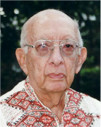
Homi Homji: un-wavering conviction
Between 1974 and 1980, Homi was a trustee of the Hospital founded by his parents Bomanshaw and Cooverbai Minocher Homji, a member of its managing committee and subsequently its chairman. "Even after he left Karachi, he was readily available to the trustees and the managing committee…and gave freely of his time. Of impeccable character, honest in his dealings and unwavering in his convictions, he has been and will remain a role model for those who have followed him. As a loving and caring person to his family he copied these traits in his other activities also,” states the resolution.
Homi was the youngest of the Homjis’ three children. After his birth the family moved to Peshawar in the North West Frontier Province where the Navsari born Bomanshaw operated a petroleum distribution business. Homi’s mother Cooverbai was the daughter of Sir Kavasji Katrak, a prominent Parsi of Karachi. "Peshawar at this time was akin to the Wild West. Pathan tribesmen ran rampant and routinely swooped down from the hills with bullets flying, to plunder the town, forcing the Homji family to duck and take cover in order to avoid injury,” notes Homi’s son Kavasji in an e-mail to Parsiana. Later the family moved to Karachi.
Born on July 13, 1913, Homi did his matriculation from Bai Veerbaiji Sopariwala Parsi High School, standing first in his class, after which he proceeded to do his BA from the University of Bombay. Rather than taking the easy way out by running his grandfather’s grocery store, after learning the ropes Homji left his employ and joined the Ordinance Services with the British Government of India. After Independence, he joined the Government of Pakistan and was heavily involved in the Village Aid Program, headed by Zulfiqar Ali Bhutto during the Ayub Khan regime. The job involved tremendous field work for extended periods of time. At one of the many international conferences that Homi attended, he was offered a senior position with ECAFE in Bangkok, the resolution informs us.
"At the end of three years, Homi was faced with one of the most difficult decisions of his life. The UN decided to offer him a permanent position. However, the Government of Pakistan wanted him back and replaced by another. The UN countered that if Homi was not given the position, the job would go to another member country. The Government threatened to confiscate his pension. Homi gave up his Government pension and continued to work for the UN for 15 years. He finally retired as chief, Social Affairs Division, around 1977,” notes Kavasji..
Married to Villie (nee Minwalla), a Montessori teacher and a sports enthusiast like himself, they had three children – Kavasji, Rashna and Coombi. Both Homi and Villie were excellent tennis players and won many titles and championships in Bangkok. With his job and otherwise, the Homjis traveled extensively, worldwide – including a trip to Peking and the Great Wall of China.
Homi’s greatest desire after retiring was to serve the Parsi community. "In his words, to give back more than what he had received over the years,” recalls Kavasji. After writing two books on the community and doing solid organizational and social work with the community in Karachi, Homi and Villie decided to migrate to Canada in 1980 to be closer to the children and their families. They celebrated 60 years of marriage in Toronto on December 15, 2006.
Homi wrote two more books and a number of articles and pamphlets on the religion and the community. He served as president of the Zoroastrian Society of Ontario (ZSO), was actively involved in the formation of the Federation of Zoroastrian Associations of North America (FEZANA) and was its first vice president. He was an elder statesman for the community in North America, providing guidance, encouragement and balance. A qualified priest by lineage, "he displayed religion in action throughout his life,” writes his son.
From a family perspective, Kavasji describes him as a loving, affectionate and generous father, always acting with the family’s interests in mind — an excellent provider and of an impeccable character. "But Homi also epitomized perfection in his work. From himself and from others, he demanded and generally received results due to hard work, honesty, integrity, patience and perseverance. In spite of his goal orientation and determination, he also displayed great tolerance and compassion. While in the UN one of the employees he ‘inherited’ from the previous boss, was close to a nervous breakdown and ready to quit. Homi assured her of her job and gradually nurtured and coaxed her back into her position. Another time, a particularly difficult employee was motivated into a good working relationship. When Homi retired, his successor was threatened at gunpoint by this employee when the working relationship soured again,” adds Kavasji.
He spent a lot of time in daily prayer throughout his life, during his working career and especially after retirement, observing and celebrating all the hamkaras, etc. He also made periodic pilgrimages to Bombay to do the round of atash behrams. In the last five years or so of his life he would spend two to three hours daily in prayer besides time in contemplation, informs his son.
Time was when Homji often shared his views in letters to the editor of Parsiana, always advocating a tolerant, liberal approach to community problems. Though he continued to subscribe to the journal, his active involvement had receded over the past decade.
Homji embodied the principles of the Zarthoshti faith, practicing what he preached and being a true role model for many. Although his worldly accomplishments were remarkable, the true essence of the man lay in the way he touched the lives of others. Even in passing "Dad had wanted things kept simple, quiet and without fuss…”
Homji is survived by his wife Villie, his son Kavasji and daughters Rashna and Coombi.
◆ ◆ ◆
From the archive