
The Mahatma and the man
Silly Point Productions first ever musical on Gandhi scripted by Danesh Khambata has met with critical acclaim
"The way he lived his life was his message,” Khambata continues. After scrutinizing 18 to 19 books on and about Gandhi, scanning the internet, the skeleton of the script was ready for the all-Indian musical by Silly Point Productions (SPP). In fact, two years after conceptualizing, the play went under the lights.
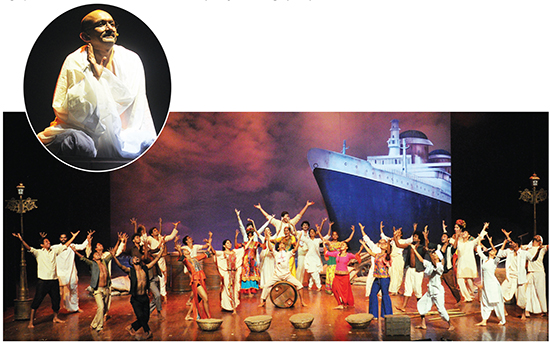
Inset: Gandhi; Dance scene from the play
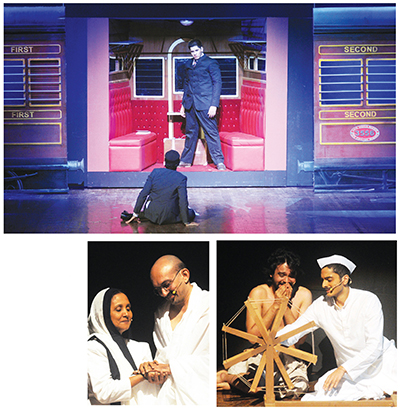
Nishi Doshi played the young, devoted Kasturba, the archetypal mother. The older, philosophical Kasturba was depicted by Nivedita Baunthiyal. Khambata illustrates respect and affection Gandhi had for his life partner not only in the grief at her death but also with a line from the play delivered with pathos — "If there were no Ba there would be no Bapu.”
Historical events of the Swadeshi movement, the Dandi march and Jalianwala baug incident are also portrayed briefly but specifically. Rapt attention from the audience climaxed as the diminutive figure sang the national anthem. The audience arose instantly and harmonized with him in song and spirit. Gandhi stood steadfast in the vast space of the stage with an outsized tricolor fastened at the far end. Khambata elucidates, "The personal space Gandhi felt with the country was represented with this small figure with a huge flag. It was intentional.”
When the anatagonized, lost son Harilal comes to pay a visit to his dying mother Kasturba, Khambata reveals the steely woman’s fortitude. The son (played by Harsh Singh) bemoans the absence of a nurturing father and instead became the Father of the Nation, as he was termed by Dadabhai Naoroji. Kasturba tells her son, "I’ve given up a husband; you’ve given up a father but he’s given up a family.” The author’s compassion for Gandhi is evident as Khambata proclaims that the world has judged him as "a cruel father but what he went through, no one knows… how does a man feel in losing a son?” referring to the estrangement between Gandhi and Harilal.
Putting it all together
"You know I made six drafts of the play. Honesty had to be highlighted, after that (I) wanted to represent his inner voice (his innermost thoughts).” The writer is expansive in telling us that initially he did not like the ending but changed his mind after reading a random speech of Gandhi on the net, about ten days before casting.
Khambata talks about "a fabulous learning experience, very humbling. From putting up the production to writing, to gathering the dancers, singers, actors from modest backgrounds who came from far out places every day whether physically bruised (during rehearsals) or not, always smiling. I know sometimes food was not sufficient and still all they asked for was one extra banana. In fact they thanked me for making them a part of this. There were no egos, great bonding…”
The writer added nothing disturbed the rehearsals – "I am disturbed by ego – not once did I see that. I am blessed to have had this crew.” The director applauds the perfection "though most (of the team) is new on the block.”
The slight framed director applauds the tenacity of dancers and singers claiming "each one comes with one’s own honesty and with one’s own heart. I believe in three ‘Hs’ honesty, heart and humility. It is not a mantra because then you have to follow it.” As a director, Khambata believes "it is my job to create a connect.”
He pays special tribute to Diana Sethna who put 300 costumes on stage in three weeks, Dawn Cordo who managed the vocals, Fali Unwala who crafted the stage props, his older brother Nariman who has written the music for Gandhi with Rahul Pais, SPP partner Sajeel Parakh who handled the sets and doubled up as the harijan in the musical.
Pleased with how the first season has gone, the production house would like to have more shows at a later stage, Khambata divulges. The venue of all 10 shows was the Jamshed Bhabha Theatre at the National Centre for the Performing Arts (NCPA) as technically it is the only auditorium in Bombay that can handle the effects and changes of scenes, the director establishes. Special thanks he says are due to Khusroo Suntook, Deepa Gehlot and Binaifer Bhesania of the NCPA.
The first play Khambata wrote was Kalaam in Hindi with Meherzad Patel. "It was a one-hour serious play.” He alleges his Hindi is not good but "I write with emotion not with language!” His first play and musical are both about injustice, racial discrimination, victimization, the divide between the rich and the poor.
The writer acknowledges stalwart Sam Kerawalla as his mentor in theater and applauds his encouragement and support of young talent. Kerawalla introduced him to acting in Parsi theater when Kerawalla judged a competition at Jai Hind College. Khambata says he is not nervous once on stage, though he considers himself a reserved person. At St Mary’s School ICSE, he had still not been initiated into acting. Apart from pursuing theater, Khambata played the drums in The Other People band for eight years when he was not pursuing his alternative passion — photography. He shot some brands which he believes helps him with lighting on stage today.
The director believes good is perpetuated. There is always a bright side to everything. The cycle of good is permanent, leading him to end the interview with "Every time a Gandhi goes, a young Gandhi is born.”
The playwright chose SPP for showcasing his musical. SPP founder Patel invited Khambata, Parakh, Darayus Subedar, Danesh Irani and Sharmeela Kazerouni to join in 2008 and formed a limited liability partnership five years later. The cricket crazy Patel named it SPP as the silly point is the risky position right next to the batsman. The production house founder desired to be self-sufficient always and is pleased that the venture is self-supporting today.
Father Rohinton is a liaison officer in a large housing society and mother Armaity is a therapist for the hearing impaired. The entire family follows Meher Baba. The devotee informed us that Gandhi and Baba were in touch and Mohandas is said to have admired the silence Baba kept for 54 years whilst "I only keep silent once a week.” Khambata believes he is a liberal Zoroastrian but states that his connection is with God.
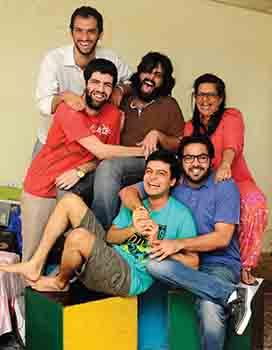
SPP founder Meherzad Patel had so far been the writer of all the comedies produced specifying "The scale is what is relevant, not the genre. Musicals are something we’ve been doing with various schools as part of their annual day – but we wanted our first SPP musical to be an original… You have musicals on Jesus Christ, but not the Father of the Nation." The partners felt that "it (Gandhi) was a subject matter that required musical treatment, never attempted before," Patel responds to our query why a musical after a flurry of comedies?