
In Memoriam
The gutsy Gandhian
Died: Dr Aloo Jehanbux Dastur, 96, respected Gandhian who was former president of Mani Bhavan Gandhi Sangrahalaya (MBGS) and Gandhi Smarak Nidhi and the first woman to serve on the Union Public Service Commission (UPSC), on September 3, 2010 in Bombay.
"A fearless crusader for equality and justice… Alooben, as she was affectionately called by those who knew her, was a unique blend of uprightness and humility,” noted a condolence tribute from MBGS. Always reticent to speak of her own contribution to the national cause or her accomplishments, it was a challenge collecting data on her, mentioned Dr Usha Thakkar, honorary director of the Institute of Research on Gandhian Thought and Rural Development. Believing in keeping a low profile, "she really practiced the norms of simplicity and dignity showing deep concern for human rights and human values,” remarked Thakkar who found Dastur "very straightforward.” When Thakkar had tried to convince Dastur to share the salient signposts in her life, she was invariably cut short by the devout Gandhian, "Chupkar, baby, maaré vaasté kai nai lakhvanu (keep quiet, there is nothing to be written on me).”
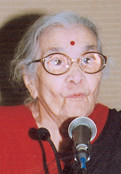
Dr Aloo Dastur: "fearless crusader for equality”
"Baby” was the endearment she used for all the junior ladies working with her at Mani Bhavan, not because she did not remember their names (in fact with her sharp memory until the end she knew not only the names of the staff members but also their families) but because they were all young in age compared to her.
When she was in Delhi working on the UPSC, she was approached by some journalists who came seeking her views. When they reiterated that they had approached her because she was the first woman on the Commission they were refused an interview with a firm response: "So what? I am only doing my duty.” Nominated by the central government "from amongst persons of eminence, ability and integrity,” she additionally enjoyed the distinction of serving for three years on the first National Commission for Minorities chaired by Minoo Masani. "She remained a champion of minority rights and tirelessly advocated their joining the mainstream,” commented R. Srinivasan, retired professor of political science, in his article in Freedom First, October 2010.
A renowned academic, she was former head of the Department of Civics and Politics, Bombay University and Sir Pherozeshah Mehta Professor of Politics who played a significant role in organizing new courses, syllabi and teaching emerging subjects like International Politics. A member of the Senate and the Academic Council of Bombay University, she was additionally executive council member of the University Grants Commission, member of the Central Advisory Board of Education and a member of the Indian Council of Social Science. "Meeting and interacting with her was a tonic for one left her chamber reassured that he or she was cared for — a word of encouragement, a word of appreciation, sharing of one’s exultation… all these spread cheer particularly to whose who had struggled hard,” remarked Srinivasan.
Committed to many just causes, she was included in the Indian delegation to the United Nations Commission on the Status of Women and the Indian delegation to the United Nations Educational, Scientific and Cultural Organisation.
"A lady with principles, she was a strict Gandhian and highly disciplined,” observed Mani Bhavan trustee Usha Trivedi who admired Dastur’s frugal ways and insistence on restricting MBGS’s expenditure. Although she was very particular about maintaining relations, would invariably return a phone call and extend all courtesies to staff members, the spinster would politely decline all wedding invitations joking, "Hu maaraa lagan maa nathi gai (I have not attended my own wedding)!” reminisced Trivedi. Exacting in her ways, she was particular that visitors only enter her room after knocking on the door. She is known too to have reprimanded a young man for not buttoning up his shirt.
Wearing khadi had become a way of life for this Gandhian ever since Bapu had advised her to adopt the humble fabric when she was but six years of age, her recollections were carried in Time Out Mumbai, Issue 9. Even her school uniforms (she was a student of St Joseph’s Girls Convent) were of khadi. She was 16 when the salt satyagraha was launched, in the midst of her matric examination in 1930. "I couldn’t study. We would get reports every half hour about how many people got arrested. This is just history to you but it was our life,” she had told the Time Out correspondent.
The youngest of five siblings, all of whom were influenced by Gandhian philosophy, her brother Noshir went to jail three times. Her father wrote for the Chronicle, and never the Times because that publication was considered pro-British. In fact Aloo refused to go to Elphinstone College since it was government backed and opted instead to study political science and economics at Wilson College. She began her teaching career at the Sophia College in Bombay, spent some years at Vallabh Vidyanagar in Anand and returned to Bombay University as a reader in politics. The subject of her doctoral thesis was "Man and his environment” which was later published as a hardbound book. In the 1960s she was part of an all India team, sent to Yugoslavia on then Congress leader Jayaprakash Narayan’s initiative, to study the emerging pattern of decentralization.
Although involved in the Congress Socialist Party she chose to distance herself from "the heat and dust of politics” but during the Emergency she expressed her opposition by resigning from all government supported bodies. As recalled Srinivasan, "She took the lead in writing to the President of India opposing the imposition of the Emergency and the entire Department of Civics and Politics supported this gesture by signing this memorandum… One learnt later that she was closely watched by the police…”
As honorary director of the Institute of Research on Gandhian Thought and Rural Development she was instrumental in organizing MA classes in rural areas affiliated to the Bombay University. Besides chalking out courses, she would oversee a panel of teachers and guides to implement the programs. In addition to authoring Gandhi’s Contribution to the Emancipation of Women, Dastur had co-authored along with fellow Gandhian Usha Mehta another book, Congress Rule in Bombay, 1952-56.
A picture of elegance, she would be impeccably attired in khadi with matching handbag and slippers, recall her associates. Her khadi purchases would invariably be from the outlets managed by the Gandhi Seva Sena (GSS), an organization which had many Parsi founder members like Perin and Goshi Captain as also Dastur’s sister Najoo. After the passing away of Najoo nearly two decades ago Dastur started taking an active role, working as honorary secretary here, recalled GSS president Surangiben Vakil. "Despite her age she would regularly participate in the monthly meetings until the end,” making determined efforts to promote gramodyog (cottage industries) and khadi, the two principal branches of GSS. Vakil referred to Dastur’s egalitarian treatment of all, irrespective of class, caste or status.
In the last few years she gifted away all her good saris and collection of books. Reading though kept her busy until the end and she would happily peruse the new books on Gandhi sent to her by the librarian. But if those were shoddy publications showing glaring errors in English she would promptly reprimand her former colleagues at Mani Bhavan for sending her books that would "spoil my English.”
A mentor to hundreds of street children, the family bungalow on St Paul’s Road in Bandra was an open house to all of them, stated Meghshyam Ajgaonkar, executive secretary of MBGS. In fact even the hawkers down the road availed of her premises to store their wares when necessary. Her life too was "an open book, not hiding anything from anybody,” observed Ajgaonkar. Although she had limited means she was reluctant to turn away anyone approaching her for financial aid. In fact, to her former cook she voluntarily sent a monthly stipend for years after he retired from service. Known for her love and kindness, Dastur was regarded as a mother by all who worked with her. As declared Ajgaonkar, "She was like a saint… the noblest soul I have come in touch with.”
When conveying her vision of a free India, Dastur had written "of a country and people that had set their sights on making life and living less irksome and somewhat pleasant; reducing social inequities; eliminating religious antagonisms and hatred; restoring to our women their rightful place at home and in society; taking nature and education to all our children; giving to the country a good, stable and transparent political system; making genuine efforts at establishing a just economic order covering the entire population and standing tall among the nations of the world on its own moral approach to international issues. Sad to say this vision is increasingly getting blurred since the last few years.”
◆ ◆ ◆
From the archive