
History
“The quintessential dissenter”
Statesman Minoo Masani is remembered on the occasion of his birth centenary
On November 27, 2004 several speakers addressed a gathering at The Taj Mahal Palace and Tower in Bombay in memory of Minoo Masani. Parsiana publishes excerpts from two of the speakers, Prof Sadanand Varde and Zareer M. Masani.
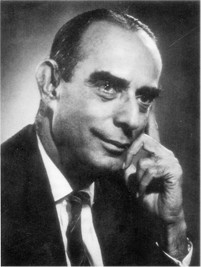
Prof Sadanand Varde
Minoo Masani was a man of impeccable integrity, what I would call, the ‘Quintessential dissenter.’ In his life, he was a votary of freedom and human rights and an opponent of all forms of authoritarian rule. He was a freedom fighter, in fact some of you would be surprised to know that Masani was the founding secretary of the Congress Socialist Party in 1934. He was in jail in the Salt Satyagraha in 1932-33. And in 1942, when Mahatma Gandhi was arrested after the Quit India slogan and was kept at the Aga Khan Palace, Masani’s reaction was, "I must go and storm the Aga Khan Palace,” as if he was storming the Bastille. And with a group of people he marched towards the Palace, to free Gandhiji. That was of course not possible. He was arrested, and went to jail for six months. And in 1943, he became the Mayor of Bombay.
He had a keen intellectual, analytical ability. That’s how, as a member of the Constituent Assembly and a member of the Sub-Committee on Fundamental Rights and Minority Rights, he made a signal contribution to the making of the Constitution. There were others also, but the stamp of his thinking, his contribution is seen in the provisions of the Fundamental Rights, as enshrined in our Constitution. He was fascinated by the Russian Revolution. In fact, he considered it as a major event in human history. But he was soon to be disillusioned, particularly after the Moscow Trials, the liquidation by Stalin of all his colleagues, and the forced collectivization of agriculture and the concentration camps.
He was a strict disciplinarian and a stickler for time. There was a seminar and a Central Minister was to come for the inauguration at10 a.m. Masani waited for five minutes. The minister did not turn up. The seminar got going. And in between, say after about 20-30 minutes, the minister came. I think Masani was chairing the session. He sat in his seat, waved at the minister, who then took his seat. Masani continued with his session for another hour or so. After the session was over the minister got an opportunity to speak. That was Masani. He had no respect for any kind of hierarchy. He was really an adherent of the rule of law.
I should say that in the Parliamentary history of India, Masani’s contribution is indeed a phenomenon. He crossed swords with the likes of (Prime Minister) Pandit (Jawaharlal) Nehru and gave enough evidence of his erudition, of his precision of expression and his grasp of issues. I don’t remember Masani having ever walked out of the House. Now most members are there to now and then walk out of the House. The exercise is more for the feet than the brain.
Masani never went for anything that was popular. He went for everything that was proper. And that is why he founded in 1981, the Society for the Right to Die with Dignity. I have been associated with him in this since day one. The first immediate response of some people was "What is this Society for the Right to Die with Dignity?” You talk about the right to live with dignity. People do not have enough food to eat, there is poverty, Masani didn’t ignore these issues. But he said this is a human problem of existence. And he pointed out to cases of patients terminally ill, declared by doctors to be incurable in terms of existing medical technology. What about them? If they want to die, is it proper to prolong their death? Not prolong their life, but prolong their death?
Zareer Masani
He was the child of a very liberal father who believed in the Empire, believed in the vision of India evolving towards self rule, my grandfather (Sir) Rustom Masani, and my father, in his childhood was influenced by the very enlightened liberal atmosphere at home. He went to the Cathedral and John Connon School for the first couple of years, which I later went to. He actually left it after a couple of years, and was probably much better off after that. He has said in his own biography, Bliss was lit in that Dawn, how he was quite amazed to find that it was dominated at that time by white British pupils and a few Anglo-Indians, and he was quite unusual as an Indian. He was bullied by the Brits there and he soon discovered that he had to fight back. So he learnt to basically return punches, and so on after initially going through a period of being quite badly bullied.
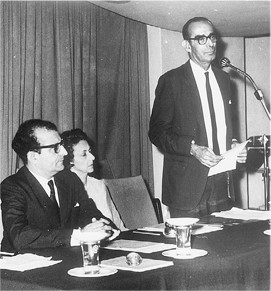
From left: Nani Palkhivala, Rodabeh Sawhney and Masani
Perhaps, for that reason, he in a rather perverse way, supported the Kaiser and the Germans during World War I. When the War broke out, he was nine, but he mentioned how he argued with people in support of the Kaiser, and this didn’t make him popular at school either. Anyway, he later went to the (Bharda) New High School which was much more nationalistic. He went to England later to learn Law at the London School of Economics and Lincoln’s Inn.
He was much a socialist and a nationalist by then, this was by the 1920s, but he had a very strong respect for the British attitude towards law and justice, towards the concept of the rule of law, and he later has actually mentioned how he benefited from this. In the 1930s, he had been to prison. When he came out of prison, the Attorney General in Bombay, Sir Jamshedji Kanga, tried to have him debarred on the grounds that he had committed an offence and that he had gone to prison. This was of course resisted. The case went to the Bombay High Court, and he was very much impressed by the fact that Sir John Blumont who heard the case as Chief Justice of the High Court, ruled in his favor and against the pro-British Attorney General. Nevertheless, the Attorney General appealed to the Privy Council. My father got some Queen’s Counsels to represent him free of charge, and to his own surprise, he won his case in the Privy Council, and was restored to the Bombay Bar. So he quotes this approvingly in his biography as an example as to how even when the odds were against him, British justice did prevail in the end.
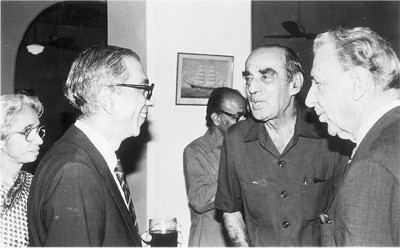
Masani (center) in conversation with Freny and Russi Lala and J. R. D. Tata (extreme right)
Even during his most socialist and nationalist phase, he always felt that there were certain rules of the game by which the British played. My father played cricket as a child, and believed there was a sense of fair play, and he always said later, that the British played cricket politically against the nationalist movement, and that it would not have been possible to have a non-violent movement and win Independence peacefully had the British not played cricket.
Even when he was the General Secretary of the Congress Socialist Party in the 1930s, he respected Gandhiji for actually playing cricket with the British and he said that that was Gandhiji’s greatness that he realized that the British were Christian gentlemen, trying to play cricket. And Gandhiji played the game according to their own rules. Of course, if the Soviets or the Nazis would have been here, they would have executed Gandhiji long before he became effective. But the British played ball with him. Gandhiji was shrewd enough to utilize the nature of British rule in India to extort Independence without much bloodshed. So this was something that he respected with his opponents in the Raj, that they were sportsmen, they behaved in a sporting way.
He has described his own arrest at Chowpatty Beach in the 1930s, and how a British police officer who arrested him, said, "I know your father. What a pity, you are disgracing him. What a silly young man you are...” and so on. My father said we were treated like gentlemen. It was that the British respected us as political opponents. We were never treated (in the manner) the other imperial powers treated their opponents.
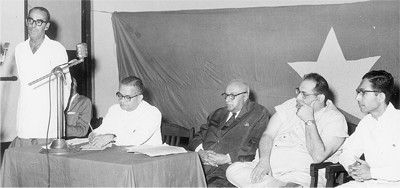
Masani (standing) addressing a Swatantra Party meeting in 1960. Seated (from left) are N. Dandeker, A. D. Shroff, Piloo Mody and B. K. Mistry
One exception he did mention, was in the Punjab, when he went there as the secretary of the Congress Socialist Party. The Punjab police had the worst reputation and Punjab also had the worst reputation for terrorism. So there was more adversity and confrontation. He said, "I had broken the law asking me to leave the province. I waited for the police to come. And when they came to arrest me, they produced handcuffs and suggested that I put my wrists into them. I flatly refused on the ground that I waited for them to come and arrest me and so the question of my running away did not arise. They maintained that in the North, political prisoners did run away, so it was necessary. I said, that I wasn’t one of them. When I thought of having some sparring with them, they gave up, and agreed not to handcuff me. I would say the Punjab police traditionally are pretty brutal.” I suppose that continues to this day. It illustrates the fact that he stood up to the Punjab police and they too respected the fact that they had an adversary who was a gentleman, and they treated him like a gentleman.
What is striking in all his photographs as the leader of the Congress Socialist Party, etc is that he is the single individual who is wearing a suit and a tie. The others all wore things ranging from khakhee shorts or khaddar, but he was always there with his suit and his tie, and somehow he always got away with it.
Then coming on to the legacies of the Raj, he firmly felt that there was an imperial vision of democratic self government which India owed very much to the nature of British rule over here. He said, "foreign rule in any case is bad, and I have no regrets that I have participated in obtaining Independence for India, under Gandhiji’s leadership. But British rule in India was not maligned. It was not needlessly cruel. Way back in the 19th century, people like Mount Stuart Elphinstone, who founded the Bombay Elphinstone College, to which my father went, have been on record saying that the purpose of British rule was to educate Indians to be able to rule themselves and (to permit) the British to retire. That’s the concept which you don’t expect from foreign rulers, a century before it happens.
When freedom came, the British left us valuable legacies which have come in very useful in ruling ourselves. The main legacy of which he himself was very much a part of, was of course the Indian Parliament. My father was a member of the Indian Legislative Assembly which was elected in 1940 and to which he was elected in 1945, before Independence, while it was still the colonial legislature. He remained in Parliament, on and off, till 1971. But he said to me at one stage that he regarded the Imperial Legislature as the best Parliament in which he had ever served...
He also felt the same about the mu-nicipal government, because he was a municipal councillor in Bombay from the 1930s onwards, and then for a brief period in the 40s, he was the mayor of Bombay. He said, "The Bombay Municipality through the 1930s was a highly superior organization, far superior to many of the Parliaments we now have and certainly the State legislatures.” He further said that the municipal corporations and the provincial assemblies were training grounds for the Union Parliament. The Central Legislative Assembly was far more than a training ground. It was more mature than the later evolved Lok Sabha.
And then he says about the Bombay Municipality, that, and I think I should quote him, because it is such a contrast with municipal government today when everything is so venal, corrupt and decadent.
"When I was Mayor from 1943 to 1944, we were very proud of Bombay... In each of the wards, the local citizen was able to choose between one man and another, on the strength of their education, their equipment and their political track record. Today, the political parties have hogged the municipal elections and people are elected without reference to their own qualifications. People say you can elect even a lamppost if he is, say a Congressman or a BJP or a Shiv Sena candidate. And now we have too many Lampposts and not enough of the kind of people who made Bombay what it was by being strong civic leaders. The mayor of Bombay was, once upon a time, a very eminent citizen, but now, he is anyone who can get the majority party to vote him in.”
◆ ◆ ◆
From the archive