
Observation
Memories of Mucca
This small, frail woman managed her huge household in Quetta with remarkable courage, care and confidence
All but blind, weak and frail but sustained by a heart of gold and inner strength gained from years of hard work, Mama never complained about her condition, not even old age. Friends respected her more than ever before and took time to come to see her and always inquired about her well being from the rest of us. When asked if she needed anything she would politely say, "No thank you, I have everything.” She never asked for any favors and got none. She appeared to be content in all situations. Towards the end of June 2006 she fell ill with a severe chest infection from which she partially recovered after a brief stay in hospital but was left totally exhausted and very weak for the next two months. Even in this precarious condition whenever asked how she was, she would say "majama chaoun (I’m fine).” She died on the morning of September 2, 2006 in her own bed at home, in ‘Baghicha.’ The little girl Mucca Elavia, whose parents set out from Surat in the Victorian age, passed away at the age of 96 as a grand old lady at Quetta in the Cyber age, bringing to an end an era stretching from the early 20th century to the beginning of the 21st century.
Mama was born at Kotri, in Sindh, on April 11, 1910, the second child of Mancherji Elavia and Putlibai, who were from Surat. She was named Muccamai. The time was the end of the Victorian age during the British Raj in India. Mama had a younger brother Jijabhai, youngest sister Najamai and an elder brother Faqirji who did not survive his adolescence.
Mancherji Elavia was a railway engineer, as steam-engine drivers were called in those days. He worked for the North Western Railways, and was posted at Kotri and Rohri for most of his service life. It was at Rohri that my grandmother Putlibai died at an early age and my mother had to take on the duties of looking after her younger brother and sister during their school days. She took the heavy burden on her young shoulders seriously and learnt the art of house management. Some years later my grandfather remarried one Shireenbai who was unkind to the step children and my mother bore the brunt of her bad temper. Although she had a rather difficult childhood, she never spoke to anyone about her hardships. Soon afterwards my grandfather Mancherji also died at Rohri.
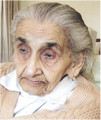
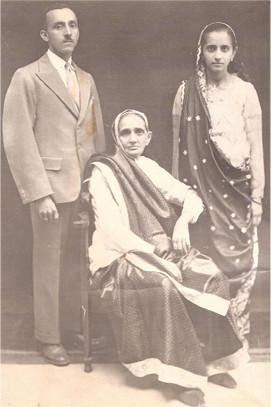
Edulji and Mucca Rana, with his mother Bachubai (seated) in 1932. (Above) Mucca, aged 96
Mama would tell us of how she would walk along the railway line with her brother and sister from Rohri to her school at Sukkur, crossing the river Indus twice a day over the famous Landsdown Railway Bridge (one of the world’s longest railway suspension bridges), and how at times some engine drivers recognizing them would stop their engine to give them a lift home to protect them from the scorching heat of the day. She would talk of the happy days spent at Sukkur and Rohri, of playing on the banks of the Indus, of picnic boat rides and outings to Saatbella on the river, always fondly remembering friends, uncles and aunts. With affectionate pride she would tell us about her father bringing home his salary in gold guineas and of the horse carriage he owned. Engineers of those days were among the highly paid professionals.
My father Edulji Rattanji Rana had come to work at Sukkur Barrage in the late 1920s from Navsari, his home town. Sukkur Barrage is only a few miles downstream from Landsdown Railway Bridge. As fate would have it, he met and married Mucca Elavia at Sukkur. Their first child, Feroze, was born at Sukkur. In early 1932 my father got a job at Quetta Electric Supply Company as power-house foreman, so they moved to Quetta to live at the Powerhouse on Bijli Road. Papa went on to serve the Quetta Electric Supply Company for the next 42 years. My parents survived the disastrous earthquake of 1935. Mama and Papa lived the best part of their married life at Bijli Ghar (Powerhouse) Quetta, where my sister Lily, I, Pervez and younger brother Manch were born.
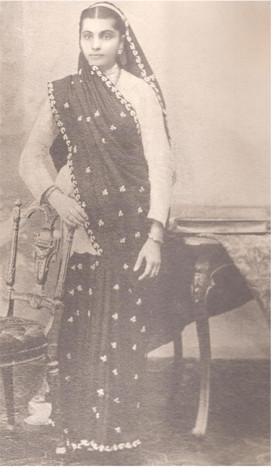
Putlibai Elavia (circa 1909), Mucca’s mother, died young
At the Powerhouse Mama not only brought up her own family but also managed the two adjoining houses of five or six other adults, with a common kitchen called the ‘canteen.’ Although a rather small and frail woman she managed the household without ever complaining about the hard work she had to do for years on end. We grew up under her vigilant care in a house full of uncles and aunts and happy days thanks to Mama’s good management. I do not recall her being ill for any length of time or being away; everybody else would come and go but Mama was always there, constant and reliable. All our friends called her Mucca Aunty; they were very fond of her and happy in her company. She in turn was kind to them but strict; she loved them and they knew it.
After Papa’s retirement from Quetta Electric Supply Company they all moved to ‘Baghicha’ at Samungli Road, Quetta, to live at the farmhouse that was built by Noshirwan Romer. He was lovingly known as Kaka by all. Here Jehangirji Golwalla, Hoshangji Talati and our family continued to live together as they had done at Powerhouse. In the new setting Mama as usual managed the house, kitchen, servants and all. Since they had moved lock, stock and barrel from Bijli Ghar to ‘Baghicha,’ this was a monumental task. I often wonder now from where Mama found the courage, energy and time at her age to do all this work, whereas at that time we took her for granted.
Dear Papa passed away on June 26, 1985 aged 82, and dear Kaka on November 2, 2002 aged 96. Jehangirji and Hoshangji had died earlier, so Mama was left without the people of her times who had lived with her.
Now resting in peace at the Parsi cemetery in Quetta, Mama is dearly missed by her four children, nine grandchildren, five great-grandchildren and all who knew her.
◆ ◆ ◆
From the archive